Benefits of Decentralized Storage: Security, Cost, and Control You Can't Get from Centralized Cloud
 Jan, 25 2026
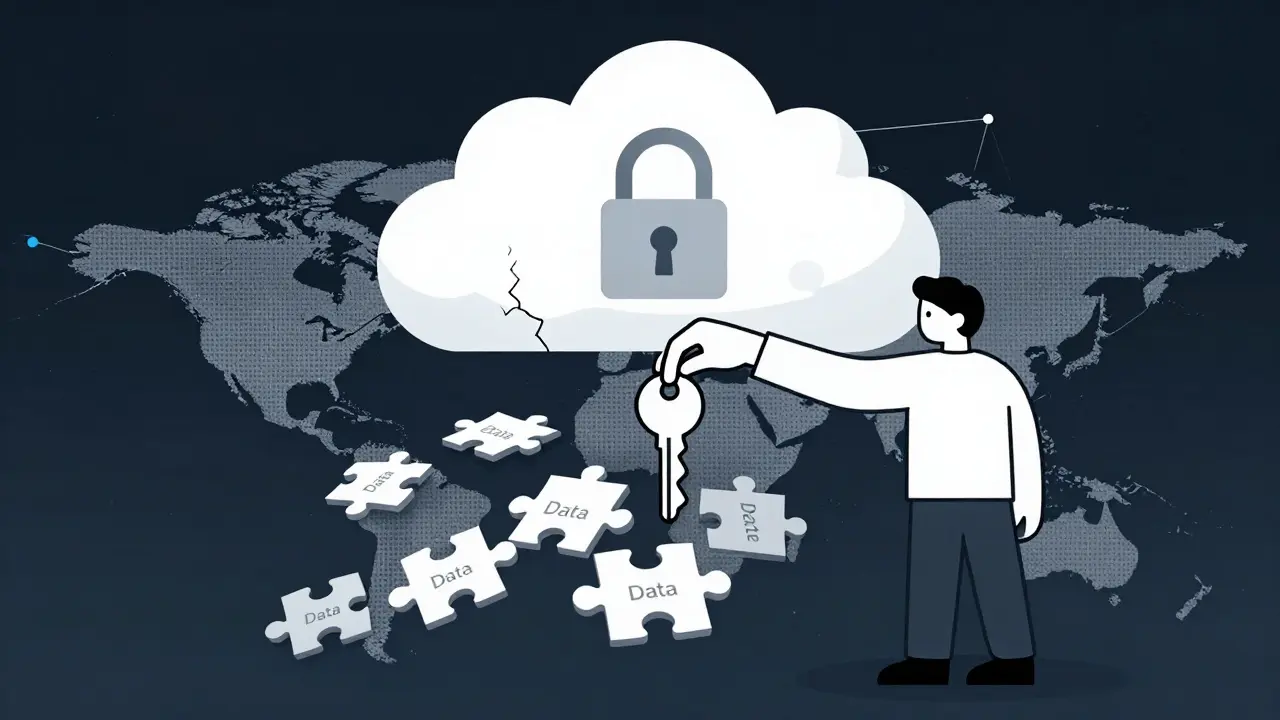
Think about where your photos, documents, and business files are stored right now. Chances are, they’re sitting in a giant server farm owned by Google, Amazon, or Microsoft. You don’t own that data-you’re just renting space. And if those companies decide to change their terms, get hacked, or shut down a service, your files could vanish overnight. That’s the risk of centralized storage. Decentralized storage flips that model entirely. Instead of trusting one company to hold your data, it spreads it across thousands of independent computers around the world. No single entity controls it. No one can shut it down. And you hold the keys.
Zero Single Points of Failure
Centralized storage has one big weakness: it’s built on a single point of failure. If Amazon’s S3 service goes down, thousands of websites go offline. If Microsoft’s Azure data center suffers a power outage, critical backups disappear. These aren’t hypotheticals-they happen. In 2021, an AWS outage took down Netflix, Slack, and even parts of the U.S. government’s website for hours. Decentralized storage eliminates this risk. Your data isn’t stored on one server. It’s broken into small encrypted pieces and scattered across dozens, sometimes hundreds, of nodes-computers owned by regular people and small businesses around the globe. If one node goes offline, your data stays safe because the other nodes still have their pieces. You don’t need to rely on a corporation’s uptime guarantee. The network itself keeps running, no matter what. It’s like having your house built with 100 different bricks, each held by a different person. Take away one brick? Your house still stands.True Data Ownership and Privacy
When you upload a file to Google Drive, Google holds the encryption keys. That means they can, technically, access your files-even if they claim they don’t. In 2023, internal documents leaked from a major cloud provider showed employees routinely accessing user data for internal audits, sometimes without triggering alerts. You think you’re private? You’re not. You’re just trusting them not to look. Decentralized storage changes that. Your files are encrypted on your device before they even leave your computer. Only you have the key. No node operator, no company, no government can decrypt your data without it. Even if someone hacks a storage node, all they get is a jumble of unreadable fragments. This isn’t marketing fluff-it’s how protocols like Filecoin and Arweave are built. You’re not just storing data. You’re owning it. And that’s what true data sovereignty looks like.Drastically Lower Costs
Cloud storage isn’t cheap. And it’s getting worse. Companies like AWS and Google charge not just to store your data, but to retrieve it. Egress fees can hit $0.09 per gigabyte. For a company backing up 50 terabytes a month, that’s $4,500 just to download their own files. Many startups have been caught off guard by these hidden costs. Decentralized networks don’t charge egress fees. Ever. You pay once to store your data. After that, you can download it as much as you want-no extra charges. Why? Because there’s no middleman. Instead of paying a corporation’s profit margin, you’re paying individuals who have spare hard drive space. Think of it like Airbnb for storage. Someone in Poland, Brazil, or Japan rents out unused space on their drive. The cost? Often 10x lower than AWS. One study from late 2025 found that decentralized storage averaged $0.005 per GB/month, compared to $0.023 for AWS S3. For large-scale users, that’s tens of thousands in annual savings.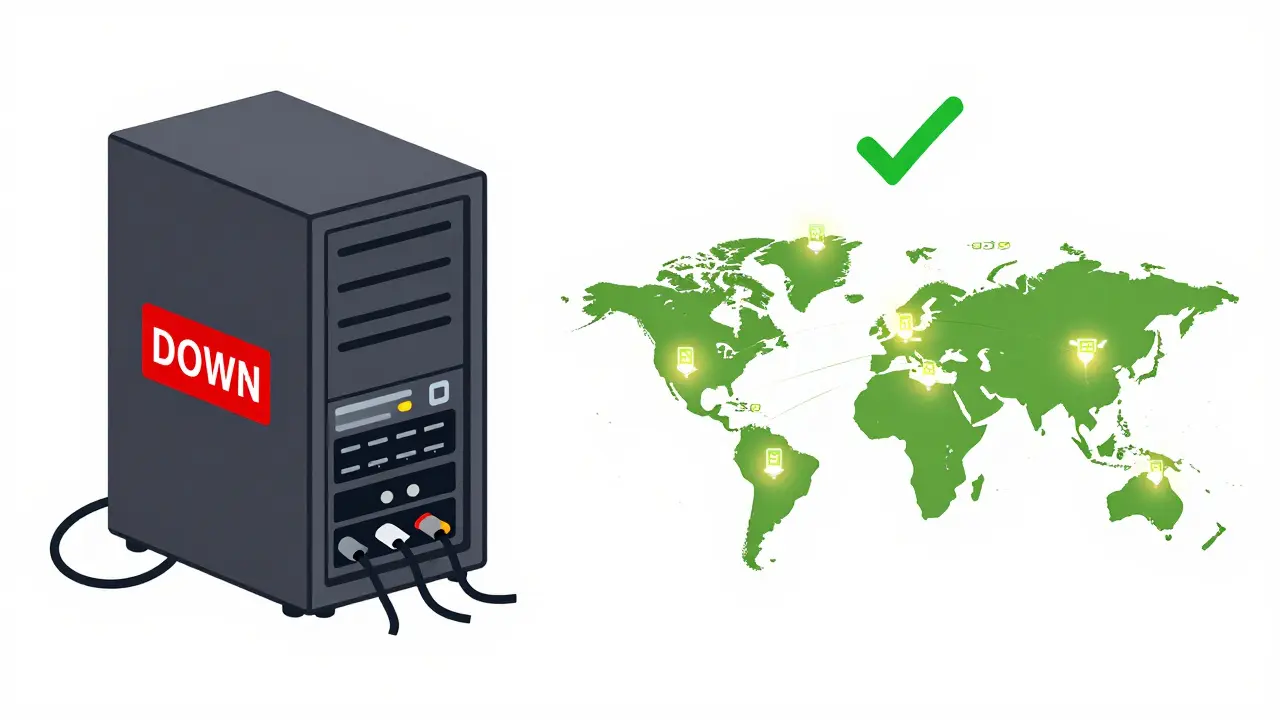
Global Speed and Edge Performance
Ever tried downloading a large file from a server on the other side of the world? It’s slow. That’s because centralized systems route everything through a few massive data centers. Decentralized storage fixes this by bringing data closer to you. If you’re in Toronto and your file is stored on a node in Montreal, it loads in milliseconds. If you’re in Sydney and your data is on a node in Brisbane, you’re not waiting for a server in Frankfurt to respond. This isn’t just about convenience-it’s about performance. Apps that need real-time access to data-like medical imaging platforms, live video editing tools, or decentralized finance dashboards-rely on low latency. Decentralized networks naturally optimize for this. Data is stored where demand is highest. The more users join the network, the faster it gets. It’s self-optimizing. No corporate IT team needed.Unbreakable Resilience Against Attacks
Ransomware attacks are rising. In 2024, a single breach cost a mid-sized hospital $12 million to recover data. Centralized systems are prime targets because they hold all the data in one place. Hackers only need to break into one system to lock everything down. Decentralized storage makes ransomware nearly impossible. Your data isn’t a single target-it’s thousands of tiny, encrypted fragments. Even if a hacker compromises a dozen nodes, they get nothing. They can’t reassemble the file without the decryption key-and you control that. Plus, since the network is immutable (especially on blockchain-backed systems like Arweave), no one can delete or alter your files after they’re uploaded. Once it’s stored, it’s permanent. This is why industries like legal, healthcare, and journalism are starting to adopt decentralized storage for compliance and archival purposes.Freedom from Vendor Lock-In
How many times have you heard, “We’re locked into AWS because migrating is too expensive”? That’s vendor lock-in. You’re stuck paying high prices because switching means re-uploading terabytes of data, rewriting code, and risking downtime. Decentralized storage has no lock-in. Your data is stored in a standard format. You can move it between providers with a simple command. No contracts. No penalties. No negotiations. If one provider raises prices, you just switch to another. The network doesn’t care who you use-it just stores data. This freedom gives you real negotiating power. You’re no longer a customer. You’re a participant.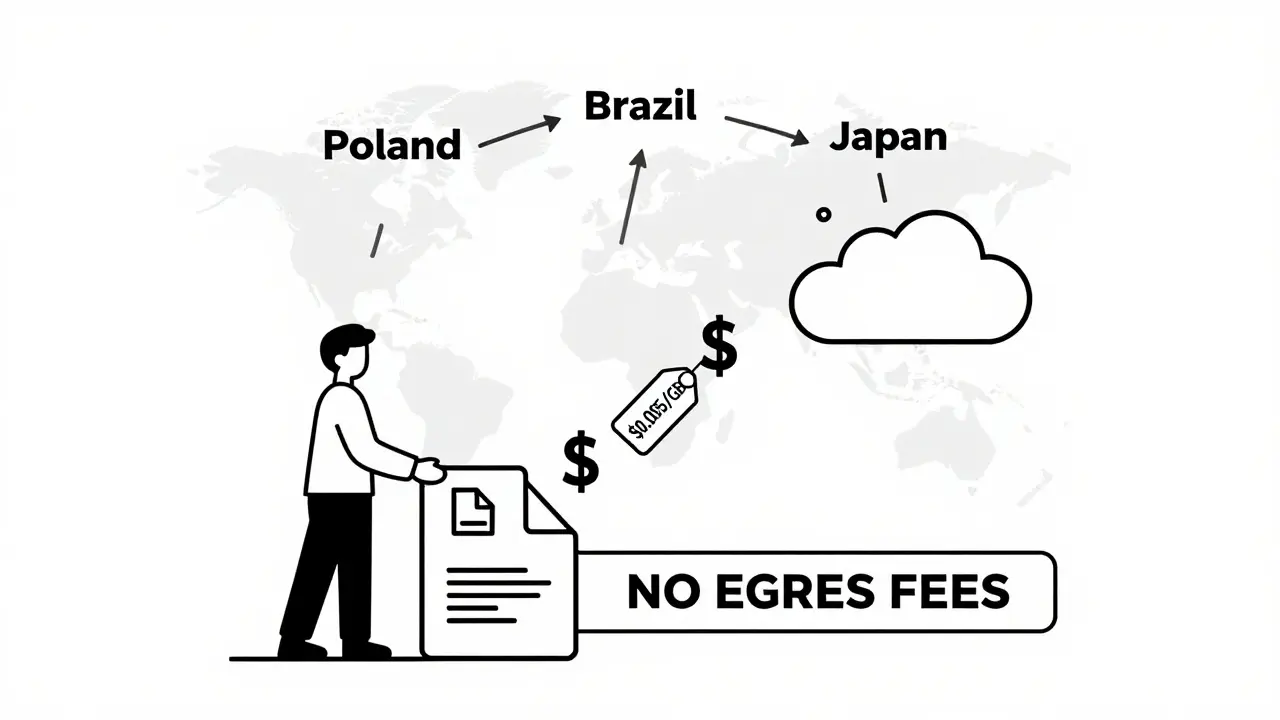
Compliance Made Simple
GDPR, HIPAA, CCPA-these regulations demand control over where your data is stored. With centralized cloud services, you can’t guarantee that your EU customer data isn’t sitting in a server in Texas. You’re relying on their word. Decentralized storage lets you choose. You can set rules: “Only store my data in nodes located in Germany.” “Only use nodes that comply with ISO 27001.” “Never store sensitive files on servers in countries with no data protection laws.” The network enforces these rules automatically. No legal team needed. No audits. Just configuration. For multinational companies, this cuts compliance costs by up to 70% according to a 2025 Deloitte report on blockchain-based infrastructure.Who’s Using This Today?
You might think decentralized storage is just for crypto nerds. It’s not. A European pharmaceutical company now stores clinical trial data on Arweave to meet strict EU data integrity rules. A newsroom in Brazil uses Filecoin to archive investigative reports, ensuring they can’t be deleted by authoritarian regimes. Independent filmmakers upload 4K documentaries to decentralized networks so they retain full rights without paying Netflix or YouTube a cut. These aren’t experiments. They’re production systems. And they’re growing. In 2025, decentralized storage networks handled over 12 exabytes of data-more than all of Google Drive and Dropbox combined. Adoption is accelerating because the benefits aren’t theoretical. They’re measurable, repeatable, and scalable.It’s Not Perfect-But It’s Better
No system is flawless. Decentralized storage can be slower to upload if your internet connection is weak. Some interfaces still feel clunky compared to Dropbox. And yes, you’re responsible for your own keys-if you lose them, your data is gone forever. But these are usability issues, not design flaws. They’re being fixed fast. The bigger question is: Are you okay with trusting a corporation with your most personal data? With your business records? With your life’s work? Decentralized storage doesn’t ask you to trust anyone. It just gives you control. And in a world where data breaches are routine and privacy is eroding daily, that’s not just a feature. It’s a necessity.Is decentralized storage really more secure than cloud storage?
Yes. Centralized storage keeps all your data in one place, encrypted by the provider’s keys. That means they-or hackers who breach them-can access it. Decentralized storage breaks your data into encrypted fragments and spreads them across hundreds of independent nodes. Even if 20 nodes are hacked, you still have the only key to reassemble the file. It’s mathematically impossible to access your data without that key.
How much cheaper is decentralized storage than AWS or Google Cloud?
On average, decentralized storage costs 60-80% less per gigabyte per month. For example, AWS S3 charges around $0.023/GB/month, while Filecoin and similar networks charge $0.005/GB/month. The biggest savings come from eliminating egress fees-AWS charges $0.09 per GB to download your own data. Decentralized networks charge nothing to retrieve data.
Can governments or hackers delete my data on decentralized storage?
No. Once data is stored on a blockchain-based decentralized network like Arweave, it’s permanent and immutable. Even if a government orders a node operator to delete files, they can’t-because the data isn’t on one server. It’s scattered and encrypted across thousands. No single entity has the power to remove it. This is why journalists and activists are turning to these networks for long-term archiving.
Do I need to understand blockchain to use decentralized storage?
No. You don’t need to know how blockchain works any more than you need to know how electricity works to plug in a lamp. Apps like Storj, Filebase, and ArDrive let you upload files with a simple drag-and-drop interface. Behind the scenes, the network handles encryption, fragmentation, and distribution. You just get the benefit-without the complexity.
What happens if I lose my encryption key?
If you lose your key, your data is permanently inaccessible. There’s no “forgot password” button. That’s the trade-off for true ownership. That’s why it’s critical to back up your key securely-on a hardware wallet, encrypted USB, or printed copy stored offline. Treat it like your house key. If you lose it, you’re locked out.
Is decentralized storage slow to upload or download?
Upload speed depends on your internet connection, not the network. Download speed is often faster than centralized services because data comes from nearby nodes, not a distant data center. For large files, it might take longer than a local server, but for most users, the difference is negligible-especially once the network grows and more nodes are added nearby.
Can I use decentralized storage for my business website?
Absolutely. Many websites now run entirely on decentralized storage. Static sites (HTML, CSS, JavaScript) can be hosted on IPFS or Arweave. Dynamic apps connect to decentralized backends for data storage. Companies like Shopify and WordPress are starting to integrate decentralized options for users who want to avoid vendor lock-in and censorship. It’s not just for crypto-it’s for anyone who wants control over their digital presence.