Enforcing NFT Royalties On-Chain: How Smart Contracts Protect Creator Income
 Feb, 28 2026
NFT royalties are meant to give creators a cut every time their digital art, music, or collectible is resold. It sounds simple: you make something, someone buys it, and every time it changes hands after that, you get paid. But in practice, that payment doesn’t always happen. Why? Because most NFT marketplaces don’t have to follow the rules built into the NFT itself. That’s where on-chain royalty enforcement comes in - it’s the only way to make sure creators actually get paid, no matter where the NFT is sold.
How NFT Royalties Are Supposed to Work
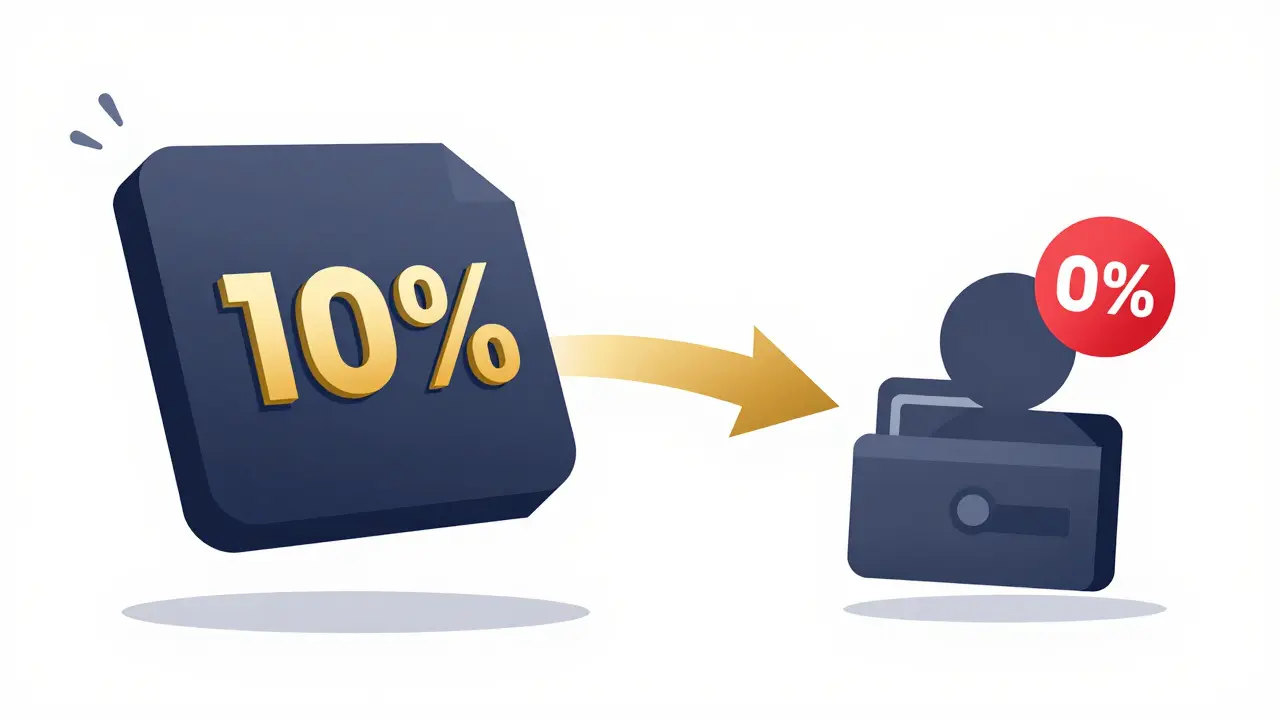
When an artist mints an NFT, they can set a royalty percentage - say, 10% - in the smart contract that powers the token. That contract says: "Every time this NFT is sold, send 10% of the sale price to this wallet." It’s automatic. No invoices. No follow-ups. Just code doing what it’s told.
This idea became standardized with EIP-2981 is a technical standard on Ethereum that defines how NFTs declare royalty payments for secondary sales. Also known as Ethereum Improvement Proposal 2981, it was introduced in 2020 and adopted by major platforms like OpenSea and Foundation. Before EIP-2981, every NFT project had its own way of handling royalties. Some didn’t do it at all. Others used custom code that only worked on their own marketplace. EIP-2981 fixed that. It gave everyone a common language: "Here’s the royalty percentage. Here’s who gets paid. Here’s how to read it."
It works with the two main NFT standards: ERC-721 is the original Ethereum standard for unique, non-fungible tokens and ERC-1155 is a more flexible standard that supports both unique and fungible tokens in the same contract. Together, they let creators embed royalty rules directly into the token’s code. That means if someone buys your NFT on OpenSea, LooksRare, or even a new marketplace you’ve never heard of, the smart contract should still trigger the payment.
Why Most Royalties Don’t Get Paid
Here’s the problem: marketplaces aren’t required to honor these rules. They can choose to ignore them. And many do.
Take Blur is a trader-focused NFT marketplace that launched in late 2022 with an optional royalty model. On Blur, buyers can set the royalty percentage to zero. Even if your NFT says "10% royalty," Blur just pays the seller the full amount and pockets the difference. According to blockchain analytics firm Nansen, on July 16, 2023, royalty payments on Ethereum-based NFTs hit a two-year low - mostly because Blur accounted for over 40% of trading volume at the time.
Other marketplaces like OpenSea initially followed suit, then reversed course. In early 2024, OpenSea rolled out tools to block sales from non-compliant platforms. But that’s not a fix - it’s a band-aid. It doesn’t change the fact that the NFT itself doesn’t have the power to stop a sale. It just relies on one marketplace to police others.
Two Ways to Enforce Royalties On-Chain
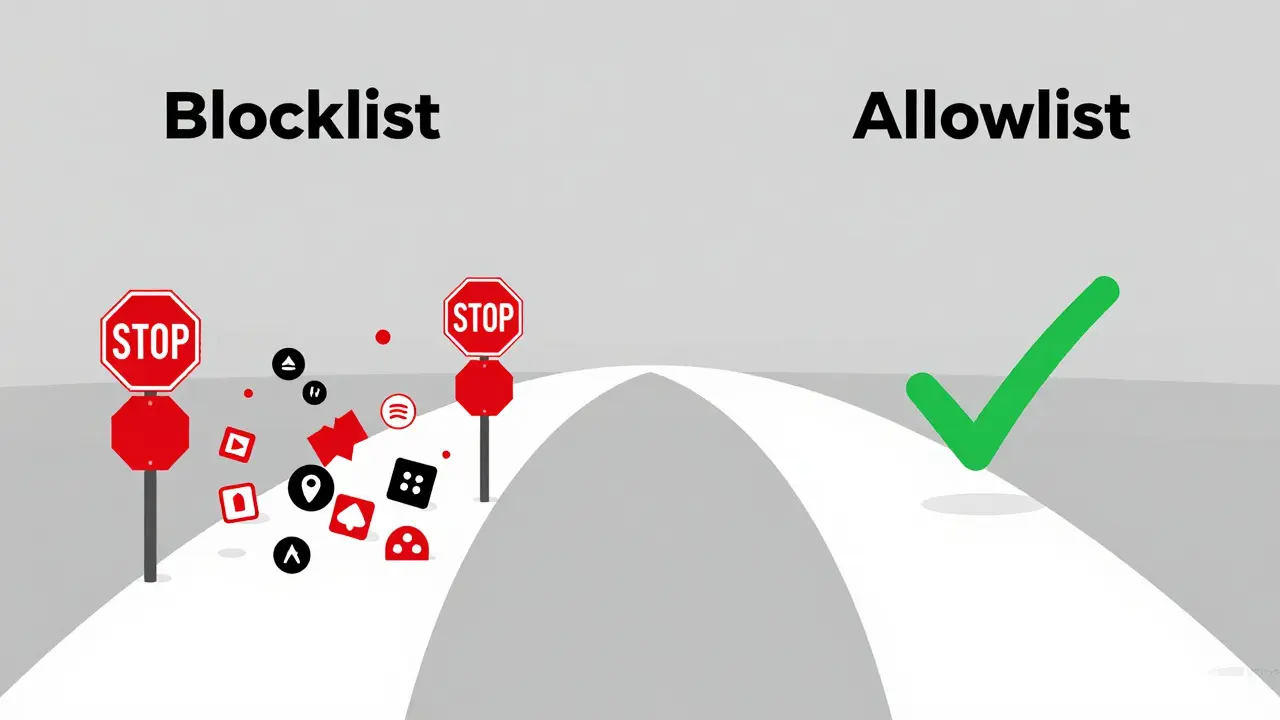
To truly enforce royalties, you need to build the rules into the blockchain’s core - not just rely on marketplaces to be nice. There are two main technical approaches: blocklists and allowlists.
Blocklists: Stop the Bad Actors
A blocklist works like a firewall. It keeps specific smart contracts from transferring NFTs. If a marketplace like Blur tries to move your NFT, the blockchain says: "Nope. Not allowed."
The problem? New marketplaces pop up every week. Each one has a unique smart contract address. To keep a blocklist working, creators have to constantly monitor the blockchain for new apps, analyze their code, and decide: "Is this one stealing royalties?" Then they have to manually update their list. It’s like playing whack-a-mole with hackers. And if you miss one, your NFTs get sold without you getting paid.
Allowlists: Only Let the Good Ones In
An allowlist does the opposite. Instead of blocking bad apps, it only lets approved ones handle your NFTs. You decide which marketplaces, wallets, or dApps can transfer your asset. If someone tries to sell it on a platform not on your list, the transaction fails.
This is more secure - but it kills composability. Composability means your NFT can work with any other tool, app, or service on the blockchain. If your NFT can only be sold on one marketplace, it becomes a locked-down asset. Buyers don’t want that. They want to trade freely. So allowlists create a trade-off: safety vs. freedom.
The Cross-Chain Problem
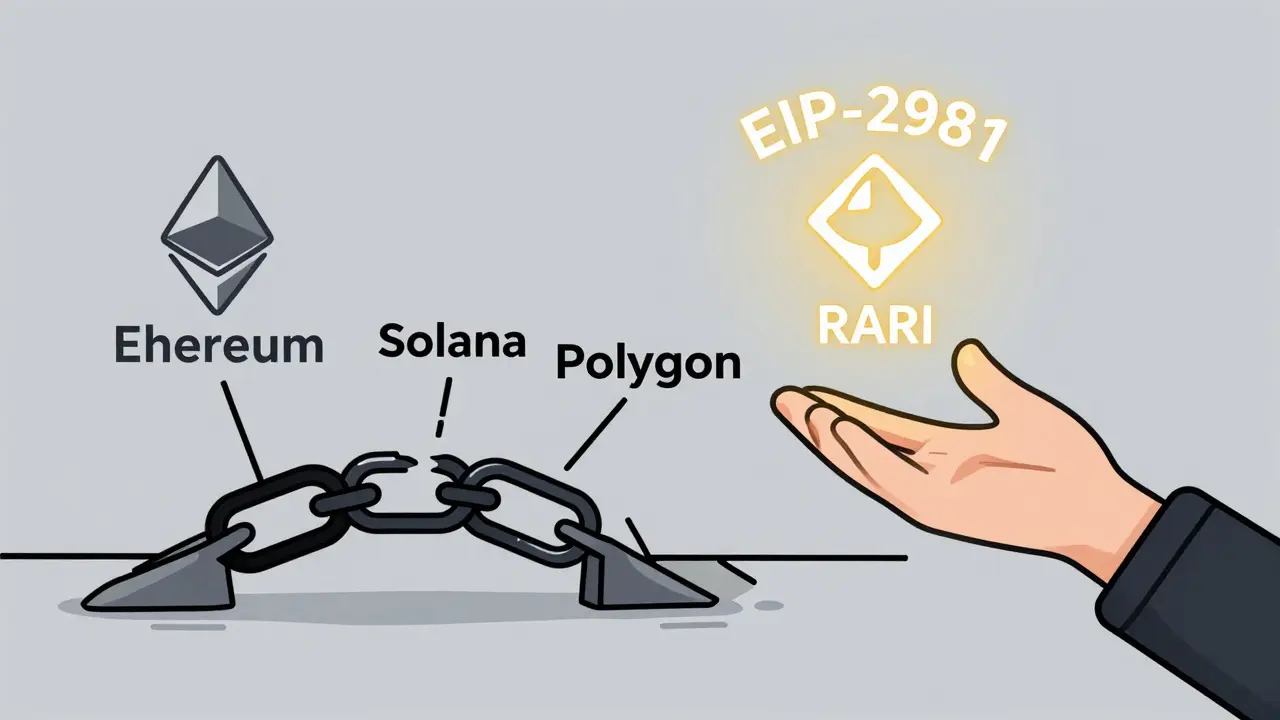
Most NFTs live on Ethereum. But what happens when someone moves your NFT to Solana, Polygon, or Arbitrum? The royalty rules you set on Ethereum don’t carry over. Each chain has its own standards. Solana doesn’t use EIP-2981. Polygon has its own royalty system. There’s no universal translator.
That means if your NFT leaves Ethereum, the creator gets nothing. Bridges - tools that move assets between chains - usually don’t read or enforce royalty data. So even if your NFT is technically "owned" by someone on another chain, the smart contract that should pay you is sitting idle on Ethereum.
This isn’t just a technical glitch. It’s a financial hole. A digital artwork worth $10,000 on Ethereum could be sold for $8,000 on Solana - and the artist gets zero. Until chains agree on a shared standard, this will keep happening.
What’s Being Done About It?
Some teams are building solutions from the ground up.
In June 2023, Enjin is a blockchain platform focused on NFTs and gaming that launched a mainnet with royalty enforcement baked into its core protocol. Unlike Ethereum, where royalties are optional, Enjin’s chain forces every NFT transfer to respect embedded royalty percentages. No exceptions. No marketplaces can bypass it.
Then in January 2024, the nonprofit RARI Foundation is a Web3 organization that released a mainnet EVM-compatible blockchain with native, non-optional royalty enforcement. Their system doesn’t rely on marketplaces. It doesn’t need blocklists or allowlists. The blockchain itself checks the royalty every time an NFT changes hands. If the payment isn’t made, the transfer is rejected.
These aren’t just experiments. They’re blueprints. If more chains adopt this model - where royalties are part of the protocol, not an add-on - we could finally see a future where creators get paid, no matter where their NFTs go.
The Bigger Picture: Creators vs. Composability
There’s a tension at the heart of this issue. On one side, creators need income. On the other, users want freedom. The more you lock down an NFT to protect royalties, the less useful it becomes in the broader Web3 ecosystem.
Think of it like this: if your NFT can only be traded on one platform, it’s not really part of the open web. It’s a walled garden. That’s why some experts argue that the answer isn’t more restrictions - it’s better standards. EIP-2981 was a step. But we need something deeper: a universal rule that every chain, every wallet, every dApp must respect.
Right now, the industry is split. OpenSea is trying to enforce. Blur is trying to disrupt. Enjin and RARI are trying to rebuild. And creators? They’re caught in the middle.
What Creators Can Do Today
If you’re an artist, musician, or developer who mints NFTs:
- Always use EIP-2981. Don’t rely on custom code.
- Check which marketplaces list your NFTs. Avoid ones that let buyers disable royalties.
- Consider minting on chains like Enjin or RARI if you want guaranteed enforcement.
- Use tools like Nansen or Dune Analytics to track where your NFTs are being sold - and whether royalties are being paid.
- Join creator collectives pushing for on-chain standards. Change won’t come from one person.
It’s not enough to just mint and hope. You have to be proactive. The blockchain doesn’t protect you - the rules you build into it do.
What’s Next?
The future of NFT royalties isn’t in marketplaces. It’s in the protocol layer. If every blockchain, wallet, and exchange starts treating royalties as non-negotiable - like gas fees or transaction timestamps - then creators finally get the long-term income they deserve.
Until then, the system is broken. And until creators demand better, it will stay that way.
Can NFT royalties be enforced without a blockchain?
No. Royalties rely on smart contracts - self-executing code on a blockchain. Off-chain systems, like centralized databases or legal contracts, can’t automatically trigger payments when an NFT is sold. Without the blockchain, royalties become voluntary agreements, which most marketplaces ignore.
Why do some NFT marketplaces ignore royalties?
Marketplaces like Blur ignore royalties to attract traders. Buyers get lower prices because they don’t pay the creator’s cut. The marketplace profits from higher trading volume. It’s a business model built on undercutting creators - and it works, at least in the short term.
Does EIP-2981 guarantee that I’ll get paid?
No. EIP-2981 only provides a standard way to declare royalties. It doesn’t force marketplaces to honor them. Your NFT can have perfect EIP-2981 compliance and still lose royalties if sold on a non-compliant platform. True enforcement requires the blockchain itself to check and reject non-paying transfers.
Can I use EIP-2981 on Solana or other chains?
EIP-2981 is an Ethereum standard. Solana, Polygon, and other chains use different systems. Some have adopted similar royalty logic, but there’s no universal cross-chain standard yet. If you move your NFT off Ethereum, you risk losing royalty enforcement unless the target chain has its own compatible mechanism.
Are there legal risks to enforcing royalties on-chain?
In some countries, smart contracts aren’t legally recognized as binding agreements. Even if your code says "pay 10%," a court might not enforce it. Also, if royalties are enforced too strictly - like blocking all transfers - it could be seen as restricting property rights. Legal clarity is still evolving.