Major BaaS Providers in 2025: Backend, Banking, and Blockchain Services Compared
 Feb, 20 2026
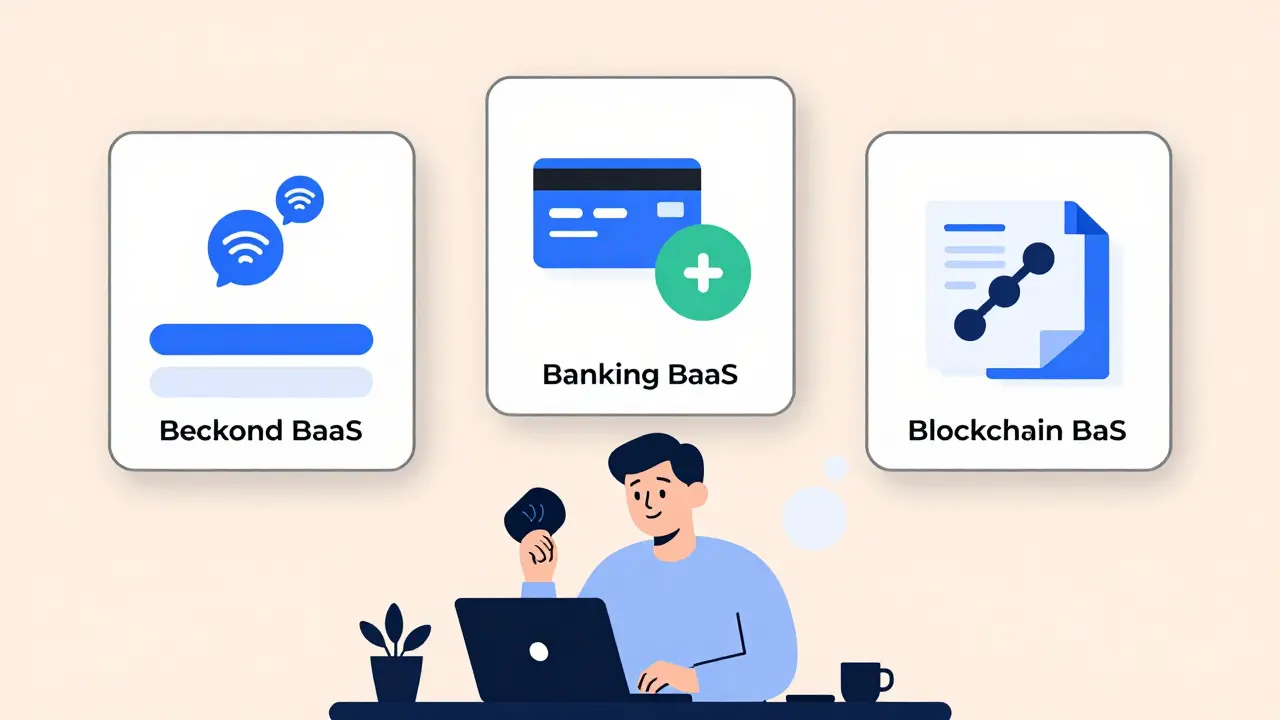
By 2025, the term BaaS doesn’t mean just one thing anymore. It’s shorthand for three wildly different but equally important services: Backend as a Service, Banking as a Service, and Blockchain as a Service. Each one solves a completely different problem for businesses - whether you’re building a mobile app, embedding payments into your platform, or launching a blockchain-based product. If you’re trying to pick the right provider, knowing which BaaS you actually need is half the battle.
Backend as a Service: Skip the Server Pain
Most apps today don’t need teams of backend engineers just to handle user logins, push notifications, or real-time data. That’s where Backend as a Service comes in. These platforms give you ready-made APIs and infrastructure so you can focus on the frontend - the part users actually see.Firebase, from Google, still leads the pack. It’s free to start, handles authentication, real-time databases, cloud storage, and analytics all in one place. Developers love it because it works instantly with Android, iOS, and web apps. But Firebase isn’t the only option anymore.
Supabase is the open-source alternative that’s gaining serious traction. It uses PostgreSQL - a powerful, reliable database - instead of Firebase’s proprietary system. You get real-time subscriptions, edge functions, and even AI-powered search, all with transparent pricing. No hidden fees. No lock-in. If you hate being tied to a vendor, Supabase is your best bet.
Appwrite is another strong contender. It’s fully open-source, so you can self-host it on your own server or use their cloud. It supports over 10 programming languages and has built-in features like file uploads, user management, and database queries. Unlike Firebase, Appwrite doesn’t force you into a specific ecosystem. You keep control.
For game developers, PlayFab (owned by Microsoft) is unmatched. It handles player profiles, leaderboards, matchmaking, and even in-game economies. If your app is a game, this isn’t just a convenience - it’s a necessity.
And then there’s AWS Amplify. Amazon’s version is deeply tied to its cloud infrastructure. If you’re already using AWS for hosting or databases, Amplify integrates smoothly. But it’s less beginner-friendly than Firebase or Supabase. You need to understand cloud concepts to get the most out of it.
Banking as a Service: Embed Finance Without a Bank License
Want to let your users open bank accounts, send payments, or get debit cards - without becoming a bank? That’s Banking as a Service. In 2025, this is no longer a niche. It’s a standard feature for fintech apps, marketplaces, and even e-commerce platforms.Treezor, based in France and owned by Société Générale, is one of the most trusted in Europe. It’s licensed as an Electronic Money Institution (EMI), which means it can issue payment cards, process SEPA transfers, and handle KYC checks across 25 European countries. If you’re targeting EU customers, Treezor’s compliance infrastructure alone saves you months of legal work.
Solarisbank, from Germany, is another top player. It’s fully licensed and offers banking accounts, lending, and card issuance with clean APIs. It’s especially strong for startups that need to move fast but can’t afford to build compliance from scratch.
Itexus stands out globally. Unlike many BaaS providers that offer pre-built modules, Itexus lets you build custom financial workflows. Need a payroll system that works with crypto? A loyalty program that pays out in real-time? Itexus handles it. They’re the go-to for businesses that need more than a template.
For non-European markets, Railsr (UK-based) and Bankera (Lithuania) are strong choices. Railsr focuses on embedded finance for SMEs in Europe and Asia, while Bankera targets digital businesses like crypto exchanges and affiliate platforms. Both offer fast onboarding and support for multi-currency accounts.
The real advantage? You don’t need a banking license. These providers act as the legal backbone. You just integrate their APIs and start offering financial services under your brand. That’s why companies like Robinhood, Revolut, and even Shopify now use BaaS providers instead of building their own banking infrastructure.
Blockchain as a Service: Deploy Chains Without the Complexity
Blockchain isn’t just about Bitcoin anymore. In 2025, enterprises use it for supply chain tracking, secure document signing, tokenized assets, and automated contracts. But setting up a blockchain network? That’s expensive and slow. Enter Blockchain as a Service.Rapid Innovation leads this space with a simple promise: deploy your blockchain app in 90 days or it’s free. They specialize in combining blockchain with AI and Web3 tools, making them ideal for startups that need to move fast. Their hourly pricing model is rare in this space - most providers charge monthly or per node.
Kaleido is the enterprise favorite. It supports Ethereum, Hyperledger, and other protocols on a single platform. If your company needs to run multiple blockchains - one for inventory, another for payments - Kaleido lets you manage them all from one dashboard.
BlockApps gives you tools to build Ethereum-based smart contracts without deep blockchain knowledge. It’s perfect for companies that want to tokenize assets or automate contracts but don’t have a blockchain dev team.
Paystand isn’t a general blockchain provider. It’s laser-focused on one thing: eliminating B2B payment fees. By using blockchain, it cuts out intermediaries and settles payments in minutes instead of days. If your business deals with invoices and vendor payments, this is a game-changer.
Cryptowerk is different. It doesn’t build blockchains. It uses them to prove data integrity. Think of it as a tamper-proof timestamping service. Law firms, healthcare providers, and auditors use it to verify that documents haven’t been altered. It’s not flashy, but it’s critical for regulated industries.
Blockstream? They’re Bitcoin specialists. If your project needs Bitcoin integration - like satellite-based transaction broadcasting or the Liquid Network for fast cross-border settlements - they’re the only real choice.
How to Choose the Right BaaS
You can’t pick a BaaS provider without knowing what you’re trying to solve. Here’s how to decide:- If you’re building an app and need user auth, push notifications, or real-time data → Backend as a Service (Supabase, Firebase, Appwrite)
- If you want to offer bank accounts, cards, or payments within your product → Banking as a Service (Treezor, Solarisbank, Itexus)
- If you’re launching a blockchain app, token system, or smart contract → Blockchain as a Service (Rapid Innovation, Kaleido, BlockApps)
Don’t fall for the trap of picking the most popular name. Supabase beats Firebase for developers who hate vendor lock-in. Treezor beats generic providers if you’re targeting Europe. Rapid Innovation wins for startups on a tight timeline.
Also check:
- **Pricing transparency** - No hidden fees. Look for pay-as-you-go or hourly models.
- **Compliance** - Especially for Banking BaaS. Are they licensed? Where?
- **Integration ease** - Can you connect it to your existing tools? Does it have webhooks, webhooks, or SDKs?
- **Support** - Can you get help at 3 a.m. if your payment system crashes?
What’s Next for BaaS in 2026?
The big shift in 2025 was consolidation. Treezor got bought by Société Générale. Railsr was recapitalized. Firebase and AWS Amplify are now adding AI-powered features. The next wave will be embedded intelligence - BaaS providers that don’t just give you tools, but predict your needs.Imagine a Backend BaaS that automatically scales your database before a product launch. Or a Banking BaaS that suggests the best payment routing based on user location and fees. Or a Blockchain BaaS that detects contract vulnerabilities before you deploy.
Providers that add automation, not just features, will win.
What’s the difference between Backend, Banking, and Blockchain BaaS?
Backend BaaS handles app infrastructure like user logins and databases. Banking BaaS lets you embed financial services like payments and cards without a bank license. Blockchain BaaS gives you ready-made blockchain networks for smart contracts, tokens, or secure ledgers. They solve completely different problems.
Which BaaS provider is best for startups?
For app development: Supabase or Appwrite - both are open-source and affordable. For embedded payments: Treezor or Solarisbank if you’re in Europe; Itexus for custom global solutions. For blockchain: Rapid Innovation, because of its 90-day deployment guarantee and hourly pricing.
Can I use more than one BaaS provider at the same time?
Absolutely. Many companies use Firebase for their app backend, Treezor for payments, and Kaleido for blockchain-based contracts. The key is making sure your APIs can talk to each other. Most modern BaaS providers offer webhooks and webhooks for integration.
Is Blockchain BaaS only for crypto companies?
No. Blockchain BaaS is used by logistics firms to track shipments, hospitals to secure patient records, and even government agencies to verify documents. Crypto is just one use case. The real value is in tamper-proof records and automated contracts.
Are there free BaaS options?
Yes. Firebase and Supabase offer generous free tiers for small apps. Appwrite lets you self-host for free. For Banking and Blockchain BaaS, free tiers are rare because of compliance and infrastructure costs. But most offer pay-as-you-go plans that start under $50/month.