Mining Crypto in India: Legal Rules and Strict Restrictions in 2026
 Jan, 6 2026
If you're thinking about mining cryptocurrency in India, you need to know one thing upfront: it's not illegal, but it's not safe either. The government hasn't banned mining, but it has made it so expensive and risky that most people who try it end up losing money-or worse, facing legal trouble.
Miners Are Treated Like High-Income Earners-Even If They're Just Starting Out
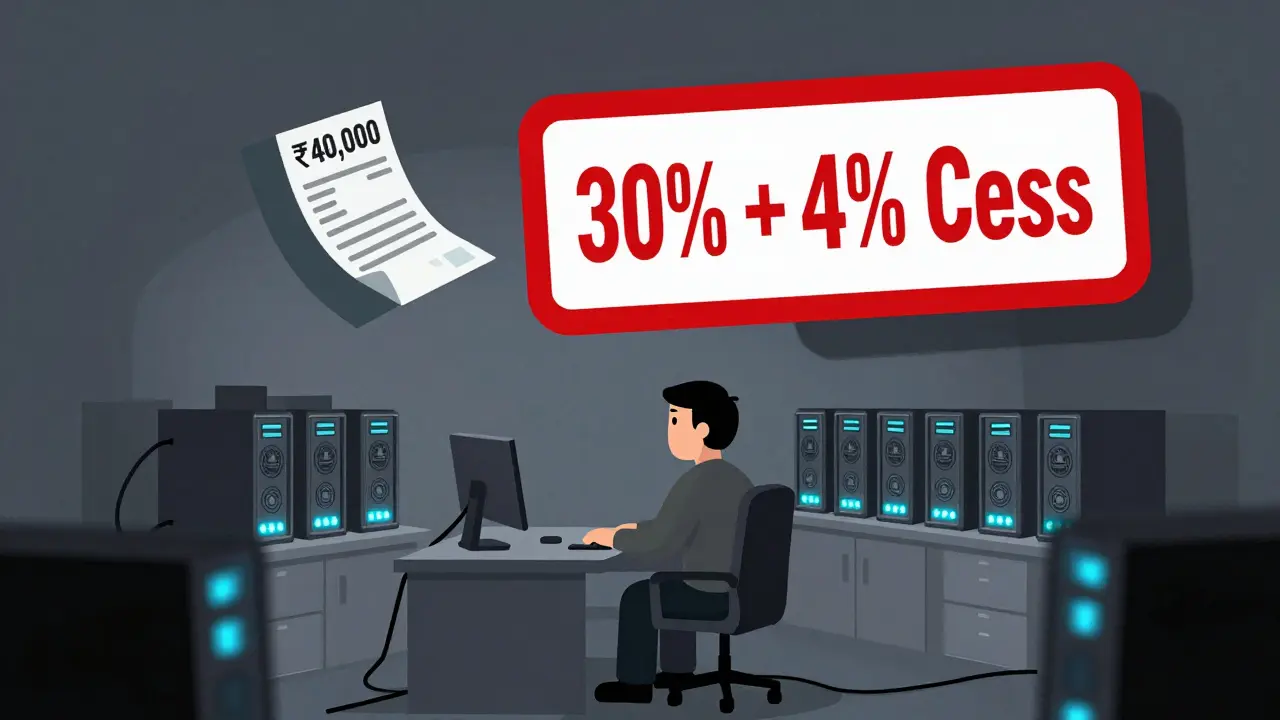
When you mine Bitcoin, Ethereum, or any other crypto in India, the tax department doesn't see you as a hobbyist. They see you as someone earning income-and they tax it at 30%. That’s not a marginal rate. That’s a flat tax on every rupee you make from mining, with no deductions allowed. Not for your electricity bill. Not for your ASIC miners. Not even for the cooling system you had to install to keep your rig from overheating.
The law says only the original cost of buying the crypto you mined can be subtracted from your income. Everything else? Gone. If you spent ₹50,000 on electricity last month and ₹80,000 on new mining hardware, you can’t write any of it off. You pay 30% tax on the full value of the crypto you pulled out of the blockchain. Add the 4% health and education cess, and your effective tax rate jumps to 31.2%.
And that’s just the start.
Every Crypto Transaction Gets a 1% Tax Bite
When you sell or trade the crypto you mined, you get hit again-with a 1% Tax Deducted at Source (TDS). This applies whether you trade on CoinSwitch, WazirX, or Binance India. The exchange automatically withholds 1% of the sale value and sends it to the government. So if you mine 0.1 BTC worth ₹30 lakh and sell it, ₹30,000 gets taken off the top before you even see your money.
Worse, this TDS is non-refundable. Even if your overall tax liability is zero because you had losses elsewhere, that 1% is gone. You can’t get it back. The government doesn’t care if you broke even. They take their cut at the point of sale.
Government Is Watching Every Move-With AI
India doesn’t rely on audits or random checks. It uses AI-powered systems like Project Insight, NMS, and NUDGE to track crypto transactions in real time. These systems connect with exchanges, wallets, and blockchain analytics tools to flag suspicious activity. If your wallet receives a large amount of crypto from a mining pool, and you never declared it, you’ll get an automated notice within days.
These notices aren’t warnings. They’re demands. You have 30 days to explain where the crypto came from, prove you paid taxes, and show records of your mining setup. If you can’t? Penalties start at 50% of the tax due-and can go up to 200%. In extreme cases, you could face up to seven years in prison.
The Financial Intelligence Unit (FIU-IND) has already fined Binance ₹18.8 crore and Bybit ₹9.27 crore for failing to report user transactions. Both companies are now registered with FIU-IND, but that doesn’t mean miners are safe. The government is using these fines as a warning: if exchanges don’t cooperate, they’ll shut down. And if you’re mining and using those platforms? You’re in the crosshairs.
What You Must Report (And How to Do It)
If you mine crypto in India, you must declare it in your Income Tax Return under Schedule VDA (Virtual Digital Assets). This isn’t optional. The IT department now cross-checks every VDA transaction with exchange data. If you skip this, you’re committing tax evasion.
Here’s what you need to report:
- The name of the cryptocurrency mined (e.g., Bitcoin, Litecoin)
- The date you received each mining reward
- The fair market value in INR on the day you received it
- Any TDS deducted when you sold or traded it
- The cost of acquisition (the value of the crypto when you mined it)
You also need to keep records of:
- Purchase receipts for mining hardware
- Electricity bills linked to mining rigs
- Pool fees paid to mining pools
- Wallet addresses used for mining and storage
These records won’t reduce your tax bill-but they might save you from jail if the tax department comes knocking.
Electricity Costs Are a Hidden Trap
India’s electricity rates vary by state, but for mining rigs running 24/7, power bills can hit ₹20,000-₹40,000 per month per rig. That’s before you factor in the 18% GST that platforms like Bybit started charging on all crypto services in July 2025.
Let’s say you mine 0.05 BTC monthly. At ₹25 lakh per BTC, that’s ₹12.5 lakh in value. You pay ₹3.75 lakh in 30% tax. Then you pay ₹12,500 in TDS when you sell. Your electricity? ₹30,000. Your hardware depreciation? Zero deduction. Your GST on exchange fees? Another ₹22,500. You’re left with ₹8.4 lakh. But you spent ₹30,000 on power and ₹1.2 lakh on equipment last month. You’re not profiting-you’re bleeding cash.
And that’s assuming your rig doesn’t break down. Mining hardware fails fast under constant load. Replacing a single ASIC miner can cost ₹2-3 lakh. No tax break. No insurance coverage. You eat the loss.
Importing Mining Gear Is a Legal Minefield
There’s no official ban on importing mining equipment-but customs doesn’t treat it like regular electronics. Most miners report their gear as “computer parts” or “industrial electronics.” But customs officers are trained to flag high-wattage devices. If you ship in 10 Antminer S19s, you’ll likely get flagged for “commercial equipment.”
Customs may impose additional duties of 15-25% on top of the base import cost. Some miners have had their shipments held for weeks, forced to pay bribes, or even seized outright. There’s no legal recourse because mining isn’t a recognized industry. You’re not a business. You’re just someone with a bunch of machines.

Why Big Mining Operations Are Disappearing
Commercial mining farms-those with hundreds of rigs-used to exist in states like Telangana, Maharashtra, and Punjab. Now, almost all of them are gone. Why? Because the math doesn’t work.
Take a 1 MW mining farm. It costs ₹1.5 crore to set up. Monthly electricity? ₹20-25 lakh. Revenue? ₹10-12 lakh after taxes. That’s a monthly loss. Even if you cut costs by running at night when power is cheaper, you still lose money after tax, TDS, and equipment wear.
Most of these farms either shut down or moved overseas-to Kazakhstan, Georgia, or Paraguay-where electricity is cheaper and taxes are lower. Some Indian miners now operate through offshore pools and wallets, but that’s even riskier. The government plans to adopt the OECD Crypto-Asset Reporting Framework (CARF) by April 2027. That means they’ll soon demand full disclosure of all global mining activities by Indian residents.
What’s Next? More Rules, Not Less
The government hasn’t given up. In June 2025, they released a discussion paper seeking public feedback on a potential crypto regulatory framework. The goal? To bring mining under the same rules as banking and securities. SEBI, RBI, and the Finance Ministry are all involved. That means future laws could treat mining as a financial activity-requiring licenses, audits, and capital requirements.
Some experts think India might eventually allow regulated mining under strict conditions. But right now, the signals point the other way: higher taxes, more surveillance, fewer loopholes.
The Supreme Court’s 2020 ruling that lifted the RBI’s banking ban didn’t protect miners. It just said the RBI couldn’t ban crypto without parliamentary approval. That approval is coming-and it won’t be in miners’ favor.
Bottom Line: Is Crypto Mining Worth It in India?
If you’re mining as a side project with one or two rigs, you’re not making money. You’re paying for the thrill of being part of a system the government wants to shut down.
If you’re thinking about going big-with a farm, a team, and serious investment-you’re playing Russian roulette. One audit, one missed declaration, one customs seizure, and you could lose everything.
The only people winning in India’s crypto mining scene right now are the tax collectors.
Is crypto mining legal in India?
Yes, mining cryptocurrency is not explicitly banned in India. However, it operates under strict tax and regulatory rules. The government doesn’t prohibit it, but it makes it financially unviable and legally risky through heavy taxation and surveillance.
Do I have to pay tax on crypto mining income?
Yes. All income from mining is taxed at a flat 30%, plus a 4% cess. You cannot deduct electricity, equipment, or operational costs. Only the original value of the mined crypto can be subtracted as cost of acquisition. A 1% TDS is also deducted on every sale or trade.
What happens if I don’t report my crypto mining?
If you don’t report mining income, you risk an automated tax notice from the Income Tax Department. Penalties range from 50% to 200% of the unpaid tax. In cases of deliberate evasion, you could face criminal charges and up to seven years in prison. The government uses AI systems to track crypto transactions, so hiding mining income is extremely risky.
Can I import mining equipment into India?
You can import mining hardware, but it’s risky. Customs may classify it as commercial equipment and charge additional duties of 15-25%. Shipments can be held, inspected, or seized. There’s no legal protection because mining isn’t recognized as a legitimate industry. Many miners under-declare gear as "computer parts," but this is still legally questionable.
Are mining pools allowed in India?
There’s no specific law banning mining pools, but any pool that processes transactions for Indian residents falls under FIU-IND’s anti-money laundering rules. If the pool isn’t registered with FIU-IND, you could be violating the Prevention of Money Laundering Act. Most international pools aren’t registered, so using them puts you at legal risk.
Will India ban crypto mining in the future?
A full ban isn’t certain, but the trend is clear: the government wants to control and tax crypto, not ban it outright. Future laws could require mining licenses, capital requirements, or mandatory reporting to RBI or SEBI. The 2025 discussion paper and planned OECD CARF adoption suggest tighter control, not deregulation.
Can I use offshore exchanges to mine and trade crypto?
You can, but it’s dangerous. The Indian government is actively targeting offshore platforms used by Indian residents. Exchanges like Huione, Paxful, and BitMex have been flagged for non-compliance. Under the upcoming OECD CARF rules by 2027, all global crypto activity by Indian residents will need to be reported. Using offshore platforms won’t protect you from tax or legal consequences.
Is crypto mining profitable in India in 2026?
For individuals and small-scale miners, no. The 30% tax, 1% TDS, 18% GST on exchange services, high electricity costs, and lack of deductions make it nearly impossible to turn a profit. Even large mining farms struggle. Most profitable operations have moved overseas. Mining in India is now a high-risk, low-reward activity.