OKX Crypto Access Limitations by Country: What’s Blocked and Why
 Feb, 8 2026
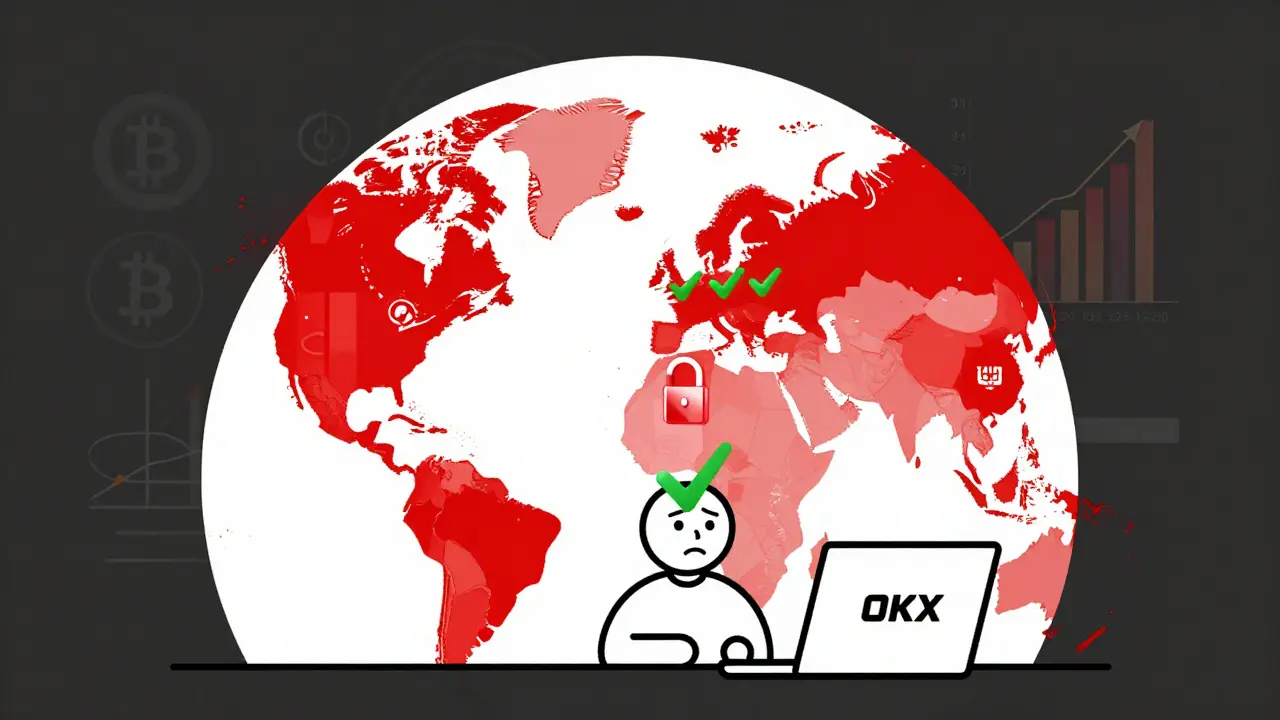
If you're trying to use OKX and got blocked, you're not alone. Thousands of users around the world hit the same wall: 'Access denied due to country restrictions.' It’s not a glitch. It’s not a mistake. It’s compliance - and it’s complicated. OKX, one of the largest crypto exchanges by trading volume, doesn’t just pick which countries to serve. It’s forced to follow a patchwork of global laws that change every few months. Some places get full access. Others get nothing. And a few get half a service - like being able to trade Bitcoin but not bet on its price with futures.
Where You Can’t Use OKX At All
There are countries where OKX doesn’t just limit features - it shuts down completely. This isn’t random. These are places with strict financial regulations or international sanctions. If you’re in the United States, Canada, Singapore, Malaysia, the United Kingdom, or the Bahamas, you’re locked out. Same if you’re in Cuba, Iran, North Korea, or Syria. Even regions like Crimea, Donetsk, and Luhansk are banned. These aren’t arbitrary. The U.S. Office of Foreign Assets Control (OFAC) and the EU’s anti-money laundering rules force exchanges like OKX to cut ties. Violating these means fines in the billions - and that’s not a risk OKX is willing to take.
But here’s the twist: Singapore is on the banned list - yet OKX Singapore exists. That’s because OKX operates a separate legal entity under Singapore’s Monetary Authority (MAS). This version only serves residents who pass local KYC and can’t be accessed by foreigners. So if you’re a Singaporean trying to log in from abroad? You’ll get blocked. If you’re a foreigner trying to use OKX Singapore? Also blocked. It’s a system built to comply with one rule while avoiding another.
Where You Can Use OKX - But Only Partially
Some countries aren’t fully banned. They’re partially restricted. This is where things get confusing. In Australia, Brazil, South Korea, and the UK, you can still sign up and trade spot crypto - Bitcoin, Ethereum, Solana. But you can’t trade futures, perpetual contracts, or leverage products. That’s because these countries have started cracking down on high-risk derivatives trading. OKX didn’t wait for fines to come. It proactively removed those features before regulators forced it.
Same goes for the EU. Since MiCA (Markets in Crypto-Assets Regulation) went fully live in December 2024, OKX stopped offering derivatives to all EU residents. Spot trading? Still allowed. Margin trading? Gone. This is a big deal for traders who used OKX for leveraged positions. Now they’re stuck choosing between a limited platform or switching exchanges - and many don’t want to.
Other countries like Bangladesh, Bolivia, and Malta fall into this gray zone too. You might be able to create an account, but deposits or withdrawals might fail. Sometimes it’s because of local banking rules. Other times, it’s because OKX’s systems flagged the region as high-risk. Users in these places often report random blocks - even if they’re legally allowed to use the service. That’s the downside of automated compliance: it’s fast, but it’s not smart.
How OKX Knows Where You Are
OKX doesn’t guess. It uses three layers of detection to figure out your location:
- IP Geolocation: Your internet address tells them your country. Accuracy? 99.2% - according to their own audit.
- Device Fingerprinting: Your browser, operating system, screen size, and even installed fonts create a unique profile. If you log in from a new device, it flags it.
- KYC Documents: When you upload your ID, passport, or utility bill, the system checks the issuing country. If you’re in the U.S. and try to use a Canadian ID? You’ll get rejected.
People try to bypass this with VPNs. But OKX’s system catches 95% of them. If you’re caught, your account gets suspended - sometimes permanently. According to their September 2025 enforcement report, over 14,000 accounts were closed for “geolocation fraud” in just eight months. That’s not a warning. That’s a policy.
Why KYC Is Non-Negotiable
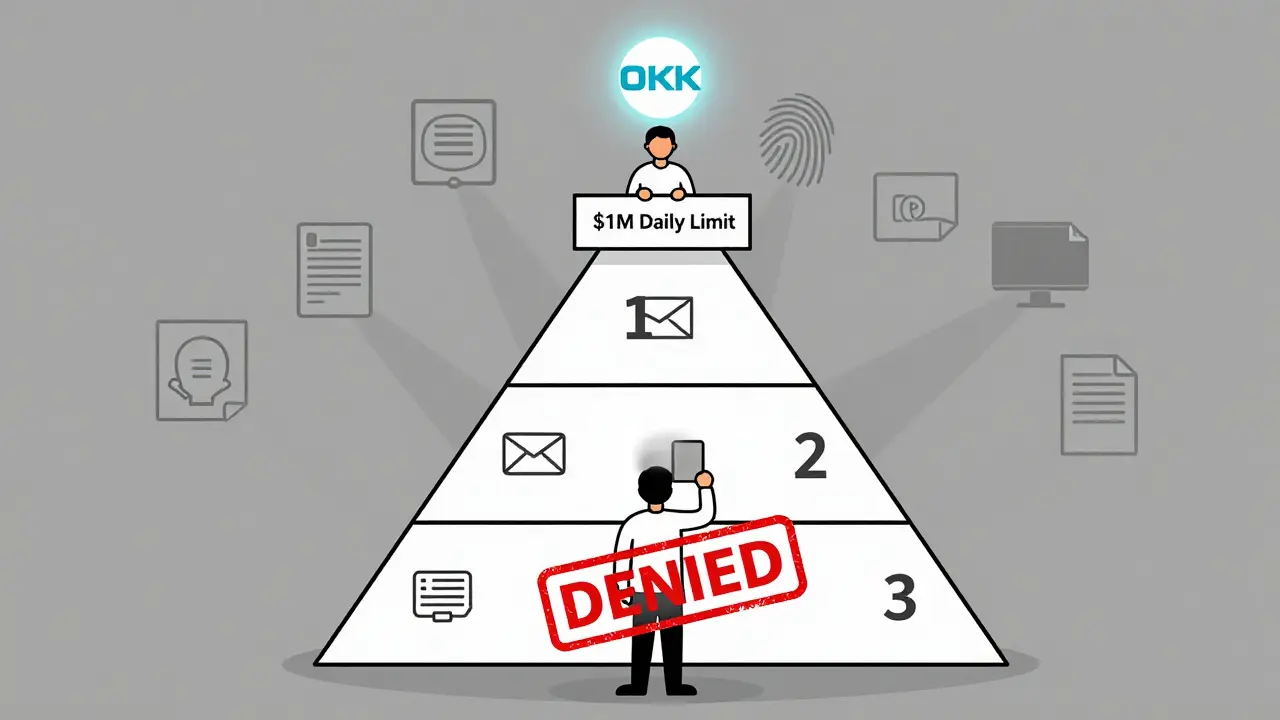
Even if you’re in a permitted country, you can’t do much without completing KYC (Know Your Customer). OKX made this mandatory in January 2023. No ID? No trading. No deposits. No withdrawals. The system has three levels:
- Level 1: Basic email + phone. Daily limit: $10,000.
- Level 2: ID + proof of address. Daily limit: $100,000.
- Level 3: ID + selfie + income verification. Daily limit: $1,000,000.
Verification takes 2 to 4 hours on average - if your documents are clear. If you’re from a developing country, it can take days. Support response times vary wildly: 8 hours in Germany, over 24 hours in Nigeria. And if your ID is blurry, expired, or taken from a screenshot? You’ll get rejected. No appeal. No explanation.
How OKX Compares to Other Exchanges
OKX isn’t the only exchange with restrictions - but it’s one of the most complex.
| Exchange | Full Access Countries | Restricted Features | Notable Bans |
|---|---|---|---|
| OKX | ~160 countries | Derivatives blocked in AU, UK, EU, KR, BR | US, Canada, Singapore, Iran, North Korea |
| Binance | ~120 countries | Derivatives banned in many regions | US, Canada, Singapore, UK, Japan |
| Coinbase | 42 countries | None - full service where available | Most of Asia, Africa, Latin America |
| Kraken | ~100 countries | Margin trading blocked in some EU states | Iran, North Korea, Cuba |
OKX serves more countries than Binance or Kraken, but offers fewer features in key markets. Coinbase is the opposite - fewer countries, but full access where it operates. If you’re in the U.S., Coinbase is your only real option. If you’re in Europe or Asia, OKX gives you more coins and lower fees - if you can handle the restrictions.
What’s Changing in 2026?
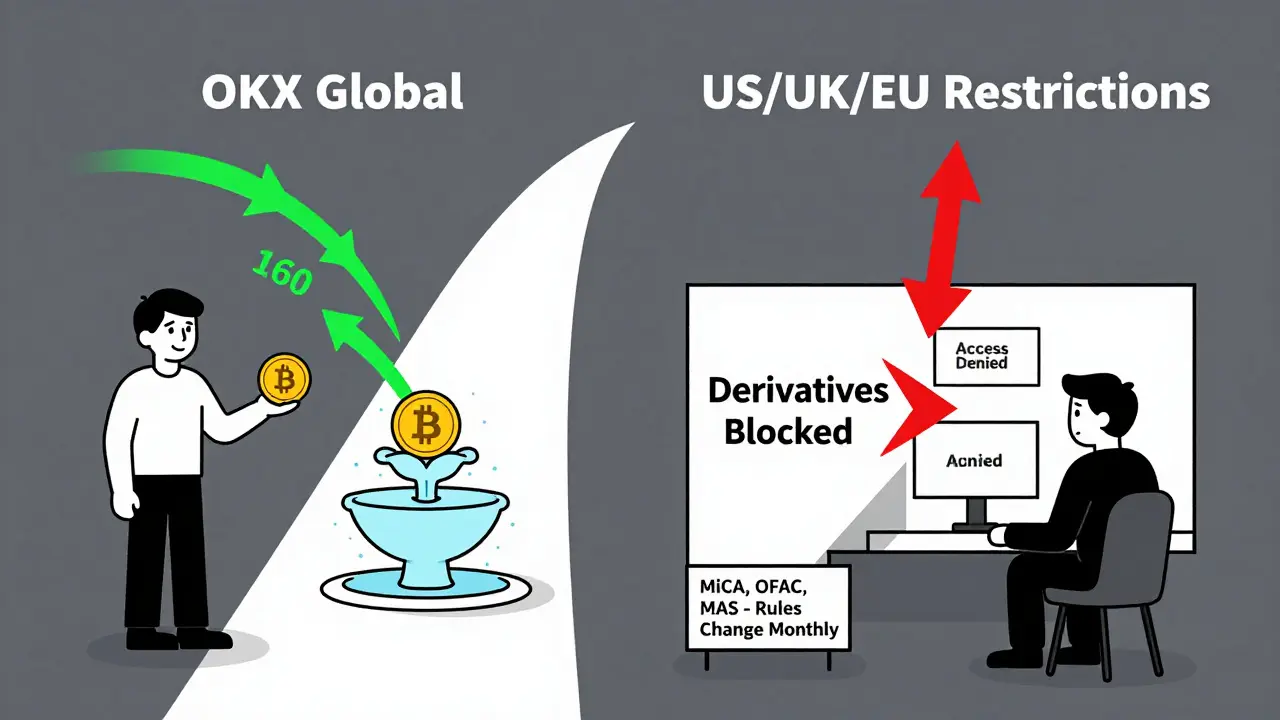
OKX isn’t staying still. They’ve spent $230 million on compliance since early 2025. That’s not marketing. That’s legal infrastructure. They’re setting up legal entities in Switzerland and the UAE to serve users from countries they once blocked. Rumors suggest they’re negotiating with U.S. regulators to launch a U.S.-compliant version. No timeline. No guarantee. But it’s happening.
They’ve already expanded derivatives access to Thailand and Vietnam. That’s a sign they’re targeting markets with clear, stable rules. Meanwhile, they’ve cut off Bangladesh and Nepal after those countries imposed new crypto controls. OKX doesn’t fight regulations. It adapts - fast.
But here’s the problem: the rules keep changing. Japan’s Financial Services Agency warned users about OKX in August 2025. France added it to their restricted list in September. The EU’s MiCA rules are still being interpreted. What’s allowed today might be banned tomorrow. If you’re using OKX, you’re not just trading crypto - you’re navigating a legal minefield.
What Users Are Saying
Reddit is full of frustrated users. One from Texas posted: “Tried to verify with my U.S. passport. Got ‘country restriction’ even though I’m in Texas.” That’s not rare. Trustpilot has over 1,800 reviews mentioning country blocks. Common complaints? “I’m in Germany but got blocked.” “My ID was accepted once, now it’s not.” “The app works on my phone but not my laptop.”
Those aren’t bugs. They’re symptoms of a system trying to do too much. Automated filters catch legitimate users. Human review is slow. And support? It’s worse if you’re not in Europe. The system works for some. It fails for many.
On the flip side, users in Germany, Japan, and Indonesia report smooth experiences. One user wrote: “SEPA deposits work perfectly. No delays. No issues. I’ve been using OKX Europe since March 2025.” That’s the sweet spot - where regulation is clear, and OKX has a local setup.
What Should You Do?
If you’re blocked:
- Check if your country is on the banned list - don’t waste time with a VPN.
- If you’re in a partially restricted country, use spot trading. Avoid derivatives.
- Complete Level 2 or 3 KYC. It’s slow, but it unlocks higher limits.
- Don’t try to bypass restrictions. Your account won’t just be frozen - it might be permanently deleted.
- If you’re in the U.S., accept that OKX won’t work. Use Coinbase or Kraken instead.
If you’re in a permitted country, OKX is one of the best options - low fees, deep liquidity, and 200+ coins. Just know the rules. And be ready for them to change.
Why is OKX banned in the United States?
OKX is banned in the U.S. because it doesn’t hold a U.S. license. The SEC and other regulators require exchanges to register as money transmitters and comply with strict anti-money laundering rules. OKX chose not to pursue this due to the cost and legal risk. Unlike Coinbase, which operates under U.S. law, OKX remains an offshore entity. Until it establishes a U.S.-based subsidiary with full regulatory approval, U.S. residents can’t legally use it.
Can I use OKX with a VPN?
Technically, yes - but it’s against OKX’s terms. Their systems detect VPN usage with 95% accuracy. If caught, your account will be suspended. Repeated attempts lead to permanent bans. Even if you get in, you might face withdrawal blocks or frozen funds. It’s not worth the risk. OKX doesn’t just block IPs - it tracks device fingerprints and KYC documents. A VPN won’t hide your identity if you’ve already uploaded your passport.
Why can I trade Bitcoin but not futures on OKX?
Spot trading (buying and selling crypto directly) is considered lower risk by regulators. Futures and leverage trading involve borrowed money and higher volatility, which regulators see as dangerous for retail users. Countries like Australia, the UK, and EU members have banned or restricted these products for non-professional traders. OKX complies by disabling them - even if you’re in a country where they’re technically legal. It’s a blanket policy to avoid legal battles.
Is OKX safe to use in permitted countries?
Yes - if you’re in a country where OKX is fully allowed. The exchange holds over $13 billion in daily volume and has passed multiple third-party audits. It stores 95% of funds in cold wallets and publishes proof of reserves monthly. It’s not as regulated as Coinbase, but it’s more transparent than most offshore exchanges. The biggest risk isn’t security - it’s sudden regulatory changes. Always keep funds you’re not actively trading in a personal wallet.
What happens if I move to a banned country after creating an OKX account?
If you relocate to a banned country, OKX will eventually detect it - through IP changes, new device fingerprints, or updated KYC documents. Once detected, you’ll lose access to trading and withdrawals. You might still see your balance, but you won’t be able to move funds. There’s no grace period. Your account will be frozen. The only way to avoid this is to withdraw everything before moving. Don’t assume your old account will work.