What is CoinUp.io (CP) Crypto Coin? A Real-World Guide to the Platform and Its Token
 Jan, 22 2026
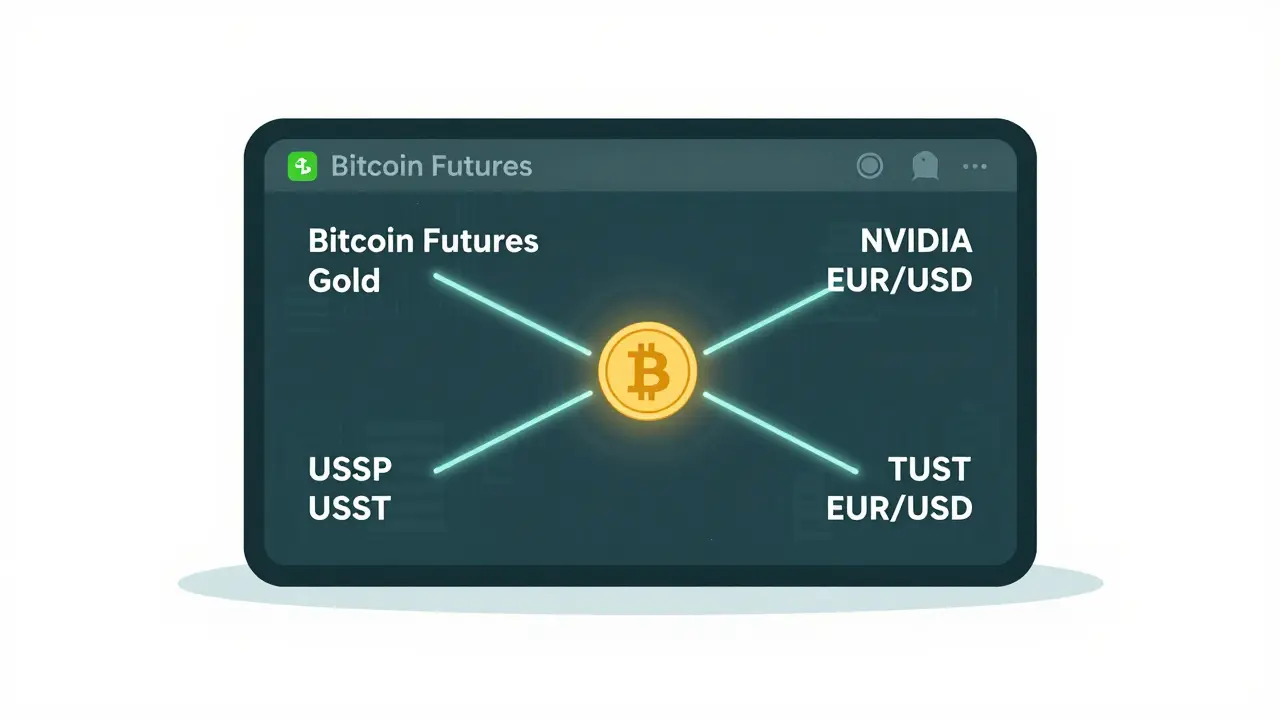
Most crypto platforms let you trade Bitcoin, Ethereum, or maybe a few altcoins. CoinUp.io does something different. It lets you trade Bitcoin futures, Nvidia stock, gold, and EUR/USD forex-all from one account, using USDT as the common currency. And at the center of this system is the CP coin, the platform’s native token. If you’ve heard of CoinUp.io and are wondering whether CP is just another meme coin or something real, here’s what you actually need to know.
What CoinUp.io Actually Is
CoinUp.io isn’t just another crypto exchange. It launched in September 2021 with a clear goal: to break down the wall between traditional finance and crypto. While most exchanges were busy adding more cryptocurrencies, CoinUp.io focused on letting users trade real-world assets like Apple stock, crude oil, and S&P 500 indices alongside crypto derivatives. That’s not a gimmick-it’s a structural design. You can open a position on BTC/USDT futures, then switch to Tesla options, then move into USD/JPY, all without withdrawing or depositing anything. The platform uses USDT as the settlement layer, so your balance stays consistent across asset classes. This wasn’t popular at first. In 2021, most traders wanted spot trading. But CoinUp.io’s founders, led by Queenie Li, believed derivatives would dominate. They were right. After the Bitcoin spot ETF launched in early 2024, derivatives volumes exploded. By late 2025, CoinUp.io was processing over $100 billion in daily derivatives trades, outpacing its spot volume by more than six times-exactly what their model predicted.What Is the CP Token?
The CP token is CoinUp.io’s native cryptocurrency, launched in late 2024 after four years of building infrastructure without issuing a token. That’s unusual. Most exchanges release tokens early to raise funds. CoinUp.io waited until their platform was stable, their user base was large (over 10 million), and their derivatives volume was proven. They called it a move for long-termism. CP has a fixed maximum supply of 1 billion tokens. As of January 2026, the price hovers around $0.22-$0.25, depending on the exchange. That gives it a market cap between $220 million and $250 million. But here’s the twist: CP briefly hit $1.98 in early 2025, a 34x increase from its launch price. That surge didn’t last. The token has since stabilized, reflecting its role as a utility asset rather than a speculative frenzy.How CP Is Used on CoinUp.io
CP isn’t just a trading pair. It has real functions inside the platform:- Trading fee discounts - Holding CP reduces trading fees by up to 30% on derivatives and spot trades.
- Access to CP Chain - The platform launched its own EVM-compatible blockchain in January 2026. CP is the gas token here, used for transactions, smart contracts, and DeFi apps built on the chain.
- Liquidity mining - Users can stake CP in liquidity pools on CP Chain and earn 8-12% APY, according to community reports.
- Future governance - Starting Q3 2026, CP holders will be able to vote on platform upgrades, fee structures, and new asset listings.
How CoinUp.io Compares to Binance, Bybit, and OKX
CoinUp.io doesn’t compete directly with the giants. It competes in a different space.| Feature | CoinUp.io | Binance | Bybit |
|---|---|---|---|
| Primary Focus | Derivatives + Traditional Assets | Spot + Derivatives | Derivatives |
| Assets Traded | 1,000+ cryptos + stocks, forex, commodities | 1,000+ cryptos | 500+ cryptos |
| Settlement Currency | USDT (cross-asset) | USDT, BUSD | USDT |
| Native Token | CP (launched 2024) | BNB (launched 2017) | BYBIT (launched 2021) |
| Derivatives Volume (Q4 2025) | $100B+ daily | $40B+ daily | $35B+ daily |
| Users | 10M+ | 150M+ | 10M+ |
| Public Blockchain | CP Chain (EVM-compatible) | None | None |
Who Should Use CoinUp.io and CP
CoinUp.io isn’t for everyone. Here’s who it fits:- Hybrid traders - You trade crypto but also follow tech stocks, commodities, or forex. You want to move between them fast.
- Derivatives-focused traders - You use leverage, futures, or options. CoinUp.io’s tools are built for this.
- Early DeFi adopters - You’re interested in staking, liquidity pools, or blockchain-based yield. CP Chain gives you access to that.
- You only want to buy and hold Bitcoin.
- You need instant customer support-email responses take 18+ hours, and Trustpilot ratings show complaints about slow help.
- You’re risk-averse-regulators are watching platforms like this closely. In late 2025, the SEC cracked down on exchanges offering stock trading, forcing some to pull back. CoinUp.io still offers it, but the legal landscape is shifting.

CP Chain: The Next Step
In January 2026, CoinUp.io launched CP Chain-a public blockchain designed for speed and cross-chain compatibility. It’s EVM-compatible, so Ethereum wallets and dApps work on it. The goal? To move beyond being just an exchange and become a full Web3 financial hub. On CP Chain, you can:- Stake CP for yield
- Use CP to pay for transaction fees
- Participate in DeFi protocols built on the chain
- Eventually vote on platform decisions
Risks and Challenges
CoinUp.io’s model is bold, but it’s not without risks:- Regulatory pressure - Offering stocks and forex under a crypto platform is legally gray. CoinDesk reported in late 2025 that 73% of similar platforms scaled back these offerings after SEC actions.
- CP token volatility - Even though CP has stabilized, it still saw a 34x surge and a 90% drop. Price swings are real.
- Liquidity gaps - While derivatives volume is high, it’s still far below Binance’s. Slippage can be higher during big market moves.
- Learning curve - CoinUp.io’s interface is powerful but complex. The platform estimates users need 15-20 hours to master all features.
How to Get Started
1. Go to coinup.io and sign up.Is CoinUp.io safe to use?
Yes, but with caveats. CoinUp.io holds over $500 million in reserves, is registered in the Cayman Islands, and operates in multiple jurisdictions. However, offering traditional assets like stocks alongside crypto creates regulatory gray zones. The platform has not been shut down or fined, but regulators are watching. Use only what you can afford to lose, and avoid large positions until you understand the risks.
Can I use CP coin outside of CoinUp.io?
Yes, but not widely. CP is listed on Binance, Crypto.com, and a few other exchanges. You can send it to any EVM-compatible wallet like MetaMask. But outside of CoinUp.io’s ecosystem, its utility is limited. Its main use cases-fee discounts, staking, and governance-are tied to the CoinUp.io platform and CP Chain. Don’t expect it to be accepted as payment anywhere else.
Why did CoinUp.io wait until 2024 to launch CP?
Most exchanges launch tokens early to raise money. CoinUp.io didn’t need to. They spent four years building infrastructure, growing their user base to 10 million, and proving their derivatives model. Launching CP too soon could have undermined trust. Waiting allowed them to launch with a clear utility, strong demand, and a stable platform-something many token launches lack.
Is CP a good investment?
It’s not a guaranteed investment. CP’s value is tied to CoinUp.io’s success. If the platform grows, CP usage and demand will rise. If regulators shut down its stock/forex offerings, CP’s utility could shrink. Right now, it’s best viewed as a utility token for active users-not a speculative asset. Hold it if you trade on CoinUp.io regularly. Don’t buy it just because the price went up once.
What’s the difference between CP and BNB?
BNB is a mature token with wide adoption across hundreds of dApps, DeFi protocols, and even real-world payments. CP is newer, tied to one platform, and still building its ecosystem. BNB is a general-purpose crypto asset. CP is a platform-specific utility token with a niche focus: cross-asset trading. Think of CP as BNB in its early days-potential, but unproven at scale.
If you’re someone who watches both the crypto market and Wall Street, CoinUp.io gives you a rare tool. The CP token isn’t flashy, but it’s the key to unlocking that tool. Whether it grows into something bigger depends on regulation, user adoption, and how well CP Chain performs. For now, it’s a platform for the curious, the hybrid traders, and those who believe the future of finance isn’t just crypto-or stocks-but both, together.