Best DAO Governance Tools and Platforms in 2026: A Practical Guide
 May, 21 2026
Running a decentralized organization shouldn't feel like herding cats through a smart contract. Yet for many Web3 communities in 2026, that’s exactly what it looks like without the right infrastructure. You have token holders who want to vote, treasuries that need secure management, and proposals that must execute across multiple blockchains. The gap between "we decided this" and "the code executed this" is where most DAOs stumble.
The good news? The landscape of DAO governance tools has matured significantly. We’ve moved past the experimental phase of 2021 into an era of specialized, production-grade platforms. Whether you’re a small community managing a shared wallet or a protocol coordinating millions in treasury assets, there is a tool built specifically for your structure. Choosing the wrong one can lead to security vulnerabilities or voter fatigue; choosing the right one streamlines decision-making and builds trust.
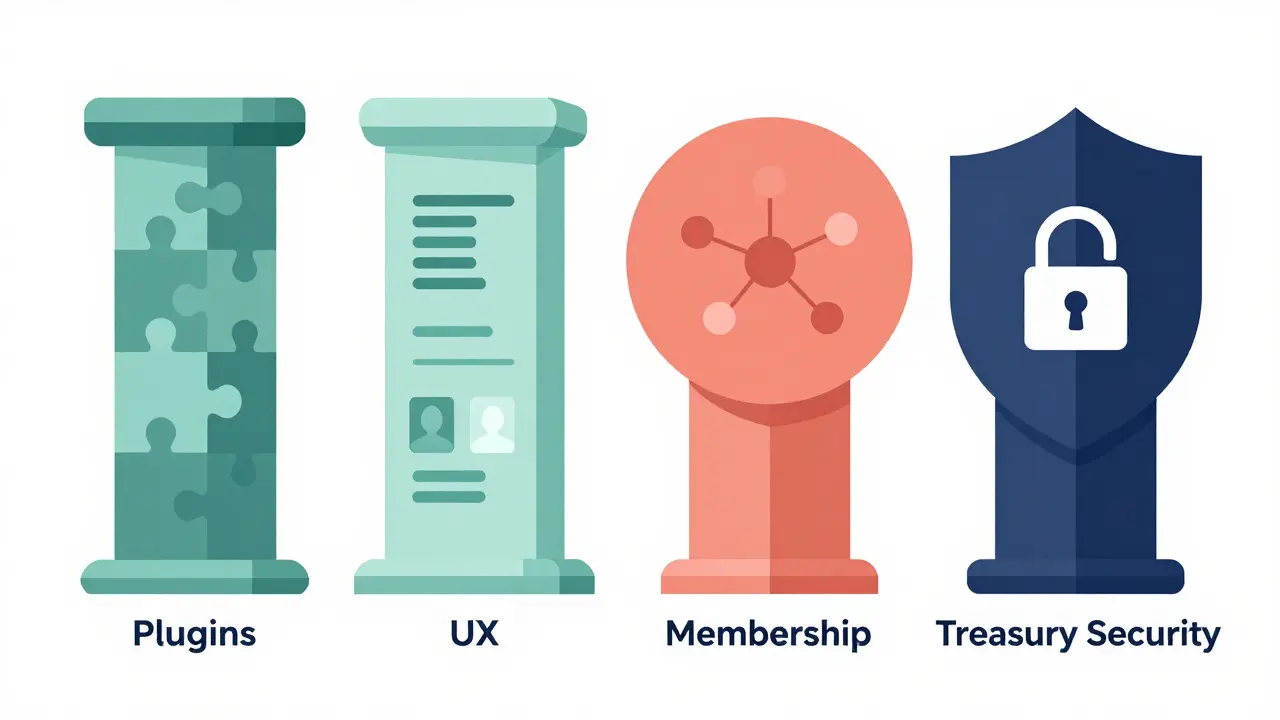
Understanding the Four Pillars of DAO Governance
Before picking a platform, you need to understand how they differ architecturally. In 2026, the market isn’t dominated by one-size-fits-all solutions. Instead, we see four distinct approaches based on what the organization values most: modularity, user experience, simplicity, or treasury security.
Most teams fall into one of these buckets:
- Modular Frameworks: For protocols needing granular control over permissions and complex logic.
- Governance Interfaces: For token-based DAOs prioritizing ease of use and analytics for voters.
- Membership-Centric Platforms: For communities where membership status matters more than token price.
- Treasury-First Stacks: For groups starting with secure multisig wallets and evolving toward decentralization.
Let’s break down the leading players in each category so you can match your team’s needs to the right technology.
Aragon OSx: The Modular Powerhouse
If your DAO is building a complex protocol or requires highly specific permission structures, Aragon OSx is likely your best bet. Unlike older monolithic frameworks, Aragon OSx uses a plugin architecture. This means you don’t deploy a single giant contract. Instead, you install plugins for voting, treasury management, or membership as needed. You can swap out a voting plugin for a different one later without redeploying your entire organization.
This approach shines when you need granular permissions. Aragon allows you to define roles with extreme precision-who can propose, who can execute, and who can change the rules. It supports dual governance models (e.g., token holders vote on strategy, core contributors vote on operations) and multichain vote aggregation. If your DAO operates across Ethereum, Arbitrum, and Optimism simultaneously, Aragon OSx handles the complexity of aggregating votes from those chains into a single execution trigger.
Who is it for? Protocol DAOs, product teams, and organizations that plan to evolve their governance model over time. It offers both no-code interfaces for basic setups and developer-friendly APIs for custom plugin creation. However, be aware that setting up complex permission trees requires technical expertise or hiring a consultant.
Tally: The User Experience Leader for Token Voting
Voter turnout is the silent killer of many DAOs. People don’t vote because the process is confusing, or they forget to delegate their tokens. Tally solves this by focusing entirely on the user interface and experience for Governor-style DAOs (like those using OpenZeppelin’s standard).
Tally isn’t just a voting portal; it’s a comprehensive dashboard. It provides real-time analytics on voter history, delegation trends, and treasury visibility. For delegates-the people representing thousands of token holders-Tally is indispensable. It simplifies the workflow of tracking delegated power and casting votes on behalf of others. Crucially, Tally excels at multichain coordination. If your proposal involves executing transactions on two different Layer 2 networks, Tally orchestrates the flow so you don’t have to manually track gas limits and transaction hashes across separate explorers.
Who is it for? Token-based DAOs on Ethereum and EVM Layer 2s that prioritize high participation rates and clear data visualization. If your community relies heavily on delegation and you want to reduce friction for casual voters, Tally is the industry standard. Note that while the UI is hosted, the execution happens on-chain, meaning you still pay gas fees for proposal execution.
DAOhaus: Simplicity and Exit Strategies
Not every DAO needs complex tokenomics. Some are just groups of friends, investors, or collaborators pooling resources. DAOhaus, built on the Moloch v3 framework, focuses on membership rather than open token markets. You join by being invited or applying, and you hold "shares" and "loot" tokens that represent your stake and rewards.
The standout feature here is the ragequit mechanism. In traditional partnerships, leaving a group is messy. In a DAOhaus, if you disagree with the direction, you can exit cleanly. The system automatically calculates your share of the treasury and sends it to you, removing your voting power instantly. This de-risks early-stage collaboration because members know they aren’t locked in forever.
DAOhaus also integrates seamlessly with Gnosis Safe via the Zodiac pattern. This means your treasury is managed by the industry-standard multisig wallet, but governance decisions flow through DAOhaus. It’s simple, effective, and avoids the overhead of managing a public token.
Who is it for? Early-stage communities, venture clubs, and project teams that value simplicity and clean exit paths over speculative token trading. It’s perfect for groups that want to coordinate without the noise of public markets.
Gnosis Safe + Zodiac: The Treasury-First Path
Many DAOs start with a Gnosis Safe multisig wallet. It’s secure, familiar, and widely used. But multisigs aren’t great for democratic decision-making-they’re designed for trusted signers. That’s where Zodiac modules come in.
Zodiac adds a modular governance layer on top of Safe. You can start with a simple multisig and gradually add modules for roles, voting, or cross-chain bridging. The Governor module allows you to implement token-based voting directly into your Safe account. The Bridge module lets you manage assets across different chains from one interface. This stack is ideal for progressive decentralization. You don’t have to migrate to a new platform; you enhance the one you already trust.
Who is it for? Teams that already use Gnosis Safe and want to add governance capabilities without changing their treasury infrastructure. It’s also great for DAOs that need strict security controls alongside democratic processes.
| Feature | Aragon OSx | Tally | DAOhaus | Safe + Zodiac |
|---|---|---|---|---|
| Core Philosophy | Modular Plugins | UX & Analytics | Membership & Exit | Treasury Security |
| Voting Mechanism | Token/Via Plugin | Token (Governor) | Membership Shares | Module-Based |
| Multichain Support | Native Aggregation | Coordination UI | Via Safe Modules | Via Bridge Module |
| Permission Granularity | High (Role Scoping) | d>Medium (Contract-Limited) | Low-Medium (Shamans) | High (Roles Modifier) |
| Best For | Protocols & Complex Orgs | Token DAOs & Delegates | Early Communities & Clubs | Progressive Decentralization |
Cost Considerations and Hidden Fees
When evaluating these tools, look beyond the software license. Most platforms are open-source or offer free tiers, but the real costs lie in on-chain execution.
- Gas Fees: Every proposal submission, vote, and execution costs gas. On Ethereum mainnet, this can be expensive. On Layer 2s like Arbitrum or Base, it’s negligible. Tally and Aragon support L2s effectively, reducing costs for users.
- Development Costs: Aragon OSx and Safe + Zodiac may require developer time to configure custom plugins or modules. Budget for audits if you’re writing custom logic.
- SaaS Pricing: Tally and DAOhaus offer hosted UIs. While currently free or low-cost for small DAOs, enterprise features or dedicated support may incur fees. Always check the latest pricing pages as models shift.
For small communities, DAOhaus with a Safe treasury is often the cheapest route. For large protocols, the cost of a poor UX (low voter turnout) far outweighs the development cost of implementing Aragon or Tally.
How to Choose Your Platform
Ask yourself these three questions:
- Who is voting? If it’s token holders, lean toward Tally or Aragon. If it’s invited members, choose DAOhaus.
- How complex is your treasury? If you hold assets on multiple chains, ensure your platform supports multichain execution (Aragon, Tally, or Zodiac Bridge).
- What is your technical capacity? If you have developers, Aragon and Zodiac offer more flexibility. If you’re non-technical, Tally and DAOhaus provide smoother out-of-the-box experiences.
Don’t try to boil the ocean. Start with the simplest solution that meets your current needs. You can always migrate or upgrade later. The key is to get started with a system that encourages participation rather than discouraging it with complexity.
Is Aragon OSx better than Tally for my DAO?
It depends on your priority. Choose Aragon OSx if you need granular permission controls, custom governance logic, or are building a complex protocol. Choose Tally if your primary goal is maximizing voter turnout through a superior user interface and rich analytics for token-based voting.
Can I use DAOhaus for a large protocol?
DAOhaus is best suited for smaller, membership-based communities or venture clubs. For large protocols with thousands of token holders and complex treasury needs, platforms like Aragon OSx or Tally offer better scalability and multichain support.
What is the ragequit feature in DAOhaus?
Ragequit allows a member to leave the DAO and immediately receive their proportional share of the treasury. This ensures that members aren’t locked into an organization they no longer believe in, providing a clean and automated exit strategy.
Do I need a developer to set up Gnosis Safe + Zodiac?
Basic setup can be done by non-technical users using the hosted UI. However, configuring advanced modules like custom Roles or Bridge settings may require some technical knowledge or assistance from a developer to ensure security.
Which platform is best for multichain governance?
Aragon OSx and Tally are the leaders in multichain governance. Aragon aggregates votes from multiple chains natively, while Tally provides a coordinated UI for managing proposals across different networks. Both are excellent choices if your DAO operates on Ethereum and Layer 2s.