Blockchain Identity Authentication Benefits: Security, Speed, and Control
 Jun, 16 2026
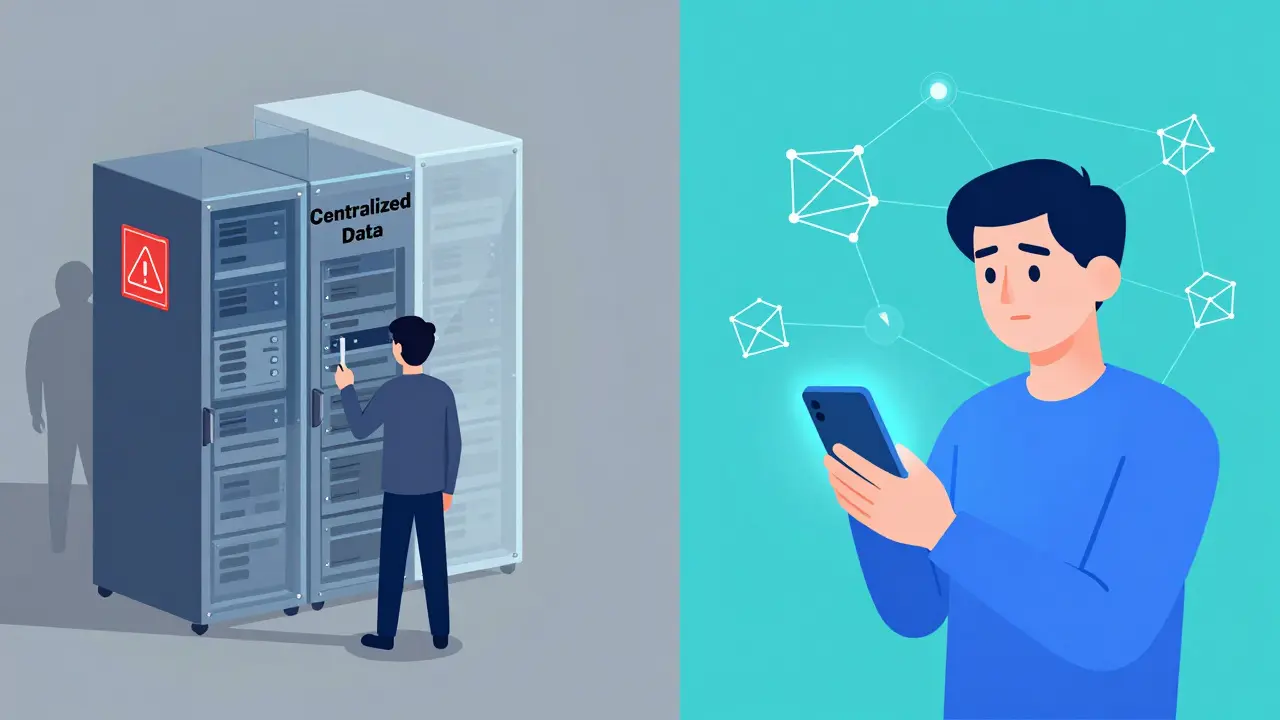
Imagine walking into a bank or logging into a government portal without typing a password. Instead of handing over your driver’s license to prove you are who you say you are, you simply tap your phone. The system verifies your identity instantly, securely, and-crucially-without storing your personal data on a central server that hackers love to target. This is not science fiction; it is the promise of blockchain identity authentication, a technology reshaping how we handle trust in the digital world.
For decades, we have relied on centralized databases managed by corporations and governments. These systems are convenient but fragile. When Equifax was breached in 2017, exposing the data of 147 million people, it highlighted a fundamental flaw: putting all your eggs in one basket is risky. Blockchain offers a different approach. By distributing identity verification across a network of nodes rather than a single server, it eliminates the single point of failure. But does this technical shift actually benefit the average user? Let’s break down why this matters for security, privacy, and speed.
The Core Problem with Traditional Identity Systems
To understand why blockchain identity is gaining traction, we first need to look at what’s wrong with the current setup. Today, your digital identity is fragmented. You have an account with Facebook, another with Amazon, and yet another with your bank. Each service requires you to repeat the same verification process-uploading IDs, answering security questions, and creating unique passwords. This redundancy is exhausting and insecure.
Centralized identity providers act as gatekeepers. They hold your data, and they control access. If their database is compromised, your information is exposed. Moreover, these systems often lack interoperability. Your verified identity at one institution doesn’t help you at another. You start from scratch every time. This inefficiency costs businesses billions in compliance and customer acquisition, while users pay with their time and privacy.
Self-Sovereign Identity (SSI) is a model where individuals maintain full control over their personal data, using cryptographic keys to manage access rather than relying on central authorities. It flips the script: instead of companies holding your identity, you do. Blockchain serves as the underlying infrastructure that makes this possible by providing a tamper-proof ledger for verifying credentials without revealing the underlying data.
Key Benefits of Blockchain-Based Authentication
The advantages of moving to a decentralized identity framework are significant. Here is what changes when you switch from traditional passwords to blockchain-based verification:
- Enhanced Security: Since there is no central database to hack, attackers have fewer targets. Even if a hacker intercepts a transaction, they cannot alter the record because the blockchain’s immutability prevents unauthorized changes. According to analysis by BlockchainX Tech (2023), this distributed architecture significantly reduces the risk of large-scale data breaches.
- User Privacy via Zero-Knowledge Proofs: One of the most powerful features is the ability to prove something without revealing the actual data. For example, you can prove you are over 21 without showing your birthdate or address. This uses zero-knowledge proofs, a cryptographic method that confirms validity without exposing the source information. PixelPlex (2023) notes that this minimizes data exposure, reducing the value of any potential leak.
- Faster Verification Times: Traditional Know Your Customer (KYC) processes can take days. J.P. Morgan’s Kinexys division reported in 2023 that traditional KYC averages 24-72 hours. In contrast, optimized blockchain identity systems can process 98% of verifications in under two seconds. Dock Labs (2025) quantified this efficiency, noting a 70% faster verification process compared to legacy methods.
- Cost Reduction: Repeatedly verifying the same documents is expensive. By allowing users to reuse verified credentials across platforms, organizations save money. Dock Labs estimates a 65% reduction in verification costs. This is particularly impactful for industries like finance and healthcare, where compliance checks are frequent and costly.
- Interoperability: With standards like the W3C’s Decentralized Identifiers (DIDs), which became a recommendation in 2022, identities can work across different platforms. You don’t need separate logins for every service. One verified credential can unlock multiple services, streamlining the user experience.
How It Works: A Simple Explanation
You might be wondering how this actually functions in practice. It doesn’t require you to become a cryptographer. Think of it like a digital wallet, similar to the ones used for cryptocurrencies, but for your identity documents.
- Credential Issuance: A trusted entity, such as a university or government agency, issues a digital credential to you. This could be a diploma, a driver’s license, or a professional certification. This credential is cryptographically signed, ensuring it is authentic.
- Storage: You store this credential in a digital wallet on your phone or computer. The data stays with you, not in a cloud server owned by the issuer.
- Verification: When you need to prove your identity-for instance, to open a bank account-you share the relevant credential with the verifier. The verifier checks the cryptographic signature against the blockchain ledger to confirm it hasn’t been tampered with. No sensitive data leaves your device unless you explicitly choose to share it.
This process relies on asymmetric key pairs. You hold a private key (like a secret password that never leaves your device) and a public key (shared with others). The blockchain records the public key and the status of the credential, ensuring integrity without compromising privacy.
| Feature | Traditional Centralized System | Blockchain Identity (SSI) |
|---|---|---|
| Data Storage | Centralized servers (single point of failure) | Distributed across user devices and blockchain nodes |
| Control | Held by service providers | Held by the user (Self-Sovereign) |
| Privacy | Full data disclosure often required | Selective disclosure via zero-knowledge proofs |
| Verification Speed | Hours to days (manual review) | Seconds (automated cryptographic check) |
| Security Risk | High (database breaches) | Low (no central honeypot for hackers) |
Real-World Applications and Success Stories
While the technology is still maturing, several projects demonstrate its potential. In Switzerland, the SwissCovid digital ID system implemented in 2022 achieved a 92% user satisfaction rate among 50,000 participants. Users appreciated being able to access health services securely without centralized data collection. This case study highlights how blockchain can balance public health needs with individual privacy.
In the financial sector, J.P. Morgan has explored blockchain for mortgage applicant verification. Traditional processes involve sending physical documents between lenders, appraisers, and borrowers-a slow, error-prone workflow. Blockchain could reduce this time from days to hours, accelerating home purchases and reducing administrative overhead.
However, it’s not all smooth sailing. A major European bank attempted a blockchain identity rollout in 2023 but faced a 40% user abandonment rate due to complex onboarding. This serves as a critical lesson: technology alone isn’t enough. User experience (UX) must be intuitive. If users lose their private keys, they lose access to their identity. Solutions like multi-factor recovery systems, offered by platforms like 1Kosmos BlockID, are essential to mitigate this risk.
Challenges and Limitations to Consider
Despite the benefits, blockchain identity authentication is not a silver bullet. Several hurdles remain before widespread adoption becomes reality.
Key Management Complexity: As mentioned, losing your private key means losing your identity. Unlike a forgotten password, there is no "forgot my password" button in a truly decentralized system. While recovery mechanisms exist, they add complexity. Non-technical users may find this daunting. Microsoft’s 2023 case study noted that non-technical users might need 8-10 hours of training to feel comfortable, compared to 2-3 hours for tech-savvy individuals.
Scalability Issues: Public blockchains like Ethereum currently process 15-30 transactions per second, whereas Visa handles 24,000. While layer-2 solutions and purpose-built networks like Hyperledger Indy are improving throughput, scalability remains a concern for global-scale deployment. However, for identity verification, which doesn’t require constant high-frequency updates, current speeds are often sufficient.
Regulatory Uncertainty: Legal recognition varies by region. The European Union’s eIDAS 2.0 regulation, effective in 2026, explicitly recognizes blockchain-based digital identities. In the U.S., however, federal frameworks are lacking, though 22 states have enacted supportive legislation as of 2024. Businesses must navigate this patchwork of regulations, which can slow implementation.
Adoption Barriers: There is a "chicken-and-egg" problem. Users won’t adopt blockchain wallets unless many services accept them, and services won’t integrate them unless many users have them. Initiatives like the Global Digital Identity Network, launched in March 2024, aim to connect national identity systems to create network effects, but progress will be gradual.
The Future Outlook: Where Is This Heading?
The trajectory for blockchain identity is upward. MarketsandMarkets projects the blockchain identity management market to grow from $1.23 billion in 2023 to $8.64 billion by 2028, a compound annual growth rate of 46.7%. Financial services lead adoption, followed by healthcare and government.
Technological advancements are also accelerating. The World Wide Web Consortium released the Verifiable Credentials Data Model 2.0 in January 2024, standardizing how credentials are structured. Additionally, integration with AI for adaptive identity assurance levels is on the horizon, announced by the Decentralized Identity Foundation in April 2024. Quantum-resistant cryptography implementations are expected by 2026, future-proofing these systems against next-generation computing threats.
Gartner predicts that by 2027, 30% of consumer digital identities will be blockchain-based, up from just 5% in 2023. This shift reflects a growing demand for privacy-preserving solutions in an era of increasing data breaches and surveillance concerns.
Conclusion: Is It Right for You?
Blockchain identity authentication offers a compelling alternative to the broken status quo of centralized identity management. It provides greater security, enhanced privacy, and significant cost savings. However, it requires a shift in mindset-from trusting institutions to trusting code and cryptography. For enterprises, the investment in integration and user education is substantial but potentially rewarding. For individuals, the benefit is reclaiming control over your personal data.
As regulatory frameworks mature and user interfaces improve, blockchain identity will likely move from niche applications to mainstream adoption. The question is no longer if it will happen, but how quickly we can overcome the remaining usability and interoperability challenges.
What is the biggest advantage of blockchain identity over traditional passwords?
The primary advantage is security through decentralization. Traditional passwords are stored in central databases that hackers target. Blockchain identity distributes verification across a network, eliminating single points of failure. Additionally, it enables selective disclosure via zero-knowledge proofs, allowing you to prove attributes (like age) without revealing underlying data (like your birthdate).
Can I use blockchain identity if I lose my phone?
Yes, but it depends on the recovery mechanism provided by your wallet solution. In a purely decentralized system, losing your private key means losing access. However, modern enterprise solutions like Microsoft Entra Verified ID and 1Kosmos offer multi-factor recovery options, such as backup codes or social recovery, to prevent permanent loss of identity access.
Is blockchain identity legally recognized?
Recognition varies by jurisdiction. The European Union’s eIDAS 2.0 regulation (effective 2026) explicitly supports blockchain-based identities. In the United States, federal recognition is limited, but 22 states have passed laws supporting blockchain identity as of 2024. Always check local regulations for specific use cases like banking or voting.
How fast is blockchain identity verification compared to traditional methods?
Blockchain verification is significantly faster. While traditional KYC processes can take 24-72 hours, optimized blockchain systems can complete 98% of verifications in under two seconds. This speed comes from automated cryptographic checks rather than manual document reviews.
What are the main risks of adopting blockchain identity?
Key risks include key management complexity (losing access if keys are lost), scalability limitations on some public blockchains, and regulatory uncertainty in certain regions. Additionally, poor user experience design can lead to low adoption rates, as seen in some early failed implementations.