Clober Crypto Exchange Review: The Only Fully On-Chain Order Book DEX That Actually Works
 Feb, 26 2026
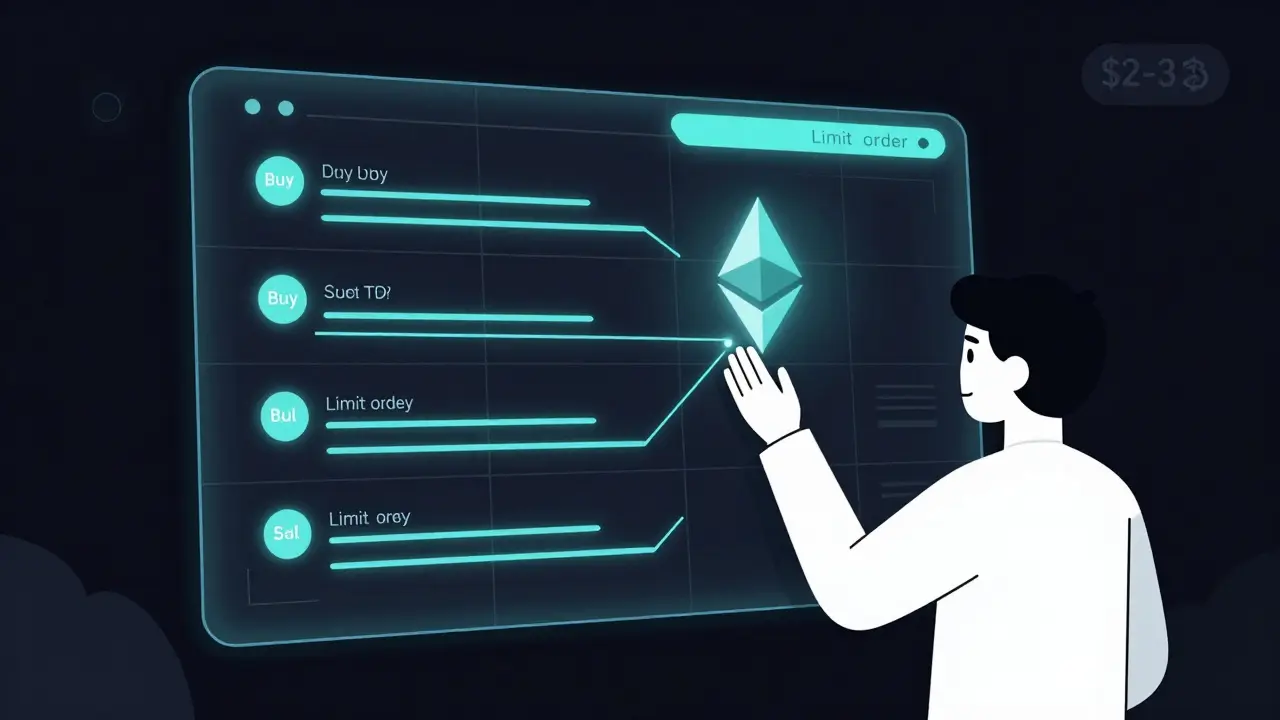
Most crypto exchanges today are either centralized platforms like Binance or decentralized ones built on automated market makers (AMMs) like Uniswap. But what if you could trade with the precision of a centralized exchange-exact prices, no slippage, limit orders-without giving up control of your keys? That’s exactly what Clober promises. And unlike previous attempts at on-chain order books that cost $20+ per trade, Clober brings that functionality to Ethereum at $2-3 per trade. This isn’t theory. It’s live, working, and changing how traders interact with DeFi.
What Makes Clober Different?
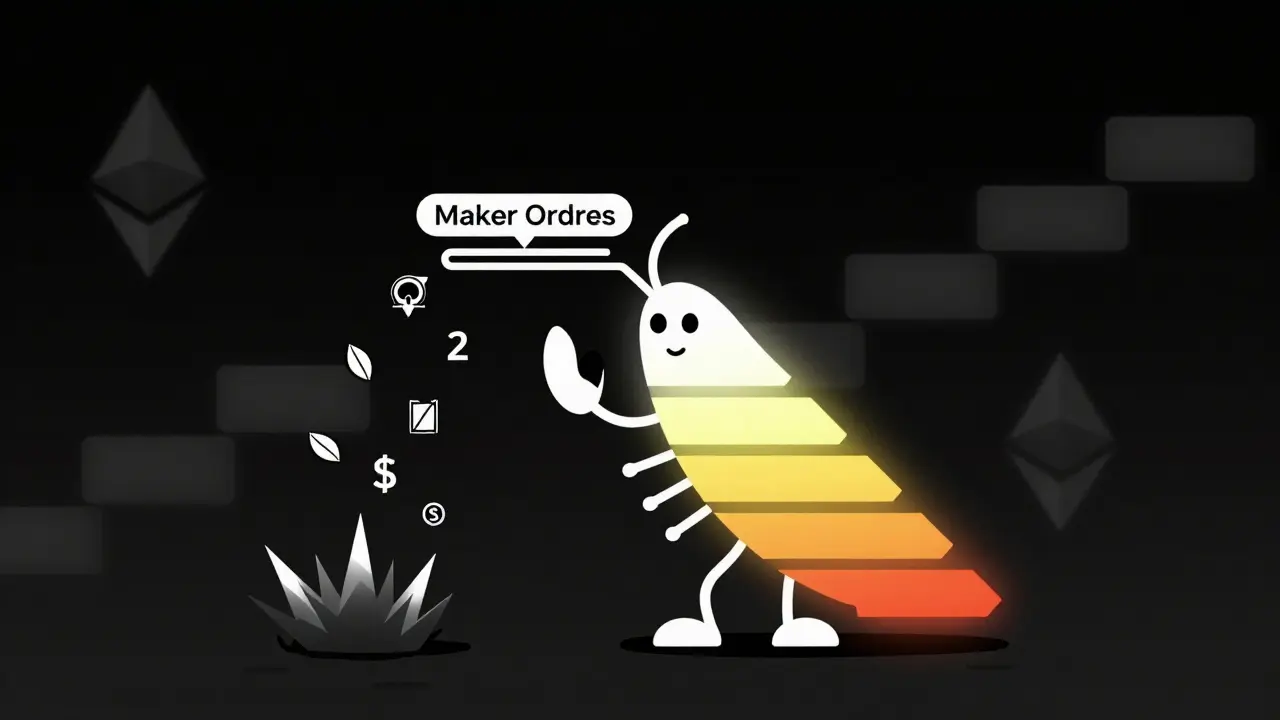
Clober isn’t just another DEX. It’s a Clober is a fully on-chain limit order book decentralized exchange built to solve a problem that’s plagued DeFi for years: how to offer precise price execution without crippling gas fees. Traditional AMMs like Uniswap use liquidity pools. You deposit tokens into a pool, and trades happen based on a mathematical formula. That’s simple, but it comes with trade-offs: impermanent loss for liquidity providers and slippage for traders. Clober throws that model out. Instead, it lets users place real buy and sell orders-just like on Coinbase or Binance-but everything happens on-chain. Your order isn’t stored in a central server. It’s written directly into Ethereum smart contracts.The magic behind this? The LOBSTER algorithm is a Segmented Segment Tree data structure designed to minimize on-chain storage writes. Instead of recording every single match between buyers and sellers (which would cost thousands in gas), LOBSTER tracks only the total amount claimable by each maker order. Takers simply consume that total. Makers then manually claim their proceeds by comparing their own order range against the total. This cuts the computational complexity from O(n) to O(log n), making it scalable. MITOSIS University’s November 2023 analysis confirmed it reduces gas costs by 85% compared to earlier on-chain order book designs.
How Trading Works on Clober
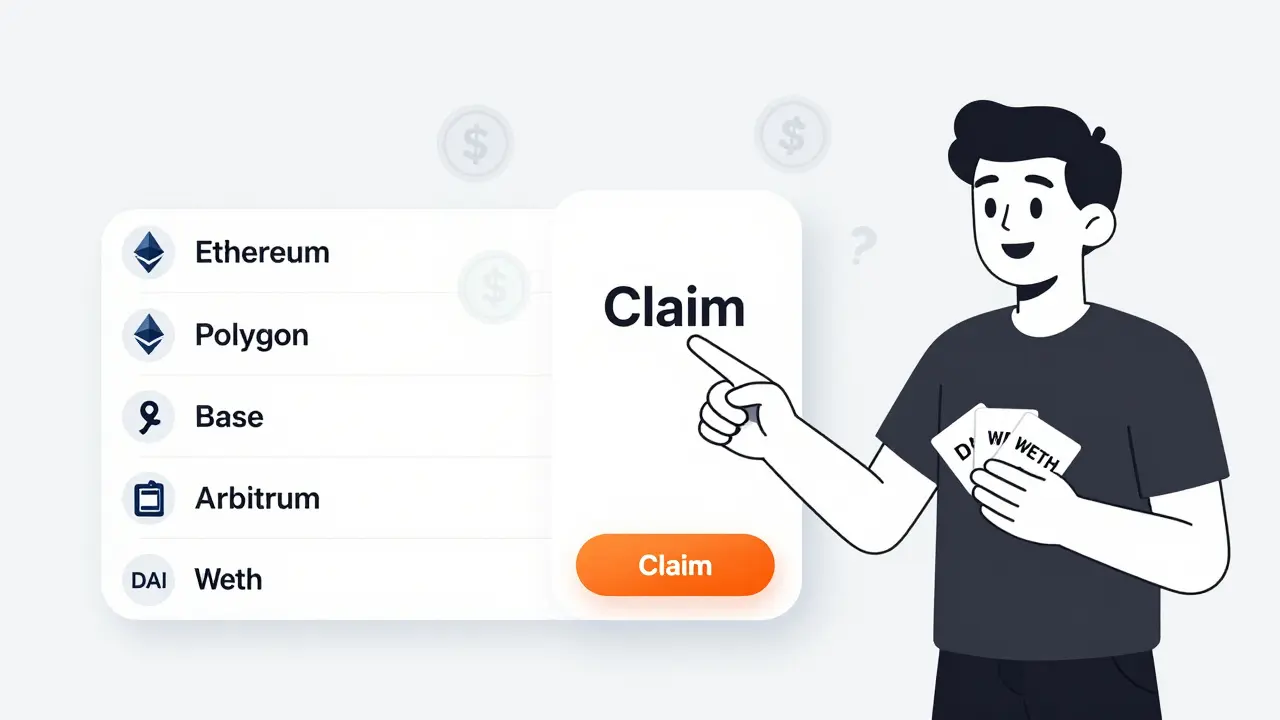
If you’ve used Uniswap, the first thing you’ll notice is how different Clober feels. You’re not swapping tokens from a pool. You’re placing actual limit orders. You set a price. You set an amount. You wait. When someone else matches your price, your order fills. But here’s the catch: you have to claim your funds manually.After your order fills, the proceeds don’t auto-deposit into your wallet. You must go back into the interface and click “Claim.” This is intentional. It reduces gas usage during matching. But it’s also the biggest pain point users report. Reddit users like u/EtherealTrader call it “annoying.” Some have even built bots to automate claiming. The official documentation on docs.clober.io gives step-by-step guides, but it assumes you already understand order book mechanics-bid-ask spreads, order cancellation, time-in-force. If you’re new to this, expect a 2-3 hour learning curve.
Market orders are supported too. But they’re not the main attraction. Clober’s real power is in limit orders. Want to buy 100 DAI at exactly $0.995? Put it in. It sits on-chain until someone sells at that price. No slippage. No slushy pricing. Just clean execution. That’s why institutional traders and stablecoin market makers are starting to pay attention. MakerDAO, for example, is exploring Clober for precise DAI redemption pricing.
Gas Costs: The Real Game-Changer
Previous on-chain order books failed because they were too expensive. Every match meant multiple transactions. Clober changed that. On Ethereum mainnet, a typical trade now costs between $2 and $3. That’s roughly the same as swapping on Uniswap. But here’s the kicker: during Ethereum congestion, gas spikes can push Clober’s cost up to $8.20, according to the University of Zurich’s August 2023 study. Still, that’s 75% cheaper than the $30+ trades of 2022.Compare that to centralized exchanges where gas is irrelevant. Or even Layer 2 DEXs like Uniswap V3 on Arbitrum, where fees are often under $0.10. Clober isn’t trying to beat those. It’s trying to beat the old on-chain order book models that were unusable. And it’s winning. By November 2023, RootData reported 82% bullish sentiment among 2,997 voters. That’s not hype. That’s real adoption.
Supported Chains and Token Pairs
Clober is EVM-compatible and deployed across at least four blockchains, though the exact list isn’t public. Based on community activity, it’s likely running on Ethereum, Polygon, Base, and Arbitrum. The platform supports over 120 token pairs, including major DeFi assets like WETH, USDC, DAI, WBTC, and LINK. But compared to Uniswap’s 10,000+ pairs, Clober’s selection is still narrow. You won’t find obscure memecoins here. This isn’t a place for speculation. It’s for traders who want clean, precise execution.The lack of token variety is a real limitation. If you’re trying to trade a new DeFi token that’s not listed, you’re out of luck. And unlike AMMs, where anyone can add liquidity to a new pair, Clober requires the protocol to officially list the pair. That means slower adoption for new projects.
Pros and Cons: The Real Talk
- Pros: No impermanent loss for liquidity providers, exact price execution, no slippage, gas costs comparable to AMMs, fully non-custodial, open-source code, growing institutional interest.
- Cons: Manual claiming process, limited token pairs, high gas during Ethereum congestion, steeper learning curve than AMMs, no mobile app yet.
Users who value control and precision love it. Those who want simplicity and speed often get frustrated. The manual claiming step is the biggest friction point. It’s not a bug-it’s a design choice to save gas. But it’s still a usability hurdle. Some in the Telegram group (4,200 members) share scripts to auto-claim. Others just accept it as part of the trade-off.
How Clober Compares to the Competition
| Feature | Clober | Uniswap (AMM) | Serum (Hybrid) |
|---|---|---|---|
| Order Type | Limit & Market | Market only | Limit & Market |
| Price Execution | Exact, no slippage | Slippage common | Low slippage |
| Gas Cost (Ethereum) | $2-3 | $2-5 | $1-4 (off-chain matching) |
| Custody | Non-custodial | Non-custodial | Partially custodial |
| Impermanent Loss | None | Yes | None |
| On-Chain Matching | Yes | Yes | No |
Clober beats Uniswap on precision and liquidity provider safety. It beats Serum on censorship resistance because Serum relies on off-chain order books. But it loses on speed and ease of use. It’s not for everyone. It’s for a specific type of trader: someone who values control, hates slippage, and doesn’t mind a little extra work.
Is Clober Safe?
Yes, but with caveats. The code is open-source and MIT-licensed. GitHub shows 12 active contributors as of November 2023. Smart contract audits have been performed, but no public audit report is available. Alex Petrov from Quantstamp warned in September 2023 that the manual claiming system could lead to unclaimed funds if users forget to check. That’s not a hack. It’s a UX flaw. If you’re not actively managing your orders, you could lose money.There’s no token. No governance. No staking. That’s intentional. Clober doesn’t want to be a DeFi yield farm. It wants to be a trading engine. That makes it less vulnerable to speculative attacks but also less attractive to users chasing high APYs.
What’s Next for Clober?
Clober’s roadmap is clear. By January 15, 2024, it plans to launch on Optimism and Arbitrum-Layer 2 chains where gas is cheaper. That could cut trade costs to under $0.50. Institutional API access is coming in Q1 2024, which could bring hedge funds and market makers onto the platform. Multi-chain liquidity aggregation is planned for Q2 2024. If they pull this off, Clober could become the backbone for institutional DeFi trading.Delphi Digital predicts on-chain order books could capture 15-20% of DEX volume by 2025. Clober is currently the only scalable implementation. If Ethereum’s scalability improves with danksharding in 2025, Clober could be the go-to for precise trading.
Who Is Clober For?
Clober isn’t for beginners. It’s not for meme coin traders. It’s not for people who want to swap ETH for USDC and forget about it.Clober is for:
- DeFi users who hate impermanent loss
- Traders who need exact price execution (stablecoin arbitrageurs, market makers)
- Users who value non-custodial control over speed
- Those willing to learn order book mechanics
If you’re looking for a simple swap, use Uniswap. If you’re looking for a trading platform that behaves like a traditional exchange but runs on blockchain-without sacrificing decentralization-Clober is the only option that works today.
Is Clober a centralized exchange?
No. Clober is a fully decentralized exchange (DEX). All trades happen on-chain via smart contracts. Your funds never leave your wallet. There’s no KYC, no account, and no central authority controlling trades. It’s non-custodial by design.
Do I need a special wallet to use Clober?
No. Any EVM-compatible wallet works-MetaMask, WalletConnect, Coinbase Wallet, etc. You just need to connect it to the Clober interface. No downloads or sign-ups required.
Why do I have to manually claim my filled orders?
The manual claiming system reduces gas costs during order matching. Instead of automatically settling every trade, Clober only records the total claimable amount. Users claim their funds when convenient. This design choice makes trading affordable but adds a step. Some users automate this with scripts shared in Clober’s Telegram group.
Can I lose money on Clober?
Yes, but not because of the platform. You can lose money if your limit order gets filled at an unfavorable price, or if you forget to claim your proceeds after an order fills. There’s no insurance or recovery system. You’re responsible for managing your own trades.
Is Clober better than Uniswap?
It depends on what you need. If you want simple swaps with low fees and lots of tokens, Uniswap is easier. If you need precise price control, no slippage, and want to avoid impermanent loss, Clober is superior. They serve different purposes. Clober is for traders. Uniswap is for swappers.
What blockchains does Clober support?
Clober is deployed on at least four EVM-compatible chains, including Ethereum, Polygon, Base, and Arbitrum. The exact list isn’t publicly confirmed, but activity suggests these are the main ones. Expansion to more Layer 2s is planned for early 2024.
Is Clober regulated?
Clober operates as a permissionless, decentralized protocol with no central entity. This gives it legal ambiguity similar to other DeFi tools. While regulators like the SEC may scrutinize order book functionality, Clober’s architecture avoids direct control over users or funds, making enforcement difficult. No official regulatory status exists.