Deflationary Cryptocurrency Examples: How Scarcity Drives Value in Bitcoin, BNB, and Ethereum
 Jan, 31 2026
What Makes a Cryptocurrency Deflationary?
A deflationary cryptocurrency is designed to reduce its total supply over time. Unlike traditional money, where central banks can print more bills, these digital assets have built-in rules that destroy coins permanently. This creates scarcity - the same principle that makes gold valuable. When fewer coins exist but demand stays the same or grows, prices tend to rise. It’s not magic. It’s math.
There are three main ways this happens: a hard cap on total supply, periodic coin burns, and halving events. Bitcoin uses the first two. Binance Coin relies mostly on burns. Ethereum blends all three. Each has a different rhythm, but the goal is the same: make the asset harder to obtain over time.
Bitcoin: The Original Deflationary Model
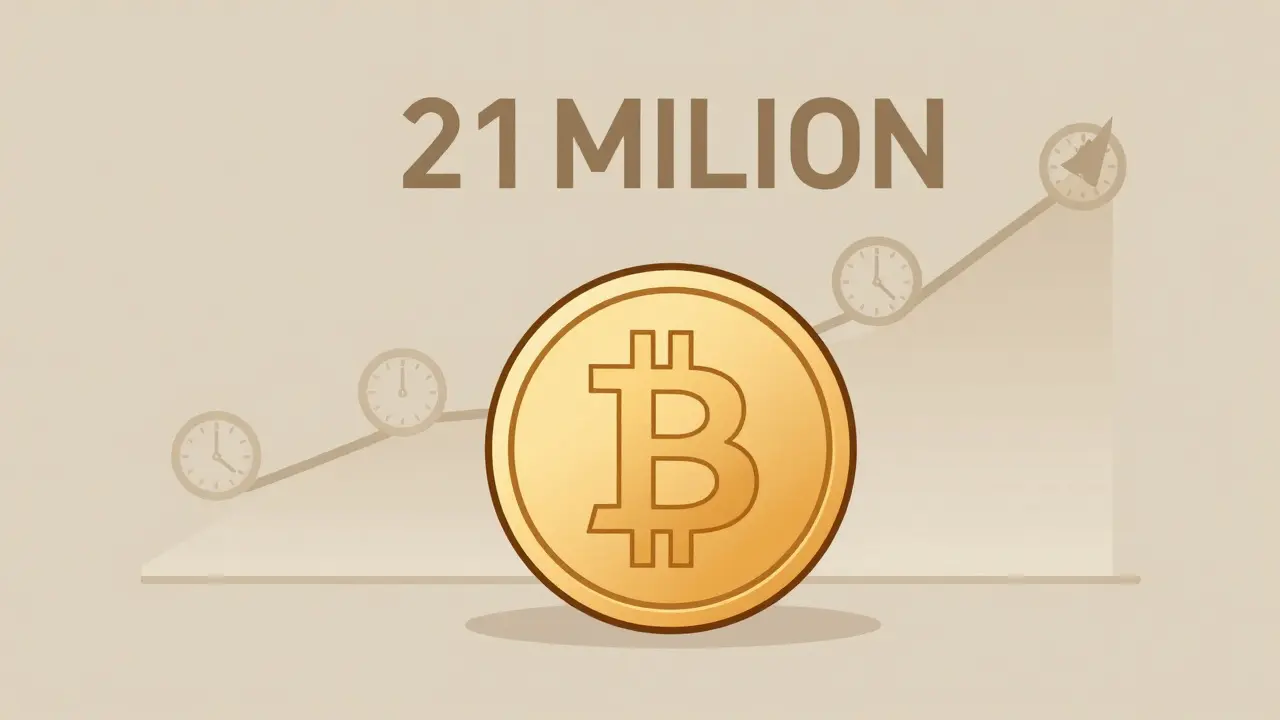
Bitcoin isn’t just the first cryptocurrency - it’s the blueprint for deflationary design. Satoshi Nakamoto coded it with a hard limit of 21 million coins. No more, no less. As of early 2026, about 19.7 million BTC are in circulation. That leaves just over 1.3 million left to mine.
The real deflationary punch comes from halvings. Every 210,000 blocks - roughly every four years - the reward for mining new Bitcoin drops by half. The last one happened in April 2024, cutting the block reward from 6.25 to 3.125 BTC. The next one, in 2028, will drop it to 1.5625 BTC. By 2140, mining will stop entirely. After that, no new coins enter circulation. Supply becomes fixed. Demand, if it keeps growing, will push prices higher.
Bitcoin’s deflationary effect is slow but predictable. Right now, annual supply growth is around 1.8%. After the next halving, it’ll dip below 1%. That’s not a crash. It’s a steady tapering. Investors call it “digital gold” because it mimics the way gold becomes harder to extract over time. Unlike fiat currencies, which lose value every year due to inflation, Bitcoin’s scarcity is programmed.
Binance Coin: The Burn Machine
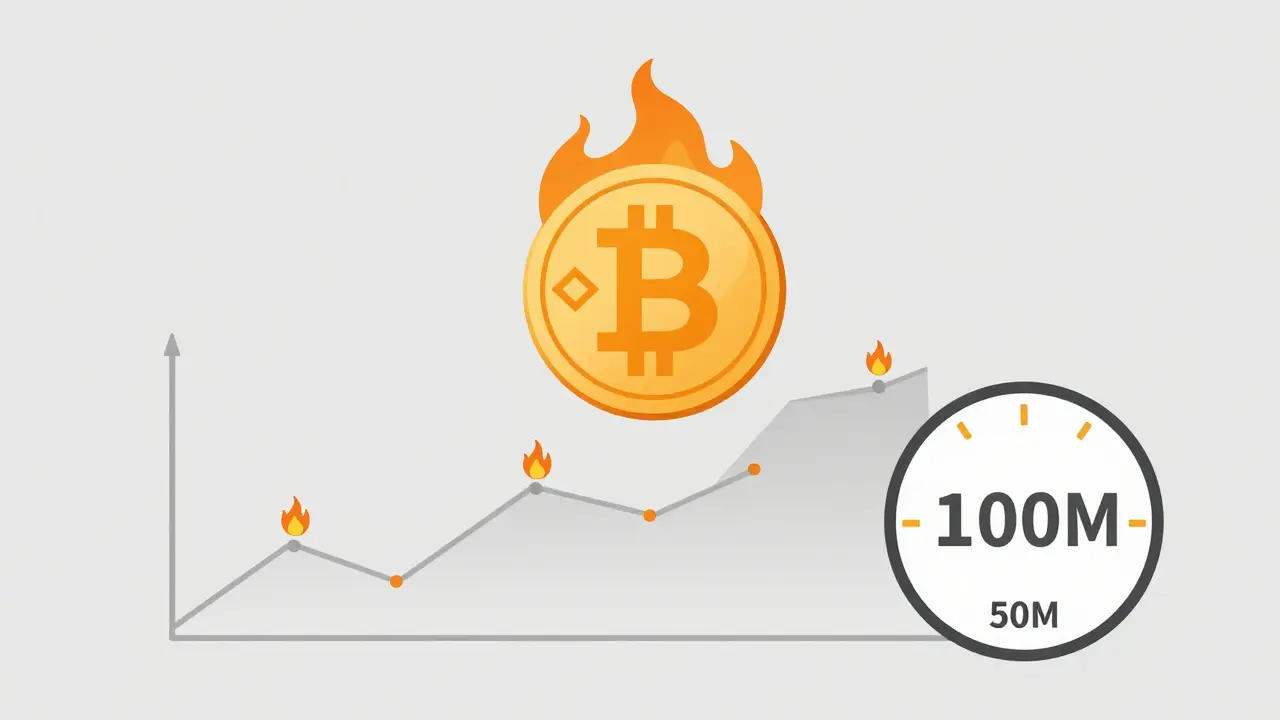
Binance Coin (BNB) doesn’t rely on a fixed cap. Instead, it burns tokens regularly. Binance, the world’s largest crypto exchange, uses 20% of its quarterly profits to buy back BNB from the open market and destroy it. This started in 2017 and was originally planned to continue until 100 million BNB were burned - half the original supply of 200 million.
By Q3 2023, over 48.8 million BNB had been burned. That’s nearly half the way there. In December 2023, Binance announced it was switching to a real-time burn system starting in Q2 2024. Now, instead of waiting three months to burn based on profits, it burns tokens daily based on actual trading volume. More activity = more burns. It’s a direct link between platform usage and token scarcity.
BNB isn’t just a speculative asset. It’s a utility token. Holders get 25% discounts on trading fees, reduced listing fees for new coins, and access to exclusive token sales on Binance Launchpad. That demand keeps the price anchored. The burn mechanism doesn’t just reduce supply - it rewards users who use the ecosystem. That’s why many long-term holders say BNB’s price has outperformed the broader market. One Reddit user who bought BNB in 2019 reported a 1,200% gain despite multiple crypto crashes.
Ethereum: Dynamic Deflation Through Transaction Fees
Ethereum changed everything in August 2021 with EIP-1559. Before that, miners kept all transaction fees. After EIP-1559, a portion of every fee - called the base fee - gets burned. It’s destroyed, gone forever. The amount burned depends entirely on network activity.
During peak times in Q2 2023, Ethereum burned over 1,200 ETH per hour. On quiet days, it was closer to 200 ETH per hour. Between August 2021 and December 2023, over 2.52 million ETH were burned - about 2.1% of the total supply. That’s not a fixed burn. It’s adaptive. When the network is busy, deflation accelerates. When it’s slow, the supply barely changes.
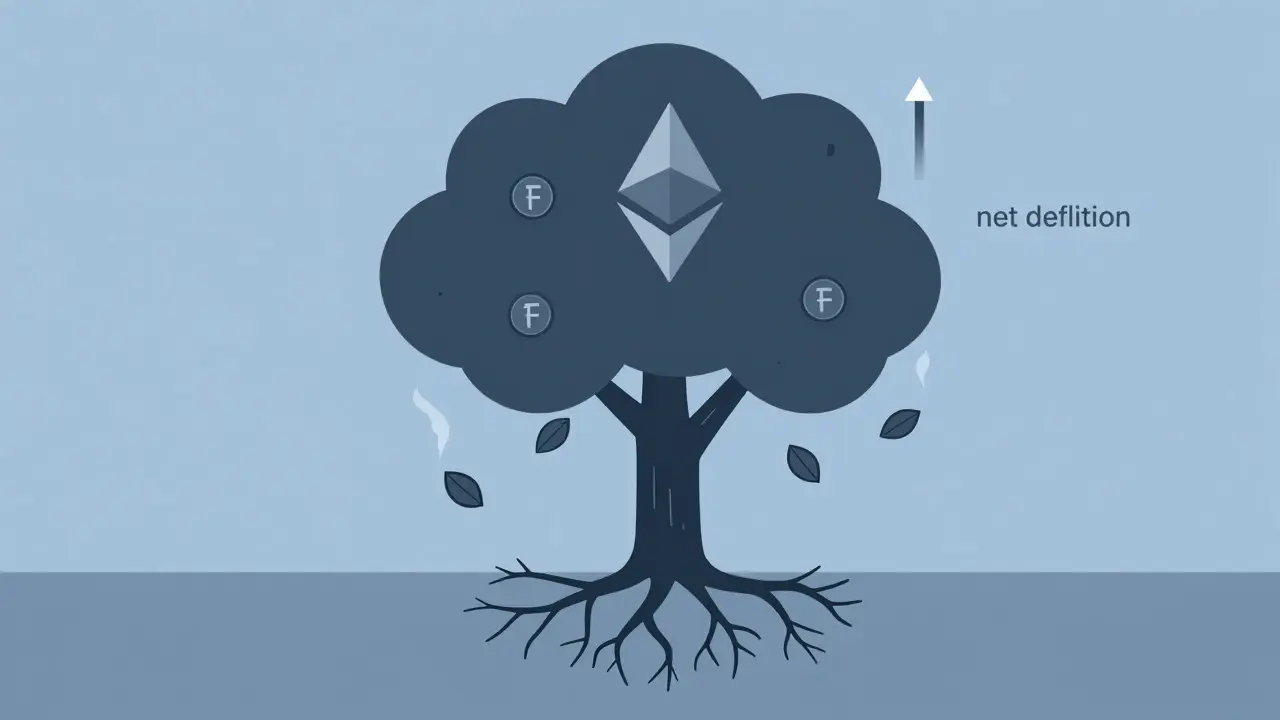
What’s even more powerful? Ethereum’s supply can go negative. If more ETH is burned than minted (through block rewards), the total supply shrinks. That’s happened on 63% of trading days since EIP-1559, according to Delphi Digital. The Dencun upgrade in early 2024 made this even more likely by improving scalability. More transactions = higher fees = more burns. Ethereum isn’t just a blockchain - it’s becoming a deflationary engine powered by usage.
Why Deflationary Cryptocurrencies Are Gaining Traction
In 2022, global inflation hit 9% in the U.S. and over 10% in parts of Europe. Traditional assets like stocks and real estate dipped. Bitcoin, however, rose 39% in real terms against the dollar, according to the IMF. Why? Because people saw it as a hedge - a store of value that couldn’t be diluted by central banks.
Corporate adoption is accelerating. PwC’s 2023 survey found that 42% of Fortune 500 companies now hold deflationary cryptocurrencies in their treasury reserves. Bitcoin makes up 87% of those holdings. Companies like MicroStrategy and Tesla bought Bitcoin not because they expected a quick flip, but because they believed its scarcity would preserve value over decades.
Even central banks are watching. The World Economic Forum’s 2024 report said 68% of central banks are exploring similar scarcity models for their own digital currencies. They’re not copying Bitcoin - they’re borrowing the idea. Deflationary mechanics are becoming a new standard in monetary design.
What Doesn’t Work: The Risks of Small Deflationary Tokens
Not all deflationary coins are created equal. Many small projects promise 5%, 10%, even 20% burn per transaction. On paper, that sounds amazing. In practice, it’s often a trap.
One user on Bitcointalk.org invested $500 in a token with a 5% burn per trade. The problem? Every time they tried to sell, they lost half their position to fees. When the market turned, they couldn’t exit without losing most of their money. High burn rates don’t just reduce supply - they make trading expensive and slow.
Another issue is centralization. Binance controls BNB’s burn. If they stop, the mechanism fails. Bitcoin’s burn is automatic. Ethereum’s is network-driven. Smaller tokens often rely on a single team to trigger burns. If the team vanishes, so does the deflationary promise.
Also, many of these tokens lack real utility. They don’t power a platform, pay fees, or offer discounts. They’re just coins with a burn function. That’s not enough to sustain value long-term.
How to Get Started
If you want to invest in deflationary cryptocurrencies, start with the big three: Bitcoin, Ethereum, and Binance Coin. They have proven track records, transparent mechanisms, and strong ecosystems.
- For Bitcoin: Use a non-custodial wallet like Electrum or BlueWallet. Buy on a reputable exchange like Coinbase or Kraken. Hold long-term. Don’t trade it like a meme coin.
- For Ethereum: Set up a MetaMask wallet. Buy ETH and use it to interact with DeFi apps. The more you use the network, the more ETH gets burned - you’re helping the deflationary cycle just by transacting.
- For BNB: Use Trust Wallet or Binance Wallet. Pay for trading fees with BNB to get the 25% discount. Watch for quarterly burn announcements - they often cause short-term price spikes.
Learning curve? Basic understanding takes 2-4 weeks. Study tokenomics, how burns work, and what drives network usage. Don’t chase tokens with no clear purpose. Stick to projects with real utility and transparent burn schedules.
What’s Next?
The trend is clear. By 2027, 65% of the top 100 cryptocurrencies are expected to have some form of deflationary mechanism, up from 48% in 2023. Bitcoin’s next halving in 2028 will push its annual supply growth below 0.5%. Ethereum’s burn rate could hit 10,000 ETH per day during high-volume periods. Binance’s real-time burn will make its supply drop faster than ever.
Deflationary cryptocurrencies aren’t just a niche trend. They’re a new kind of monetary system - one that doesn’t rely on central authorities, but on code. They reward patience, punish speculation, and value scarcity over endless printing. For investors, that means long-term holding beats short-term trading. For the system, it means stability through design, not control.
Frequently Asked Questions
Are all cryptocurrencies deflationary?
No. Most cryptocurrencies are inflationary, meaning new coins are continuously created. Examples include Dogecoin and Litecoin, which have no hard supply cap and keep minting new coins indefinitely. Deflationary coins are the exception - they either cap supply, burn tokens, or both. Only about 47% of the total crypto market cap is deflationary as of early 2026.
Can a deflationary cryptocurrency lose value?
Yes. Scarcity doesn’t guarantee price increases. If demand falls - because of regulatory crackdowns, loss of trust, or better alternatives - even a shrinking supply won’t help. Bitcoin dropped over 60% in 2022 despite its deflationary design. Deflationary mechanics help protect value over the long term, but they don’t eliminate market risk.
Is Ethereum really deflationary?
It depends on network usage. Since EIP-1559, Ethereum has been net deflationary on 63% of days since 2021. When gas fees are high (above 35 gwei), more ETH is burned than created. During low-traffic periods, the supply grows slightly. But overall, the trend is downward. Ethereum isn’t deflationary every day - but it’s deflationary more often than not.
Why does Binance burn BNB tokens?
Binance burns BNB to create scarcity and reward holders. By reducing supply, they increase the value of remaining tokens. It also aligns incentives - users who hold BNB benefit from both lower fees and rising value. The burn program is transparent, with public records of every burn event. It’s one of the most reliable deflationary mechanisms in crypto.
Should I invest in small deflationary tokens with high burn rates?
Avoid them unless you fully understand the risks. Many are scams or poorly designed. High burn rates often come with high transaction fees, making trading impractical. They usually lack real-world utility, and the burn schedule may be controlled by a single team that can stop it anytime. Stick to Bitcoin, Ethereum, and BNB until you’ve studied tokenomics in depth.