Legal Status of Cryptocurrencies in Russia: 2026 Regulations and Restrictions
 Nov, 3 2026
Imagine trying to buy coffee in Moscow with Bitcoin today. You’d likely face a fine, or worse, have the transaction reversed by your bank. Yet, just a few kilometers away, a large corporation might be settling a billion-ruble trade deal with a foreign partner using the very same cryptocurrency. This paradox defines the legal status of cryptocurrencies in Russia. It is not a simple ban, nor is it free-market adoption. Instead, it is a tightly controlled, two-tier system where the wealthy play by different rules than everyone else.
As of late 2025 and heading into 2026, Russia’s approach has shifted from outright hostility to selective liberalization. The government wants the benefits of blockchain for international trade-especially to bypass Western sanctions-but refuses to let decentralized coins threaten the dominance of the Russian ruble at home. If you are an investor, a business owner, or just curious about how this works, understanding these nuances is critical. One wrong move could freeze your assets or land you in legal trouble.
The Two-Tier System: Who Can Actually Trade?
For years, the narrative was that crypto was banned. That’s only half true. Buying and holding are legal; spending is largely prohibited. But in 2024 and 2025, the Bank of Russia introduced a game-changer: the "experimental legal regime." This framework allows cryptocurrency transactions, but only for a specific group called "especially qualified" investors.
Who qualifies? The bar is incredibly high. An individual must demonstrate:
- Investments in securities and deposits exceeding ₽100 million (roughly $1.1 million USD).
- Annual income exceeding ₽50 million (roughly $550,000 USD).
Companies must meet existing qualified investor standards under Russian law. For these elite players, trading Bitcoin, Ethereum, and other major assets is now structured and regulated. They can access derivatives and digital financial assets linked to crypto values. For everyone else-the average citizen-crypto remains in a gray zone. You can own it, mine it, and hold it in a wallet, but you cannot legally use it to pay for goods or services within Russia. The law explicitly states that only the ruble (and soon its digital version) is legal tender.
Why the Strict Ban on Domestic Payments?
You might wonder why the Central Bank is so stubborn. Their reasoning centers on monetary sovereignty. They view private cryptocurrencies as "money surrogates" that lack state guarantee and suffer from extreme volatility. If millions of Russians started pricing their apartments in Bitcoin, the Central Bank would lose control over inflation and interest rates.
This fear drove the development of the digital ruble, a Central Bank Digital Currency (CBDC). Trials began in 2023, and public implementation is scheduled to start in September 2026. The message from Moscow is clear: we want digital money, but we want our digital money. The digital ruble will allow for programmable payments and faster settlements without the decentralization risks of Bitcoin. Until then, domestic crypto payments remain strictly off-limits for ordinary residents.
The Loophole: Crypto for International Trade
While domestic payments are restricted, cross-border trade tells a different story. Since 2022, Western sanctions have cut many Russian banks out of the SWIFT system. Enter cryptocurrency. By 2025, crypto-facilitated international trade had reached a staggering 1 trillion rubles annually.
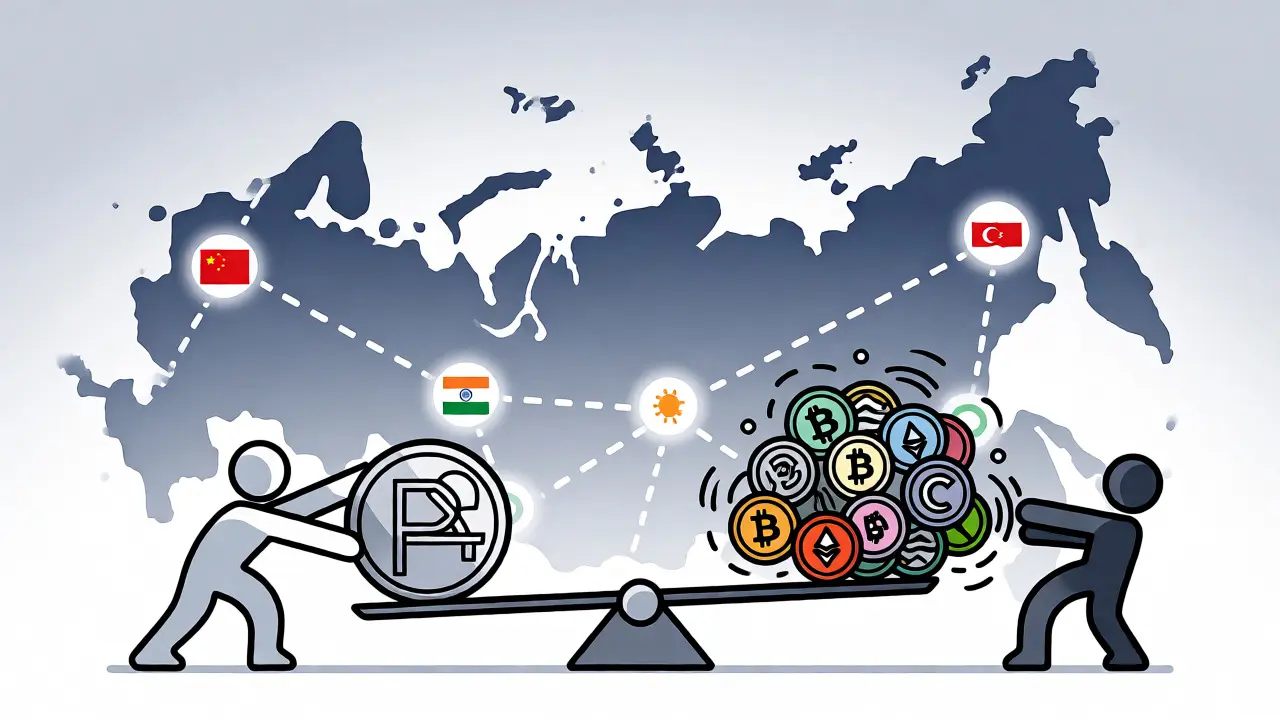
The experimental legal regime permits companies to use cryptocurrencies for settlements with foreign partners. This isn’t open to everyone; it requires strict compliance checks and reporting to the Federal Tax Service. But it has become a vital lifeline for industries like energy, agriculture, and metals. Instead of waiting weeks for wire transfers that might get blocked, firms settle deals in stablecoins or Bitcoin directly. This strategic use of crypto helps Russia maintain economic ties with China, India, and Turkey, even while keeping its internal currency market insulated.

Mining: The Only Fully Legal Activity for Everyone
If you’re not a millionaire, is there any way to engage with crypto legally? Yes: mining. In 2024, Russia officially legalized cryptocurrency mining, moving it out of the shadows. Before this, miners operated in a legal vacuum, often facing raids or unclear tax obligations.
Now, registered miners operate under specific guidelines. They must report their output and pay taxes on profits. The government sees mining as a way to monetize excess electricity capacity, particularly in regions like Siberia where power is cheap. However, this doesn’t mean miners can freely sell their coins domestically. Most export their mined assets to satisfy the demand from those "especially qualified" investors or foreign buyers. So, while mining is legal, the liquidity cycle is still heavily influenced by who is allowed to buy.
Regulatory Tensions: Treasury vs. Central Bank
Behind the scenes, there’s a tug-of-war between two powerful institutions. The Central Bank of Russia, led by Elvira Nabiullina, maintains a hawkish stance. They warn repeatedly about the risks of unregulated crypto markets, citing potential bubbles and fraud. They prefer the controlled environment of the digital ruble and limited access for sophisticated investors.
On the other side is the Ministry of Finance (the Treasury). Officials like Deputy Head Ivan Chebeskov argue for a more liberal approach. They see crypto as a tool for economic modernization and attracting investment. In September 2025, the Treasury recommended easing requirements for qualified investor status to broaden market access. While they haven’t won the argument entirely, their influence is growing. We’re seeing gradual steps toward allowing more retail participation, likely through exchange-traded funds (ETFs) or digital financial assets rather than direct coin ownership.
What Happens If You Break the Rules?
Enforcement has tightened. Recent legislative amendments target financial fraud, but they also catch casual crypto users. If you try to pay for a car in Bitcoin as a regular citizen, you risk fines. Banks are instructed to monitor suspicious transactions. If a transfer looks like a disguised crypto payment, they may block it or ask for proof of origin.
There’s also the issue of taxation. All crypto gains are taxable income. Failure to declare holdings can lead to penalties. The government uses data analytics to track flows, especially since the introduction of the experimental regime requires detailed reporting. Don’t assume that because crypto is "decentralized," it’s invisible to the Russian tax authority. It’s not.
Future Outlook: What’s Next for 2026 and Beyond?
The current framework is an experiment, literally. The three-year pilot period gives regulators time to observe market behavior before writing permanent laws. Expect continued evolution, but don’t expect a full free-for-all anytime soon.
Key trends to watch include:
- Digital Ruble Launch: As the CBDC rolls out in late 2026, it will compete directly with stablecoins for domestic utility.
- Stablecoin Regulation: Discussions are ongoing about regulating fiat-pegged tokens like USDT and USDC. These are less volatile than Bitcoin and might get clearer rules sooner.
- Retail Access: The Treasury will likely push for lower thresholds for qualified investors, potentially opening the door to middle-class investors via managed products.
Russia’s strategy is one of containment and utilization. They want the geopolitical leverage of crypto for trade and the technological edge of blockchain, but they refuse to cede monetary control. For now, if you live in Russia, treat crypto as an asset class for the wealthy and a tool for exporters-not as everyday cash.
| Activity | Regular Citizen | Especially Qualified Investor | Corporations (Exporters) |
|---|---|---|---|
| Buying/Holding | Legal (Gray Area) | Legal & Regulated | Legal & Regulated |
| Domestic Payments | Prohibited | Restricted/Experimental | Prohibited |
| International Settlements | Difficult/Unofficial | Permitted under Experiment | Permitted & Encouraged |
| Mining | Legal (if registered) | Legal | Legal |
| Derivatives Access | No | Yes | Yes |
Is Bitcoin illegal in Russia?
No, Bitcoin is not illegal to own or trade. However, using it as a means of payment for goods and services within Russia is prohibited for most citizens. Only "especially qualified" investors can legally participate in certain crypto transactions under the experimental legal regime.
Can I pay for groceries with crypto in Moscow?
Generally, no. The Russian ruble is the sole legal tender. While some merchants might unofficially accept crypto, doing so carries regulatory risks for both parties. The law mandates that domestic settlements be made in rubles.
What is an "especially qualified" investor?
This is a new category created for the crypto experimental regime. Individuals need investments/deposits over ₽100 million and annual income over ₽50 million. Companies must meet standard qualified investor criteria. This status grants legal access to crypto trading and derivatives.
Is crypto mining legal in Russia?
Yes, mining was legalized in 2024. Miners must register with the government and pay taxes on their earnings. It is currently the most accessible way for ordinary Russians to interact with the crypto economy legally.
When will the digital ruble launch?
Public implementation of the digital ruble is scheduled to begin in September 2026. It is expected to coexist with cash rubles but will eventually aim to replace them for digital transactions.
Can foreigners use crypto in Russia?
Foreigners face similar restrictions to locals regarding domestic payments. However, they may find it easier to use crypto for cross-border remittances or when dealing with businesses that accept it internationally, though local merchant acceptance remains low.