Optional vs Mandatory NFT Royalties: Which Model Wins for Creators?
 Apr, 30 2026
Imagine selling a piece of art today and getting a check every single time that painting changes hands for the next fifty years. That was the big promise of the NFT boom. By baking a royalty percentage directly into the code, artists were told they'd finally escape the "one-and-done" payment model of the traditional art world. But as the market matured, a messy war broke out between the people making the art and the people trading it.
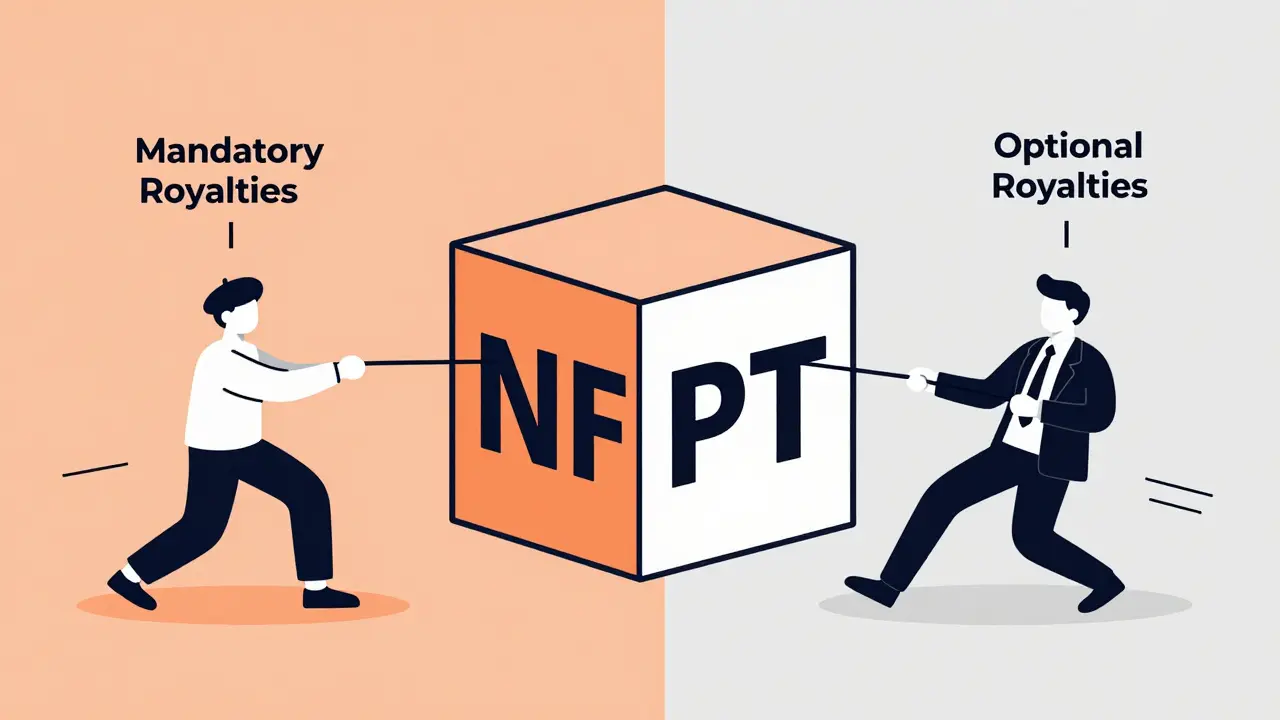
The fight boils down to a simple question: are NFT royalties is payments made to original creators for every secondary sale of their digital assets a binding contract or just a polite suggestion? If you're a creator, you likely want them mandatory. If you're a trader looking to flip a Bored Ape for a profit, you probably want them optional. This tension has split the Web3 world into two camps, each using different technical tricks to win the game.
The Tech Behind the Money
To understand the fight, you first need to understand how the plumbing works. Most NFTs use the ERC-721 or ERC-1155 standards. These tell the blockchain that a token is unique, but they don't actually "force" a payment to the creator when a sale happens on a third-party website. For a long time, royalties were handled "off-chain," meaning the marketplace (like OpenSea) simply agreed to collect the fee and send it to the artist.
To fix this, the ERC-2981 standard was introduced. This is essentially a universal way for an NFT to tell any marketplace, "Hey, the creator of this piece gets 6% of the sale price." By moving the royalty logic on-chain, creators hoped to make their earnings independent of which platform was being used. However, as it turns out, a smart contract can say what should happen, but it can't always stop a marketplace from simply ignoring the request.
The Mandatory Model: Protecting the Artist
The mandatory approach treats royalties as a non-negotiable part of the asset's value. In this model, the marketplace refuses to process a sale unless the creator's fee is paid. This is the "creator-first" philosophy. The goal is to ensure a sustainable revenue stream, usually ranging between 5% and 10%, which allows artists to keep producing work without needing a massive initial sale to survive.
Platforms like OpenSea have tried to lean into this by developing tools that block royalty-evading platforms. They argue that without guaranteed royalties, the original value proposition of NFTs is dead. If a collector can just bypass the fee, the NFT becomes just another JPEG rather than a revolutionary financial tool for artists. The trade-off here is liquidity; when fees are forced, some traders move their assets to cheaper, "wild west" platforms where the rules don't apply.
The Optional Model: Prioritizing the Trade
On the other side of the ring, you have marketplaces like Blur. They view royalties as a friction point. In the optional model, the buyer or seller can decide whether to pay the creator or set the royalty to 0%. This approach prioritizes trading volume and market efficiency over artist compensation.
Proponents of this model argue that mandatory fees artificially inflate prices and kill the momentum of a collection. If every flip costs an extra 7%, the asset becomes less attractive to high-frequency traders. In this ecosystem, royalties are treated more like a tip or a donation. If you truly value the artist, you'll pay them; if you're just speculating on a price chart, you won't. It's a cold, market-driven approach that favors the "whales" over the creators.
| Feature | Mandatory Model | Optional Model |
|---|---|---|
| Primary Goal | Creator sustainability | Trading liquidity & volume |
| Enforcement | Marketplace-level blocking / On-chain checks | User-defined / Voluntary |
| Impact on Volume | Lower (higher cost to trade) | Higher (lower cost to trade) |
| Creator Income | Consistent and predictable | Volatile and based on "goodwill" |
| Typical Platforms | Creator-focused boutiques | Trader-centric platforms (e.g., Blur) |
The Legal and Philosophical Gray Area
Here is the kicker: just because it's in the code doesn't mean it's a legal contract. Blockchain experts and attorneys have pointed out that Smart Contracts aren't actually legal contracts in the traditional sense. If a marketplace ignores an ERC-2981 request, the artist currently has very little legal recourse to sue for those lost funds. The "code is law" mantra works great until the code is being ignored by the person holding the keys to the storefront.
Even some of the biggest names in the space, like the artist Beeple, have suggested that fighting this technologically is a losing battle. The argument is that no matter how many blocks or filters a platform creates, there will always be a way to move a token without paying the fee. The only real solution is building a community of collectors who *want* to support the artist, regardless of whether the software forces them to.

Which Path Should Creators Take?
If you're minting a collection today, you're facing a tough choice. If you enforce strict royalties, you protect your long-term income, but you might find that your NFTs don't trade as often because speculators avoid your project. If you make royalties optional, you'll likely see more activity and a higher floor price due to increased liquidity, but you're essentially gambling on the generosity of strangers.
Some are now trying a hybrid approach. They set a reasonable royalty (around 2.5% to 5%) to stay competitive while still capturing some value. Others are moving away from the "percentage of sale" model entirely and focusing on providing ongoing utility or airdrops to holders, creating value that doesn't rely on a secondary sale happening at all.
Can a creator actually force royalties on all platforms?
Technically, it's very difficult. While standards like ERC-2981 provide a way to signal royalty requirements, the actual transfer of funds is handled by the marketplace. If a marketplace chooses to ignore the smart contract's signal and not charge the buyer, the creator cannot "force" the money out of the buyer's wallet without the marketplace's cooperation.
What is the average NFT royalty percentage?
Most creators set their royalties between 5% and 10%, though 6% has emerged as a common industry average. However, as the "royalty wars" continue, many creators are lowering their fees to 2.5% or even 0% to attract more traders and increase the overall volume of their collections.
Why do traders prefer optional royalties?
Traders focus on the "spread" or the profit margin between buying and selling. A 10% royalty fee acts as a tax on every transaction, which eats into their profits and makes the asset less liquid. By removing this fee, the cost of flipping an NFT drops, encouraging more frequent trades and faster price discovery.
Does ERC-2981 solve the royalty problem?
It solves the communication problem, but not the enforcement problem. ERC-2981 creates a standardized way for an NFT to tell any platform how much the royalty should be, which prevents creators from having to set different rates on five different websites. However, it still relies on the marketplace to actually execute the payment.
Are NFT royalties legally binding?
In most jurisdictions, the answer is "it's complicated." Most smart contracts are not viewed as traditional legal contracts by courts. While a creator might have a claim based on terms of service or specific agreements, enforcing a digital royalty payment through a traditional lawsuit is currently a legal gray area with very few precedents.
What to Do Next
If you're an artist, don't just set a random percentage and hope for the best. Look at where your primary collectors are trading. If your audience is mostly "diamond hand" collectors who love your work, mandatory royalties will likely be respected. If you're targeting the high-speed trading crowd, a lower or optional fee might be the only way to keep your collection moving.
Keep an eye on new marketplace tools that offer "royalty registries." These are attempts to create a master list of creators that platforms can use to verify payments. While not a perfect fix, they represent the next step in the attempt to bridge the gap between creator rights and market efficiency.