Terraformer Crypto Exchange Review: What You Need to Know in 2026
 Mar, 20 2026
There’s no such thing as a crypto exchange called Terraformer. Not in any official database, not in any major review site, and not in any regulatory filing as of March 2026. If you’re searching for it, you’ve probably seen an ad, a forum post, or a YouTube video pushing it as the "next big thing." But here’s the truth: Terraformer isn’t a real exchange. It’s either a scam, a typo, or a confusion with something else entirely.
Where Did "Terraformer" Come From?
The name sounds like it belongs to the crypto world-smooth, techy, futuristic. That’s no accident. It’s clearly meant to sound like Terraform Labs, the real company behind the Terra blockchain. Terraform Labs, founded in 2018 by Do Kwon and Daniel Shin, built a blockchain network that handled stablecoins like UST and LUNA. It wasn’t a trading platform. It didn’t let you buy Bitcoin or sell Ethereum. It was a protocol-a set of rules that powered decentralized finance apps.
Terraform Labs raised $32 million from big names like Coinbase Ventures and Pantera Capital. Their blockchain processed $2 billion in transactions every month. Transactions finished in under six seconds. Fees were tiny compared to Ethereum or Bitcoin. It was fast, cheap, and popular. But Terraform Labs never ran a crypto exchange. They didn’t hold your coins. They didn’t match buy and sell orders. That’s not what they did.
Now, someone took "Terra" and slapped on "former"-maybe thinking it sounds like "transformer"-and created a fake exchange called "Terraformer." It’s a classic scam tactic: borrow a trusted name, tweak it slightly, and hope people don’t notice.
Why This Matters: The Danger of Fake Exchanges
In 2025, over 1,200 new crypto scams were reported to global fraud databases. Many of them used names that sounded like real platforms. "Binance Plus," "Coinbase Pro X," "KuCoin Vault"-you name it. These sites look real. They have logos, fake testimonials, even live chat support. But they’re all designed for one thing: stealing your money.
If you deposit Bitcoin or Ethereum into a fake exchange like "Terraformer," here’s what happens:
- Your deposit disappears-no confirmation, no transaction hash, no trace.
- The "customer service" team stops replying after you send funds.
- The website vanishes or redirects to a phishing page.
- You get no refunds. No legal recourse. No regulatory body to turn to.
There are no user reviews for "Terraformer" because no one has used it legitimately. Any "review" you find is either written by a bot, paid by scammers, or copied from another fake site. That’s how these operations work-they recycle content to look real.
What You Should Be Looking For
If you’re looking for a real crypto exchange in 2026, here’s what actually matters:
- Regulation: Does the exchange hold a license from a recognized authority like the FCA (UK), ASIC (Australia), or NYDFS (New York)?
- Fees: Kraken charges around 0.25% per trade. Revolute X starts at 0.09%. Coinbase? Often over 1% with hidden spreads.
- Liquidity: Can you trade large amounts without the price moving wildly? Top exchanges like Bybit and Kraken have deep order books.
- Custody: Do they store your coins in cold wallets? Do they offer two-factor authentication and withdrawal whitelisting?
- Transparency: Can you see their proof-of-reserves? Do they publish regular audits?
Real exchanges don’t need flashy names. They don’t promise 10x returns. They build trust over time. Bybit offers a $30,000 bonus for new users in 2026. That’s a real promotion. It’s not a trap. It’s a marketing tactic from a licensed, audited platform with millions of users.
Terraform Labs vs. "Terraformer"
Let’s clear up the confusion once and for all:
| Feature | Terraform Labs | "Terraformer" |
|---|---|---|
| Type | Blockchain protocol | Fake crypto exchange |
| Founded | 2018 | Unknown (likely 2025) |
| Headquarters | South Korea | None (likely offshore) |
| Regulated | No (but partnered with regulated firms) | No |
| Trading | None | Claimed (but fake) |
| Users | Over 2 million | Zero |
| Status | Active (post-LUNA collapse) | Scam |
Terraform Labs is still around. After the collapse of UST in 2022, they restructured. They’re working on new blockchain projects. But they’re not running a trading platform. And they’ve never used the name "Terraformer."
What to Do If You’ve Already Deposited
If you sent crypto to a site called "Terraformer," stop everything. Don’t send more. Don’t respond to their "support" team. They’re not trying to help-they’re trying to get more.
Here’s what to do next:
- Take screenshots of the website, transaction IDs, and any messages.
- Report it to your country’s financial fraud authority (e.g., FTC in the U.S., Action Fraud in the UK).
- Notify your wallet provider-some have fraud teams that can flag the address.
- Share your experience on Reddit, Trustpilot, or CryptoScamDB. Others might be at risk.
Recovery is rare. But reporting helps authorities track patterns and shut down these operations before they hurt more people.
How to Spot a Fake Crypto Exchange
Here are five red flags that mean a crypto platform is fake:
- It has no clear company address or legal entity listed.
- Its "about us" page is vague or copied from another site.
- It promises guaranteed returns or "risk-free" trading.
- It doesn’t allow you to withdraw funds without extra fees or "verification" steps.
- You can’t find independent reviews on CoinGecko, CoinMarketCap, or Reddit.
Real exchanges don’t need to trick you. They compete on fees, security, and features. If a site feels too good to be true, it is.
Legit Alternatives to "Terraformer"
If you want a real exchange in 2026, here are three trusted options:
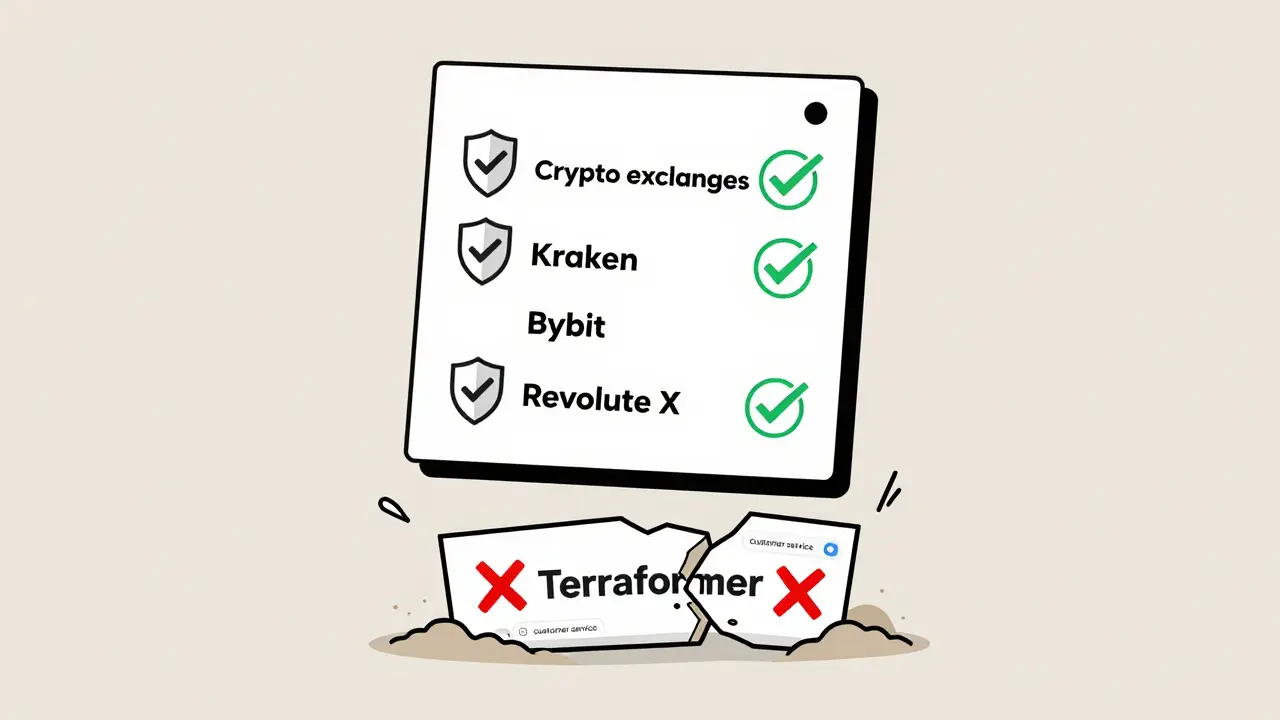
- Kraken: Known for low fees (as low as 0.16% for high-volume traders), strong security, and full regulatory compliance in the U.S. and EU.
- Bybit: Popular for derivatives trading, offers a $30,000 bonus, and has over 20 million users.
- Revolute X: For beginners in Europe, fees start at 0.09%, and it’s backed by a licensed financial institution.
All three are listed on CoinMarketCap and CoinGecko. All three have public audits. All three have been around for years. None of them use names that sound like typos.
Final Warning
The crypto space is full of opportunities-but also full of predators. Scammers know that people want to get rich fast. They use names like "Terraformer" to exploit trust. They prey on confusion. They count on you not double-checking.
Don’t be the next victim. Always verify before you invest. Google the exact name. Check CoinMarketCap. Look for regulatory licenses. Read user reports on independent forums. If you can’t find clear, verifiable information, walk away.
Terraformer doesn’t exist. But the people behind it are very real-and very dangerous.
Is Terraformer a real crypto exchange?
No, Terraformer is not a real crypto exchange. There is no official platform by that name registered with any financial authority, listed on major crypto databases, or backed by verifiable user reviews. The name appears to be a scam designed to confuse users with Terraform Labs, the company behind the Terra blockchain.
What is Terraform Labs?
Terraform Labs is a blockchain company founded in 2018 that created the Terra network-a decentralized platform for stablecoins and DeFi applications. It is not a crypto exchange. It does not allow users to buy or sell cryptocurrencies directly. Its most well-known product was the UST stablecoin, which collapsed in 2022. The company continues to develop new blockchain projects but does not operate any trading platform.
Why do people think Terraformer is real?
Scammers use names that sound similar to well-known brands to trick users. "Terraformer" sounds like "Terraform Labs," which was a legitimate and widely discussed company. Fake websites copy logos, use AI-generated testimonials, and create fake social media profiles to appear authentic. Many users don’t check beyond the name and assume it’s real.
Can I recover my money if I sent crypto to Terraformer?
Recovery is extremely unlikely. Once crypto is sent to a scam exchange, it’s typically moved instantly through mixing services or converted into untraceable assets. Your best action is to report the incident to your country’s fraud authority and share details on public scam databases like CryptoScamDB. This helps others avoid the same trap.
How do I find a safe crypto exchange in 2026?
Look for exchanges that are regulated by recognized authorities like the FCA, ASIC, or NYDFS. Check if they publish proof-of-reserves, offer two-factor authentication, and have transparent fee structures. Use CoinMarketCap or CoinGecko to verify their listing. Avoid any platform that promises high returns, has no clear address, or pressures you to deposit quickly.