What is SingularityNET (AGIX) Crypto Coin: A Complete Guide
 Aug, 24 2026
Imagine a world where you don't need to build an entire data center to run powerful artificial intelligence. Instead, you just pay a small fee in SingularityNET tokens to access the best AI models from developers around the globe. That is the core promise of this project. It is not just another cryptocurrency; it is a marketplace designed to make advanced AI accessible to everyone, from researchers to small businesses.
If you have seen the ticker symbol AGIX popping up in news feeds or trading charts, you might be wondering what makes it different from Bitcoin or Ethereum. The short answer is utility. While many coins are speculative assets, AGIX has a specific job to do: facilitate transactions within a decentralized AI network. Let's break down exactly how it works, why it matters, and what you need to know before getting involved.
Key Takeaways
- SingularityNET is a decentralized platform that allows users to buy and sell AI services using the AGIX token.
- The project was founded by Dr. Ben Goertzel and launched in December 2017, raising $36 million in its initial offering.
- AGIX functions as both a payment method for AI services and a governance token for community decision-making.
- The platform combines Neural Networks with Knowledge Graphs to create more reliable and structured AI solutions.
- Recent developments include a merger with Fetch.ai and Ocean Protocol to form the Artificial Superintelligence Alliance.
What Exactly is SingularityNET?
At its heart, SingularityNET is a blockchain-based platform for artificial intelligence that enables users to create, share, and monetize AI services through a globally accessible AI marketplace. Think of it as an app store, but specifically for AI algorithms. In a traditional setup, if you want to use a complex language model or image recognition tool, you often have to rely on big tech companies like Google or Microsoft. They set the prices, they control the data, and they decide who gets access.
SingularityNET flips this model. Here, independent developers can publish their AI tools directly to the network. Users can then browse these tools, test them out, and pay for usage directly with AGIX tokens. This removes the middleman. The transparency comes from the blockchain infrastructure, which ensures that every transaction between a service provider and a consumer is recorded securely. There is no central authority deciding who can list their AI; anyone with a working algorithm can join the marketplace.
Understanding the AGIX Token
You cannot discuss the platform without understanding its native currency, AGIX. Originally launched as "AGI" in 2017, the token was renamed after migrating to the Cardano blockchain, though it still operates on Ethereum as an ERC-20 token. This multichain nature means you can hold AGIX in wallets compatible with either network, providing flexibility for users.
The token serves three main purposes:
- Payment: It is the primary way to buy AI services on the marketplace. If you want to run a translation API or analyze medical images, you pay in AGIX.
- Governance: Holders can vote on important decisions regarding the future of the ecosystem. This gives the community a direct say in how the platform evolves.
- Staking: Users can lock their AGIX in smart contracts to support network stability. In return, they earn rewards. Currently, staking periods are typically 30 days, incentivizing long-term holding rather than quick speculation.
One thing to note is that AGIX is not mined like Bitcoin. All tokens were pre-minted during the initial launch. The maximum supply is capped at 2 billion units. As of recent data, about 1.2 billion are in circulation. This fixed supply helps prevent inflation, ensuring that the token's value isn't diluted by new issuance over time.
How the Technology Works: Hybrid AI Approach
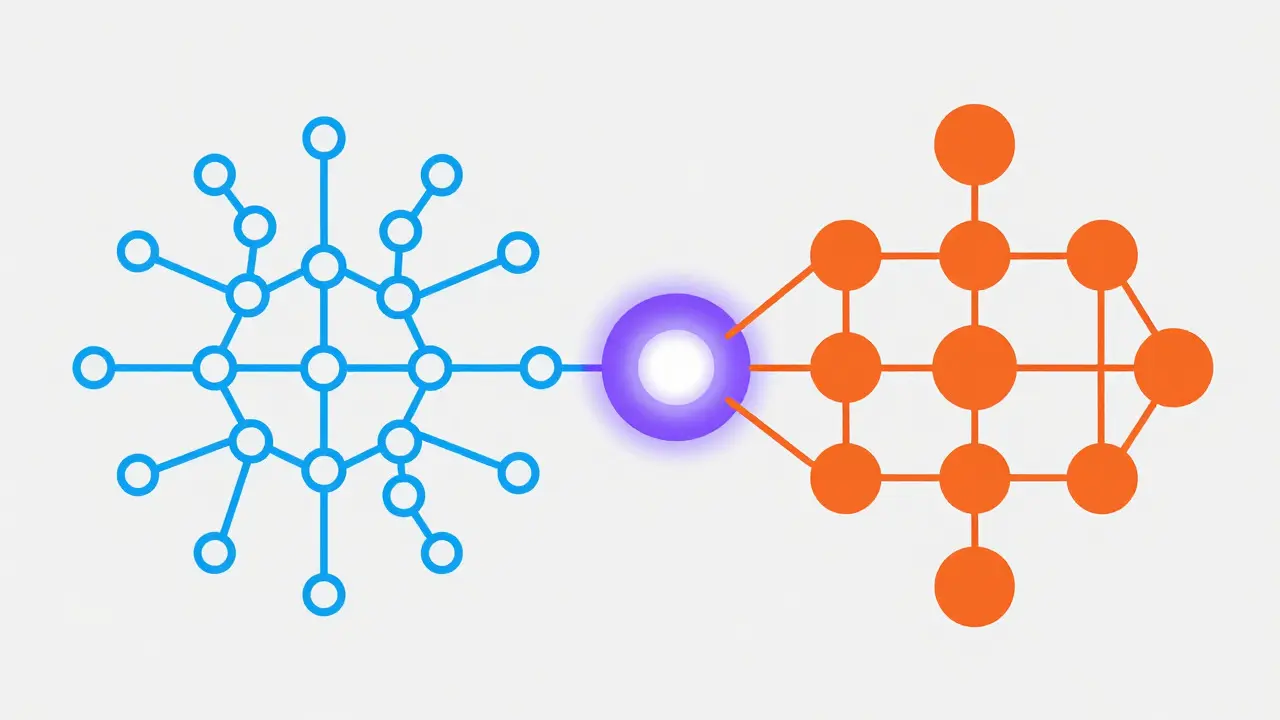
Most people associate AI with Large Language Models (LLMs), the technology behind chatbots. While SingularityNET supports LLMs, it takes a different technical approach called a hybrid approach combining Knowledge Graphs and Neural Symbolic tools with Large Language Models.
Why does this matter? Pure neural networks, while impressive, can sometimes "hallucinate" or give incorrect answers because they rely purely on pattern recognition. By integrating Knowledge Graphs-structured databases of facts-SingularityNET enriches the neural networks with verified information. This makes the AI outputs more accurate, transparent, and easier to debug. For industries like healthcare or finance, where precision is critical, this structural advantage is a significant selling point.
The platform also hosts Sophia, described as the world's most expressive robot. Sophia acts as a flagship project, demonstrating the potential of the platform to handle human-like interaction. Beyond Sophia, the team is developing "OpenCog," an AI framework aimed at achieving advanced general intelligence. This long-term vision positions SingularityNET not just as a current marketplace, but as foundational infrastructure for the next generation of AI.
Market Position and Recent Developments
The landscape of decentralized AI is changing rapidly. A major shift occurred with the announcement of a merger between SingularityNET, Fetch.ai, and Ocean Protocol. Together, they are forming the Artificial Superintelligence Alliance (ASI). The goal is to unify their efforts and potentially merge their tokens into a single asset. This consolidation aims to create a stronger, more competitive force against centralized AI giants.
For investors and users, this merger represents both opportunity and uncertainty. On one hand, combining resources could accelerate development and adoption. On the other hand, token mergers can be complex processes that affect liquidity and price volatility. Analysts suggest that the success of this alliance will heavily influence AGIX's market dynamics in the coming years.
| Feature | Centralized AI (e.g., Big Tech) | SingularityNET (Decentralized) |
|---|---|---|
| Access Control | Limited by company policy | Open to all developers/users |
| Payment Method | Fiat currency/Credit cards | AGIX Cryptocurrency |
| Data Ownership | Often owned by platform | User-controlled via blockchain |
| Transparency | Proprietary algorithms | Transparent on-chain transactions |
| Innovation Speed | Slower due to bureaucracy | Faster via open competition |
How to Get Started with AGIX
If you are interested in participating, the process is straightforward. First, you need a digital wallet that supports Ethereum or Cardano, such as MetaMask or Daedalus. Once your wallet is set up, you can purchase AGIX on major cryptocurrency exchanges. Look for reputable platforms that list the token to ensure security.
After acquiring AGIX, you have two main options:
- Use the Marketplace: Visit the SingularityNET portal to browse available AI services. You can test free versions or subscribe to paid APIs using your tokens.
- Stake for Rewards: If you believe in the long-term growth of the project, you can stake your AGIX. This involves locking your tokens in a smart contract for a set period. In exchange, you earn additional AGIX as a reward. Remember, longer staking periods generally offer higher returns, so plan your liquidity needs accordingly.
Keep in mind that crypto markets are volatile. The price of AGIX can fluctuate significantly based on broader market trends and specific project news. Always do your own research and only invest what you are comfortable losing.
Future Outlook and Challenges
The road ahead for SingularityNET is promising but not without hurdles. The primary challenge is adoption. To succeed, the platform needs more developers to list high-quality AI services and more users to consume them. The merger with Fetch.ai and Ocean Protocol is a strategic move to boost visibility and utility, but execution is key.
Additionally, the race toward Artificial General Intelligence (AGI) is intense. If centralized players release breakthrough AI models that are cheap and easy to use, the value proposition of a decentralized alternative might weaken. However, SingularityNET's focus on transparency, user ownership, and hybrid AI techniques offers a unique niche. As the demand for explainable and reliable AI grows, the platform's technical architecture could become a major differentiator.
For now, AGIX remains a vital component of the decentralized AI ecosystem. Whether you are a developer looking to monetize your algorithms or an investor betting on the future of open-source AI, understanding the mechanics of this platform is essential. The intersection of blockchain and AI is one of the most exciting frontiers in tech, and SingularityNET is firmly positioned at the center of it.
Can I mine AGIX like Bitcoin?
No, AGIX is not mined. All tokens were pre-minted during the initial launch in 2017. You can acquire AGIX by buying it on exchanges or earning it through staking rewards.
What is the maximum supply of AGIX?
The maximum supply of AGIX is capped at 2 billion tokens. Approximately 1.2 billion tokens were in circulation as of recent reports.
Which blockchains does AGIX operate on?
AGIX currently operates as a multichain asset. It functions on Ethereum as an ERC-20 token and on the Cardano blockchain. Plans exist to expand to additional networks in the future.
Who founded SingularityNET?
The platform was founded by Dr. Ben Goertzel, Simone Giacomelli, and Dr. David Hanson. It was officially launched in December 2017.
What is the Artificial Superintelligence Alliance (ASI)?
ASI is a merger initiative involving SingularityNET, Fetch.ai, and Ocean Protocol. The goal is to unite their technologies and potentially merge their tokens to promote decentralized artificial intelligence development.
Is AGIX a good investment?
Investment viability depends on factors like platform adoption, expansion of use cases, and competitiveness against other AI solutions. While fundamentals are strong, crypto markets remain volatile, so thorough research is recommended.