Aave vs Compound: Which DeFi Lending Protocol Is Right for You in 2026?
 Mar, 5 2026
When it comes to lending crypto on the blockchain, two names keep popping up: Aave and Compound. Both let you earn interest by lending your assets or borrow against your holdings - no bank, no paperwork, just smart contracts. But they’re not the same. One is a Swiss Army knife of DeFi innovation. The other is the steady, reliable workhorse. If you’re trying to decide where to put your crypto, understanding the real differences between Aave and Compound isn’t just helpful - it could save you money or even open up new ways to make money.
How Aave and Compound Work (The Simple Version)
Both Aave and Compound are decentralized lending protocols. That means they run on blockchain networks - mostly Ethereum and its compatible chains - and use code instead of banks to match lenders with borrowers. When you deposit crypto into either, you’re essentially loaning it out. In return, you earn interest. Borrowers put up collateral (like ETH or USDC) and pay interest to get cash in another asset. The big difference? How they handle it. Compound uses a system called cTokens. Every time you deposit, say, USDC, you get cUSDC in return. That cUSDC grows in value over time as interest accrues. It’s clean. Simple. Easy to track. You can even use cUSDC in other DeFi apps - it’s designed to be composable. Think of it like a digital IOU that pays you back with more. Aave doesn’t use cTokens. Instead, it tracks your balance directly on-chain. You deposit ETH, and your ETH balance in Aave grows. No extra token. Less clutter. But that’s where the simplicity ends.Interest Rates: Predictable vs. Volatile
Compound’s interest rates are algorithmic. They adjust slowly based on supply and demand, aiming for stability. If you lend USDC on Compound, you’ll usually see rates between 2% and 5% - steady, predictable, and low-risk. That’s why conservative lenders stick with it. You know what you’re getting. Aave, on the other hand, uses variable rates that can swing dramatically. One day, you might earn 3%. The next, 8%. Why? Because Aave’s rates react instantly to market shifts. If everyone suddenly wants to borrow DAI, rates spike. That’s risky - but it’s also where the big returns hide. Traders and arbitrageurs love Aave because they can time these spikes. Aave’s variable rates aren’t a bug - they’re a feature for those who know how to read the market.Flash Loans: The Secret Weapon Only Aave Has
This is where Aave leaves Compound in the dust. Flash loans are unique to Aave. They let you borrow any amount - even millions of dollars - with zero collateral… as long as you pay it back in the same transaction. That’s right. No collateral. No waiting. Just borrow, trade, repay - all in one block. How is this useful? Imagine you notice that ETH is trading for $3,200 on Uniswap and $3,250 on SushiSwap. You take a flash loan of 10 ETH, buy ETH on Uniswap, sell it on SushiSwap, repay the loan, and pocket the $50 profit. All before the transaction even confirms. No one else can do this on Compound. Flash loans are how Aave became a favorite for advanced DeFi users - and why it’s responsible for a huge chunk of DeFi trading volume.Asset Support: Aave’s 20+ vs. Compound’s Focused List
Aave supports over 20 different assets across 14 blockchains. You can lend ETH, USDC, WBTC, DAI, LINK, MATIC, and even lesser-known tokens like stETH or rETH. It’s on Ethereum, Polygon, Arbitrum, Optimism, Avalanche - you name it. If a token exists on a major chain, Aave likely supports it. Compound? It’s more selective. It sticks to the big ones: ETH, USDC, DAI, WBTC, and a handful of others. It’s mostly on Ethereum, Polygon, and Arbitrum. That’s not a weakness - it’s a strategy. Fewer assets mean less risk. Less complexity. Less chance of a token crashing and dragging your collateral down. If you’re holding niche tokens or want to use assets from different chains, Aave gives you flexibility. If you want to stick with the safest, most liquid assets, Compound keeps things clean.
Collateral and Risk: Higher Limits on Aave
Both protocols let you borrow up to a certain percentage of your collateral. This is called the Loan-to-Value (LTV) ratio. Compound caps LTV at around 75% for most assets. For ETH, it’s 75%. For USDC, it’s 70%. It’s conservative. If the price drops, you get liquidated faster. Aave goes further. It allows up to 90% LTV on some assets - meaning you can borrow more against the same collateral. That’s powerful. But it’s also riskier. If the market turns, you’re closer to the edge. Aave also lets you use more exotic assets as collateral - like staked ETH or liquidity pool tokens. That’s great if you’re trying to maximize leverage. But if you’re new to DeFi? It’s easy to get in over your head.Withdrawals: Instant vs. Delayed
Want to pull your money out fast? Aave lets you withdraw instantly. No waiting. No queue. You click, and your assets are back in your wallet. This matters if you’re reacting to market moves or need cash quickly. Compound? It’s slower. Withdrawals can take minutes to hours. That’s because of how its system processes requests. It’s not broken - it’s just not built for speed. If you’re not in a hurry, it’s fine. But if you’re trading or hedging, Aave’s instant access is a real advantage.Gas Fees and Efficiency
Aave has spent years optimizing its smart contracts to reduce gas costs. It bundles actions, minimizes calls, and reduces the number of transactions needed to lend or borrow. For users on Ethereum mainnet, that means lower fees. On layer-2 chains like Arbitrum, it’s even better. Compound’s transactions are heavier. Each action - deposit, withdraw, borrow - often requires a separate transaction. That adds up. Especially when Ethereum gas is high. Aave’s efficiency isn’t flashy, but it saves you money over time.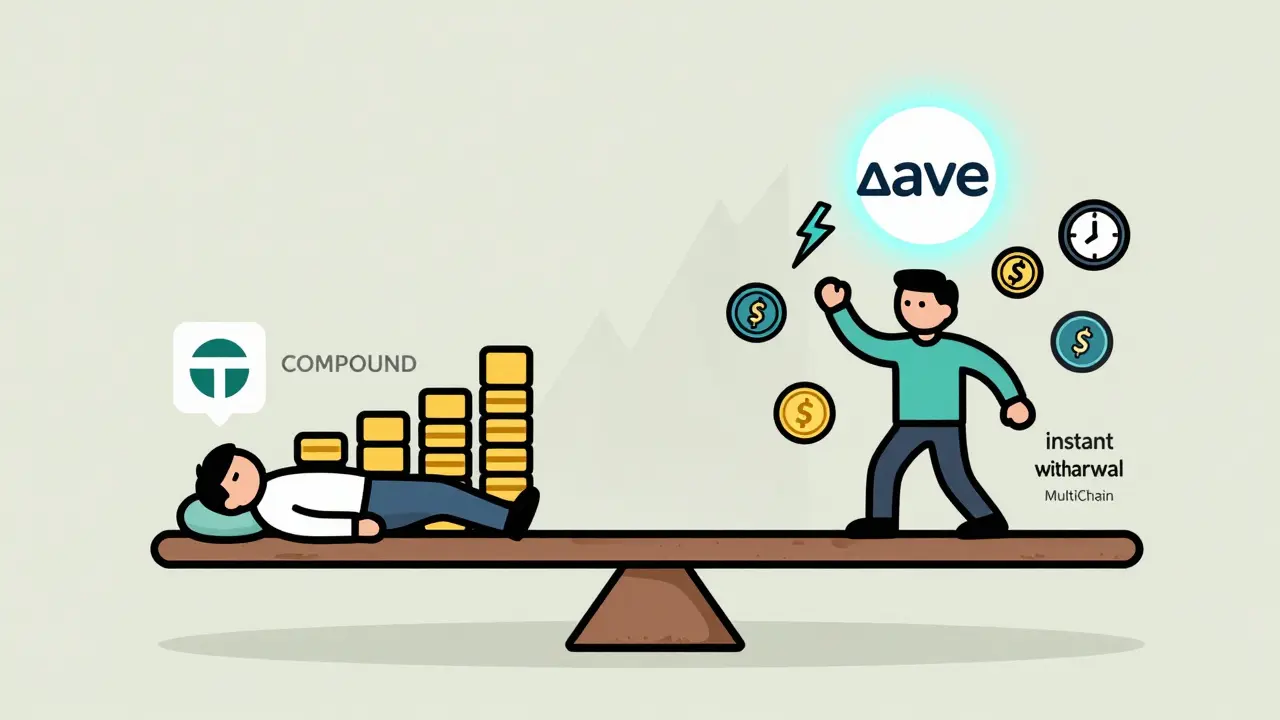
Who Should Use Which?
If you’re a beginner, or you just want to earn steady interest on your USDC or ETH without thinking too hard - go with Compound. It’s simple. Safe. Predictable. You can leave it alone for months and come back to find your balance has grown. If you’re active in DeFi - trading, arbitraging, using multiple chains, or trying to squeeze out every last bit of yield - Aave is the tool for you. Flash loans, instant withdrawals, more assets, higher leverage. It’s not beginner-friendly, but it’s the most powerful lending protocol on the market.Market Position: Why Aave Has 10x More TVL
As of early 2026, Aave has over $41 billion locked in its protocols. Compound? Around $3.6 billion. That’s not a small gap - it’s a chasm. Why? Because Aave didn’t just build a lending platform. It built an ecosystem. Flash loans turned it into a DeFi infrastructure staple. Multi-chain support made it future-proof. The ability to use staked assets as collateral attracted institutional-grade users. Compound didn’t fail. It just chose a different path. It stayed focused on Ethereum, kept things simple, and avoided complexity. That’s why it still has a loyal user base - especially among conservative investors who don’t want to chase yields.Security and Governance
Both protocols have been audited by top firms like OpenZeppelin. Both run bug bounty programs on Immunefi. Neither has suffered a major exploit since launch. Governance is token-based. AAVE tokens govern Aave. COMP tokens govern Compound. Both let holders vote on changes - interest rates, new assets, fee structures. But Aave’s governance has been more active. It’s rolled out upgrades faster, adapted to new chains quicker, and responded to market shifts in real time. Compound’s governance moves slower. It’s deliberate. Sometimes too deliberate. That’s why it hasn’t added many new assets in the last year. It’s not broken - it’s just not as agile.What About the Future?
The Ethereum Dencun upgrade in early 2025 slashed gas fees and improved scalability. That helped both protocols - but especially Aave, which relies on high-frequency transactions and multi-chain activity. Aave is expanding into new areas: staking integration, cross-chain liquidity pools, and even DeFi insurance. Compound? It’s mostly focused on improving its core lending model and expanding to more EVM chains. The trend is clear: Aave is evolving. Compound is stabilizing. If you believe DeFi will keep growing in complexity, Aave is the bet. If you think the future is simplicity and reliability, Compound still holds its ground.Can I use Aave and Compound at the same time?
Yes, absolutely. Many users split their assets. They keep stablecoins like USDC in Compound for steady yield, and use Aave for active trading, flash loans, or higher-yield assets. There’s no rule against using both - and in fact, it’s a smart way to balance risk and reward.
Is one safer than the other?
Both are among the most secure DeFi protocols ever built. They’ve been audited multiple times and have never been hacked. Compound’s simpler design gives it a slight edge in predictability. Aave’s complexity adds more attack surfaces - but its security track record is just as strong. Neither is meaningfully riskier than the other.
Do I need to understand smart contracts to use either?
No. You don’t need to read code. Both have user-friendly interfaces that let you click and deposit. But if you want to use Aave’s advanced features - like flash loans or staked ETH as collateral - you’ll need to understand the risks. Compound is easier for beginners. Aave rewards deeper knowledge.
Which one earns more interest?
It depends. Compound gives you steady, low interest - usually under 5%. Aave’s rates can spike to 10% or higher during demand surges. But they can also drop below 1%. If you’re looking for consistent returns, Compound wins. If you’re willing to monitor the market and time your deposits, Aave can outperform.
Can I use these on mobile?
Yes. Both protocols work through Web3 wallets like MetaMask, Trust Wallet, or Coinbase Wallet. You can access them via mobile browsers. Some third-party apps like Zerion or DeFi Saver also integrate both, making it easier to manage your positions on the go.
If you’re still unsure, start small. Deposit $100 into each. See how the interfaces feel. Watch how your balance changes over a week. Then decide. You don’t need to choose forever - DeFi lets you move your money anytime.