CoinWind (COW) Airdrop Details: How to Participate and Key Risks
 Jul, 24 2026
You see a notification about free tokens. Your heart skips a beat. It’s the classic crypto promise: do some simple tasks, get paid in digital assets. The CoinWind (COW) is a cryptocurrency project that recently ran an airdrop campaign on CoinMarketCap. But before you rush to click links and retweet posts, pause for a second. In the world of decentralized finance, not all shiny objects are gold. Some are just dust.
The CoinWind airdrop isn’t your first rodeo if you’ve been around crypto since 2021. It follows a very specific, somewhat dated playbook. You complete social media tasks, you wait, and maybe-just maybe-you get a handful of tokens. But here is the catch: the value of those tokens might be closer to zero than you think. And worse, there is a massive case of mistaken identity floating around this name that could cost you more than just time.
How the CoinWind Airdrop Actually Works
Let’s break down the mechanics. The primary campaign we have data on was hosted directly on CoinMarketCap, the leading cryptocurrency market tracking platform. This gives it a veneer of legitimacy because CoinMarketCap vets campaigns, but don’t let that lull you into a false sense of security regarding the project itself.
The prize pool was set at 30,000 COW tokens. They promised 1,000 winners. Do the math: that’s roughly 30 tokens per winner if distributed evenly. The window for participation was tight-running from July 20 to August 3 (UTC). If you missed that window, you’re out. There were no extensions reported.
To qualify, you had to jump through several hoops. These are standard engagement metrics designed to boost the project’s visibility rather than reward genuine utility users:
- Maintain an active CoinMarketCap account.
- Add CoinWind to your personal watchlist on the platform.
- Follow their official Twitter account (@coinwind_com).
- Join their Telegram group (@CoinWind).
- Follow their Telegram news channel (@CoinwindNews).
- Retweet their pinned message.
Notice what’s missing? There’s no requirement to use their product, stake funds, or provide liquidity. That tells you something important: this is a marketing campaign, not a community reward program. They wanted eyeballs, not builders.
The Token Reality Check: Value and Volume
Okay, let’s say you won. Congratulations. You now hold up to 30 COW tokens. What are they worth? As of the latest available data, the price sits at a staggering $0.002837 USD. Multiply that by 30, and you’re looking at less than nine cents. Nine cents for your time, your attention, and your data.
But the price isn’t the only red flag. Look at the volume. The 24-hour trading volume is effectively zero. The market capitalization is listed as $0, with a fully diluted valuation of just $283.65. For context, most micro-cap coins still manage to show *some* life. CoinWind ranks #6,631 on CoinMarketCap. That places it deep in the weeds, far below the radar of serious traders.
This lack of liquidity means two things. First, even if you want to sell those nine cents’ worth of tokens, you might not find a buyer. Second, it suggests the project is either dormant, extremely early-stage, or struggling to gain traction. Without active trading, the token has no real market price discovery mechanism.
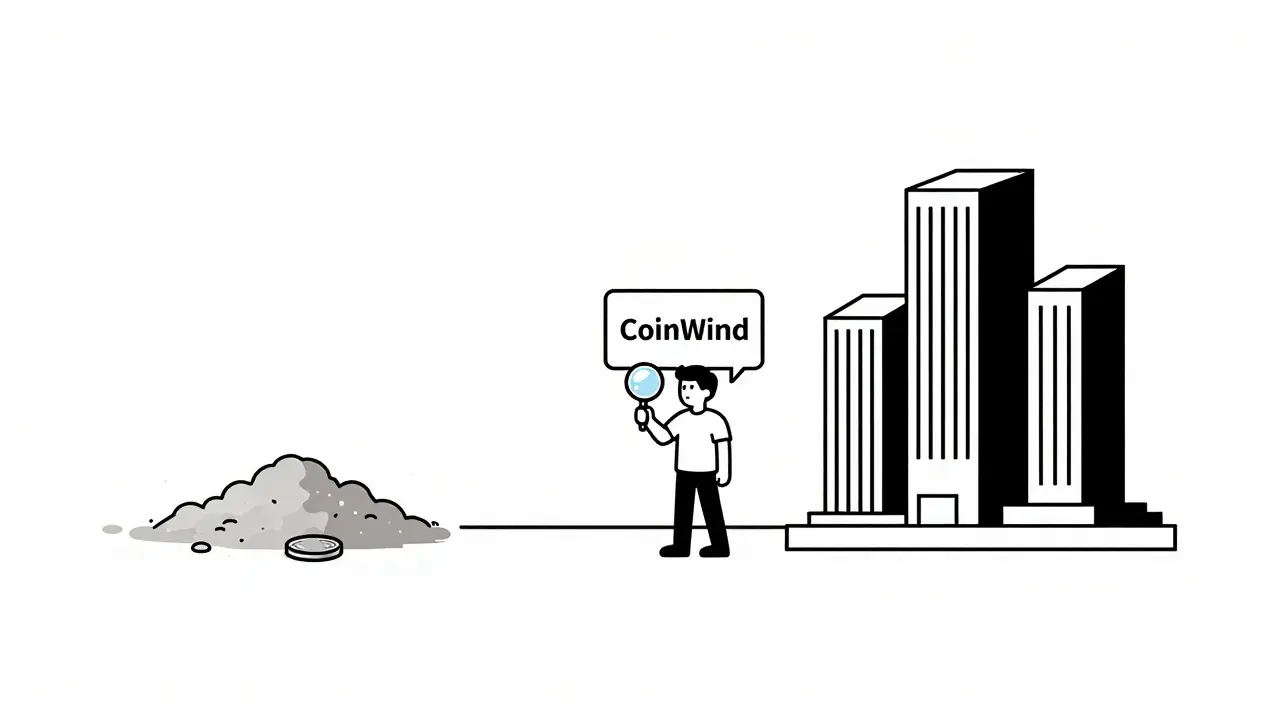
The Dangerous Name Confusion: CoinWind vs. CoW Protocol
Here is where things get tricky. And potentially expensive. If you search for "COW token" on Google, you will likely land on information about CoW Protocol, a decentralized exchange protocol focused on MEV protection and batch auctions. These are two completely different entities. Mixing them up is like confusing Apple Inc. with a local orchard named Apple Grove.
CoW Protocol is a heavyweight in the DeFi space. It has raised $23 million from major investors like 0x Labs and 1kx. Its market cap hovers around $98.59 million. It solves real problems regarding transaction efficiency and miner extractable value (MEV). It has a robust whitepaper, a clear roadmap, and a dedicated developer community.
CoinWind (COW), on the other hand, lacks these fundamental pillars. There is no comprehensive technical documentation available. No detailed whitepaper explaining the underlying technology. No public roadmap outlining future development milestones. The team behind CoinWind remains largely anonymous or unverified in public records. When you compare the two, the disparity is stark. One is an institutional-grade infrastructure project; the other appears to be a speculative token with minimal backing.
| Feature | CoinWind (COW) | CoW Protocol (COW) |
|---|---|---|
| Market Cap | $0 (Negligible) | ~$98.59 Million |
| Funding Raised | Unknown / None Public | $23 Million |
| Primary Use Case | Unclear / Speculative | MEV Protection & Batch Auctions |
| Investors | None Listed | 0x Labs, 1kx, Others |
| Documentation | Limited / Missing | Extensive Whitepaper & Docs |
| Risk Level | Very High | Medium (Standard DeFi Risk) |
If you are participating in the CoinWind airdrop thinking you are getting exposure to the next big DeFi infrastructure play, you are misinformed. Verify the contract address. Check the ticker symbol carefully. Never assume that similar names mean similar projects.
Why Do Projects Run Low-Value Airdrops?
You might wonder why anyone would bother with an airdrop that pays out pennies. The answer lies in user acquisition costs. In the broader crypto ecosystem, airdrops added over $4 billion in value in 2024 alone. For established projects, giving away thousands of dollars per user is a strategy to bootstrap network effects. They need users to vote, trade, and secure the network.
For smaller, lesser-known projects like CoinWind, the goal is simpler: awareness. By requiring you to follow their social channels and add them to your watchlist, they artificially inflate their engagement metrics. Higher follower counts and watchlist additions can make a project look more popular to potential future investors or partners. It’s a vanity metric game. You are the product, not the customer.
Additionally, distributing tokens creates a baseline holder count. Even if each person holds only a few tokens, having 1,000 holders looks better on a dashboard than having zero. It creates the illusion of community distribution, which is often a prerequisite for listing on smaller exchanges.

Risks Beyond the Wallet
We talk a lot about financial risk, but there are other dangers in the airdrop hunt. Phishing is rampant. Many fake airdrop sites mimic legitimate platforms to steal private keys. Always verify URLs. The CoinMarketCap-hosted campaign is relatively safe because it stays within their ecosystem, but third-party links shared in Telegram groups or Twitter DMs are prime hunting grounds for scammers.
Then there’s the opportunity cost. Time spent following accounts, joining chats, and retweeting posts is time not spent learning about blockchain fundamentals, developing skills, or investing in assets with proven track records. If you treat every airdrop as a lottery ticket, you’ll end up with a portfolio full of worthless dust and a cluttered social feed.
Liquidity risk is also paramount. Even if CoinWind suddenly announces a partnership or a new feature, can you actually exit your position? With $0 daily volume, selling large amounts of COW tokens could crash the price instantly, or simply fail to execute due to a lack of buyers in the order book. You might be holding tokens that are technically yours, but practically inaccessible.
What Should You Do Now?
If you already participated, check your wallet. If you received tokens, decide if keeping them is worth the gas fees to move them. Chances are, the cost to transfer them out of the airdrop platform or to a mainnet wallet might exceed their current value. Sometimes, letting go is the best financial decision.
If you haven’t participated yet, ask yourself: Is chasing nine cents worth my energy? Probably not. Instead, direct that energy toward understanding how decentralized exchanges work, how MEV affects your trades, or how to evaluate a project’s fundamentals before its token launch. Knowledge compounds faster than low-value airdrop tokens.
Keep an eye on the official CoinWind channels for any updates, but maintain healthy skepticism. In crypto, if it sounds too good to be true, it usually is. If it sounds too small to matter, it probably does. Stay sharp, verify everything, and don’t let the noise distract you from the signal.
Is the CoinWind (COW) airdrop still open?
Based on the campaign details, the primary airdrop window closed on August 3. Unless CoinWind has announced a new phase or extension on their official social channels, the opportunity to participate in that specific distribution has passed.
What is the difference between CoinWind and CoW Protocol?
They are entirely different projects. CoW Protocol is a well-funded, established DeFi infrastructure project focusing on MEV protection with a market cap near $100 million. CoinWind (COW) is a separate, much smaller token with negligible market cap, limited documentation, and unclear utility. Do not confuse the two.
How much is the COW token from CoinWind worth?
As of recent data, CoinWind's COW token trades at approximately $0.002837 USD. With zero trading volume, the price is highly unstable and may not reflect true market demand. Liquidity is extremely low, making it difficult to sell.
Did I win the CoinWind airdrop?
If you completed the required tasks during the July 20-August 3 window, you should check your CoinMarketCap account notifications or linked wallet for any token deposits. Winners were notified via the platform, and tokens were typically distributed automatically.
Is CoinWind a scam?
While not necessarily a "scam" in the traditional sense of stealing funds directly, CoinWind exhibits many characteristics of low-quality or abandoned projects: zero volume, no clear utility, and missing documentation. The risk of total loss is very high. Always exercise extreme caution with such assets.