Crypto Taxation in Russia: Rules, Rates & Restrictions for 2026
 Jul, 30 2026
For years, holding Bitcoin or Ethereum in Russia was like walking a tightrope without a net. You knew the rules were changing, but you never quite knew where your feet would land. Was it legal? Did you owe VAT? What if the government decided tomorrow that your wallet contents were taxable income?
That uncertainty ended on January 1, 2025. With the full implementation of Federal Law No. 418-FZ, signed by President Vladimir Putin in late 2024, the landscape shifted dramatically. Cryptocurrency is now formally recognized as property for tax purposes. But recognition comes with a price tag-and a set of strict new rules that many users are still struggling to navigate.
If you hold digital assets in Russia today, you aren't just an investor; you're a taxpayer under a specific, complex regime. The good news? Value-added tax (VAT) is off the table. The bad news? The reporting requirements are heavy, the penalties for mistakes are steep, and for miners, the operating environment has become significantly more restrictive.
The New Tax Rates: What You Actually Owe
Let's cut through the noise and look at the numbers. The most critical change introduced by the law is how personal income from crypto is taxed. It’s no longer a gray area. Under Article 210, Clause 2.1, Paragraph 8.3 of the Tax Code, your cryptocurrency gains are consolidated with your securities transactions into a single tax base.
Here is how the progressive personal income tax (PIT) works for residents:
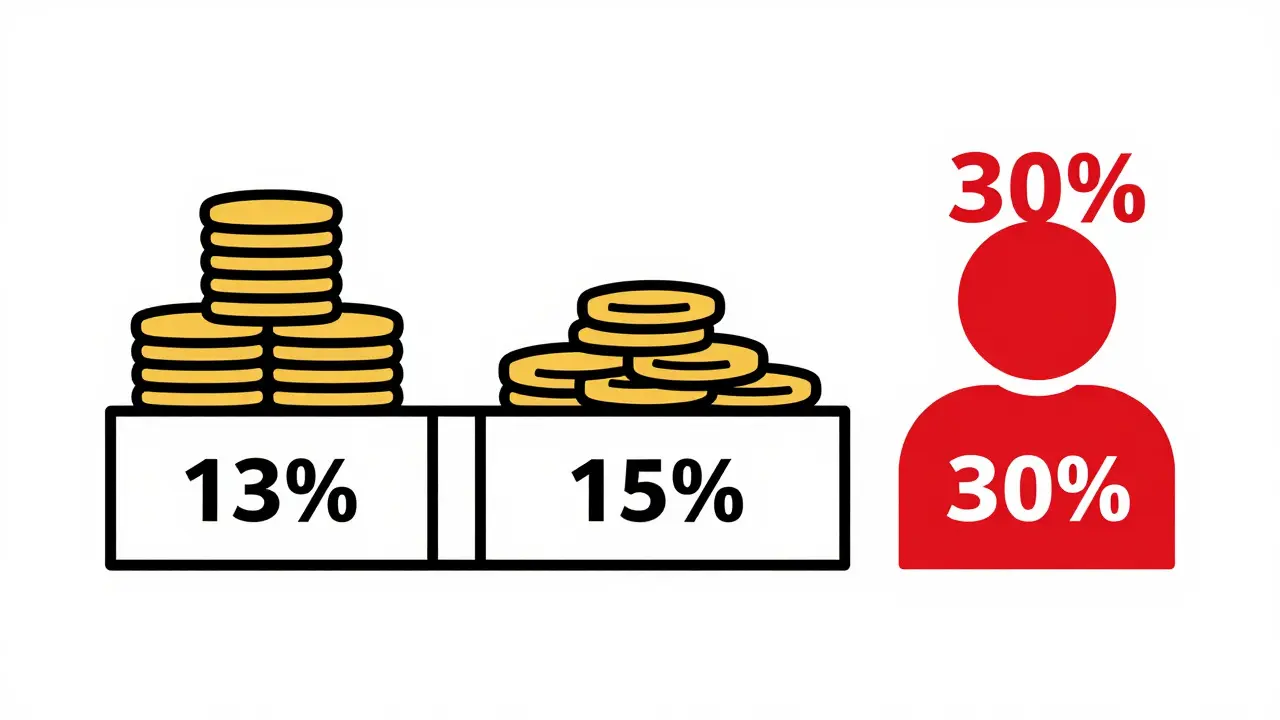
- Up to 2.4 million rubles ($32,653): You pay a flat 13% tax rate.
- Above 2.4 million rubles: Any income exceeding this threshold is taxed at 15%.
This structure mirrors the standard income tax brackets for other financial instruments, which simplifies things for accountants but adds complexity for individuals who need to track their total annual income across all sources. If you are a non-resident, the rules are harsher. You face a flat 30% tax rate on all cryptocurrency income, regardless of the amount.
For businesses, the picture is even starker. Mining operations and corporate sales of cryptocurrency are subject to a 25% profit tax. Crucially, companies must use the general taxation system (OSNO). This means small businesses can no longer hide behind simplified tax regimes like USN (Unified Simplified Taxation) or ESHN (Unified Tax on Imputed Income). According to Valen-Tax's compliance bulletin from January 2025, this mandatory shift to OSNO effectively raises the barrier to entry for smaller commercial players.
No More "Hold Forever" Loopholes
One of the biggest surprises for long-term holders was the removal of the ownership exemption. Previously, movable property held for more than three years could be sold tax-free under Article 217, Paragraph 17.1. Many investors assumed this applied to Bitcoin satoshis sitting in cold storage since 2017.
It does not. Sergey Tereshkin, in his detailed analysis published in January 2025, confirmed that cryptocurrency is explicitly excluded from this three-year exemption. Whether you held your tokens for one month or ten years, you owe taxes on the gain when you sell, swap, or spend them. There is no "long-term capital gains" discount here either-the rates remain 13% or 15% based on your total annual income bracket.
The Reporting Nightmare: How to Calculate Your Base
Paying the tax is only half the battle. Proving what you owe is where most people get stuck. The Federal Tax Service (FTS) requires precise calculation of the market value at the time of transaction. But which exchange rate do you use?
The law specifies that you must use market quotations from foreign trading organizers that meet strict criteria:
- Daily trading volume exceeding 100 billion rubles ($1.36 billion).
- At least three years of publicly available quotation data.
This sounds straightforward until you realize there are very few exchanges that consistently meet these high-volume thresholds for every altcoin you might own. As reported by Acsour in February 2025, 62% of accounting firms cited difficulties in verifying foreign exchange quotations as their primary obstacle. Users on RuTracker forums described spending dozens of hours manually calculating liabilities because automated tools couldn't reliably source the approved data feeds.
You must maintain detailed records of every transaction, including wallet addresses, transaction IDs, and the specific exchange rate used. The FTS Director Daniil Egorov issued a directive in February 2025 establishing dedicated reporting channels, but the burden of proof remains entirely on the taxpayer. Quarterly reporting is mandatory, and missing a deadline can result in fines up to 40,000 rubles per violation.
| Participant Type | Tax Rate | Reporting Frequency | Key Restriction |
|---|---|---|---|
| Individual Resident | 13% (up to 2.4M RUB) 15% (above 2.4M RUB) |
Annual Declaration (Quarterly estimates) |
No 3-year ownership exemption |
| Non-Resident | Flat 30% | Annual Declaration | Higher withholding requirements |
| Corporate Entity / Miner | 25% Profit Tax | Quarterly | Mandatory OSNO regime; Regional bans |
Mining Restrictions: Where Can You Dig?
If you run ASICs or GPU rigs, the news is mixed to poor. While the tax framework provides clarity, regional governments have leveraged energy concerns to impose severe geographic restrictions. As of early 2026, mining is completely prohibited in Dagestan, Chechnya, and the Donetsk/Luhansk People's Republics until at least 2031.
In Siberia, the situation is seasonal but volatile. Irkutsk Oblast, Buryatia, and Zabaykalsky Krai enforce restrictions during energy deficit periods-typically winter months. When the grid strains, regulators can shut down mining farms instantly. The Central Bank of Russia reported a 22% decline in domestic mining operations in Q1 2025 alone, largely due to these operational uncertainties.
Even if you are in a permitted region, the 25% corporate tax rate makes profitability razor-thin. The Higher School of Economics noted in March 2025 that this rate is 20% higher than the standard profit tax for other industries, potentially driving operations underground or forcing them to migrate abroad.
Who Is Watching? Enforcement and Penalties
The Federal Tax Service is not sleeping. They have integrated blockchain analytics tools and established direct data-sharing agreements with major international exchanges. If you sell crypto on a regulated platform, the FTS likely already knows about it.
The penalties for non-compliance are designed to sting. Beyond the initial fine for missed reporting, you face:
- Tax Shortfall Penalty: 15% to 40% of the unpaid tax amount, depending on whether the error was deemed intentional.
- Interest Charges: Calculated daily on the overdue amount.
- Criminal Liability: For large-scale evasion, though this is typically reserved for corporate entities hiding millions.
However, the enforcement has had unintended consequences. A poll by CryptoNews Russia in March 2025 revealed that while 63% of users found the 13-15% PIT rate "acceptable" compared to previous uncertainty, 38% of active users migrated to peer-to-peer (P2P) platforms to avoid triggering reporting thresholds. This suggests that while the law brings transparency, it also pushes significant volume into harder-to-track channels.

Practical Steps for Compliance in 2026
Navigating this system requires discipline. Here is a checklist to keep you out of trouble:
- Track Every Transaction: Do not rely on memory. Use software that logs wallet addresses, timestamps, and USD/RUB equivalents at the exact moment of trade.
- Verify Exchange Sources: Ensure your valuation data comes from exchanges meeting the 100 billion ruble daily volume requirement. Keep screenshots or API logs as proof.
- Consolidate Income: Remember that crypto gains add to your salary and dividend income. If your total exceeds 2.4 million rubles, calculate the marginal 15% rate carefully.
- File Quarterly Reports: Even if you owe zero tax for a quarter, submit the report. The fine for silence is often worse than the tax itself.
- Consult a Specialist: Given the complexity of Article 282.3, hiring an accountant familiar with digital assets is worth the cost. The Russian Association of Certified Accountants released a 287-page guide in March 2025, but applying it correctly takes expertise.
What Comes Next?
The regulatory framework is not static. The State Duma is scheduled to debate amendments to Federal Law No. 418-FZ, focusing on clarifying the 600,000 ruble annual reporting threshold. Currently, this threshold creates ambiguity for users with many small transactions. Additionally, the integration with the experimental legal regime for cross-border transactions (Presidential Decree No. 123) offers opportunities for international trade settlements, particularly useful given Western sanctions.
As the digital ruble pilot program expands in late 2025, expect further convergence between traditional banking and crypto infrastructure. For now, the message from Moscow is clear: Crypto is real, it's taxable, and they want their share.
Is cryptocurrency legal in Russia in 2026?
Yes, cryptocurrency is legally recognized as property under Federal Law No. 418-FZ, effective January 1, 2025. However, it cannot be used as a payment method for goods and services within the country. It is treated as a taxable asset similar to securities.
Do I pay tax if I hold crypto for more than 3 years?
Yes. Unlike other movable property, cryptocurrency is explicitly excluded from the three-year ownership exemption. You must pay personal income tax (13% or 15%) on any gains realized upon sale, regardless of how long you held the asset.
Where is crypto mining banned in Russia?
Mining is completely prohibited in Dagestan, Chechnya, and the DPR/LPR territories until 2031. In Irkutsk Oblast, Buryatia, and Zabaykalsky Krai, mining faces seasonal restrictions during energy deficit periods, typically in winter.
What is the tax rate for crypto income in Russia?
Residents pay 13% on income up to 2.4 million rubles annually and 15% on amounts exceeding that threshold. Non-residents face a flat 30% tax rate. Corporate entities pay a 25% profit tax.
How do I calculate the market value for tax purposes?
You must use quotations from foreign trading organizers with a daily volume over 100 billion rubles and three years of public data history. The Federal Tax Service requires detailed documentation of the specific exchange rate used at the time of each transaction.
Are there VAT obligations for crypto transactions?
No. Federal Law No. 418-FZ explicitly exempts cryptocurrency transactions from value-added tax (VAT), aligning with recommendations from the Ministry of Finance to reduce friction in the market.
What happens if I miss my quarterly report?
Missing a quarterly report can result in fines up to 40,000 rubles per violation. Additionally, if taxes are underpaid, you will face penalties of 15-40% of the unpaid amount plus daily interest charges.
Can small businesses use simplified tax regimes for crypto?
No. Corporate entities involved in mining or selling cryptocurrency must use the general taxation system (OSNO) and pay a 25% profit tax. Special regimes like USN or ESHN are prohibited for these activities.