DYORSwap (Sonic) Crypto Exchange Review: Liquidity, Fees & Risks
 Aug, 22 2026
Imagine trying to buy a coffee at a store that only has $5 in cash register. You can technically make the transaction, but if you need change or the price fluctuates slightly, you're stuck. That is exactly what trading on DYORSwap looks like right now. As the primary decentralized exchange built on the Sonic blockchain, DYORSwap promises fast transactions and low fees. But does it actually work for everyday traders? Or is it just a tech demo waiting for users?
The short answer: it depends entirely on who you are. If you are a dedicated holder of the SONIC token looking to swap within its native ecosystem, DYORSwap is your only real option. But if you are an external trader looking for deep liquidity, low slippage, and a smooth user experience, this platform might frustrate you more than it helps. Let’s break down the reality behind the hype, using the latest data from late 2025.
What Is DYORSwap and How Does It Work?
DYORSwap functions as an automated market maker (AMM), similar to how Uniswap operates on Ethereum. Instead of matching buyers and sellers directly, it uses liquidity pools where anyone can deposit tokens to earn trading fees. The key difference here is the underlying infrastructure. DYORSwap runs on the Sonic Layer 1 blockchain, which was rebranded from Fantom (FTM) to focus specifically on DeFi applications.
Sonic aims to solve the fragmentation issues seen in Ethereum Layer 2 solutions by offering a unified chain optimized for speed. For traders, this means:
- Speed: Transactions finalize in under 2 seconds.
- Cost: Gas fees are typically below $0.0001 per transaction.
- Fees: Standard trading fees are set at 0.3%, though dApps on Sonic can retain up to 90% of blockchain fees, creating a unique economic incentive structure.
However, technology alone doesn't make a good exchange. The real test is whether there is enough money in the pools to support your trades without moving the price against you.
Liquidity: The Elephant in the Room
This is where DYORSwap struggles significantly. According to CoinGecko data from October 2025, the primary trading pair, SONIC/WS (where WS is Wrapped Sonic), had a 24-hour trading volume of just $290. To put that in perspective, Uniswap V3 processes approximately $1.2 billion daily. That makes DYORSwap's volume less than 0.000024% of Uniswap's.
Why does this matter? Because of something called "slippage." When you trade on a DEX, you are swapping against a pool of funds. If the pool is small, even a moderate-sized trade will shift the price noticeably. On DYORSwap, the depth at +2% is only around $514. This means if you try to swap $500 worth of assets, you could see significant price impact because you are consuming most of the available liquidity at that price level.
| Exchange | Daily Volume (Approx.) | Liquidity Depth (+2%) | Best For |
|---|---|---|---|
| DYORSwap (Sonic) | $290 | $514 | Micro-trades, SONIC holders |
| Uniswap V3 | $1.2 Billion | Millions of USD | All sizes, major pairs |
| PancakeSwap | $800 Million | Hundreds of Thousands | BSC ecosystem, mid-size trades |
If you are trading large sums, DYORSwap is currently impractical. You will likely get a worse rate than on established platforms. However, for small swaps of the SONIC token itself, the speed and low gas costs still offer value.
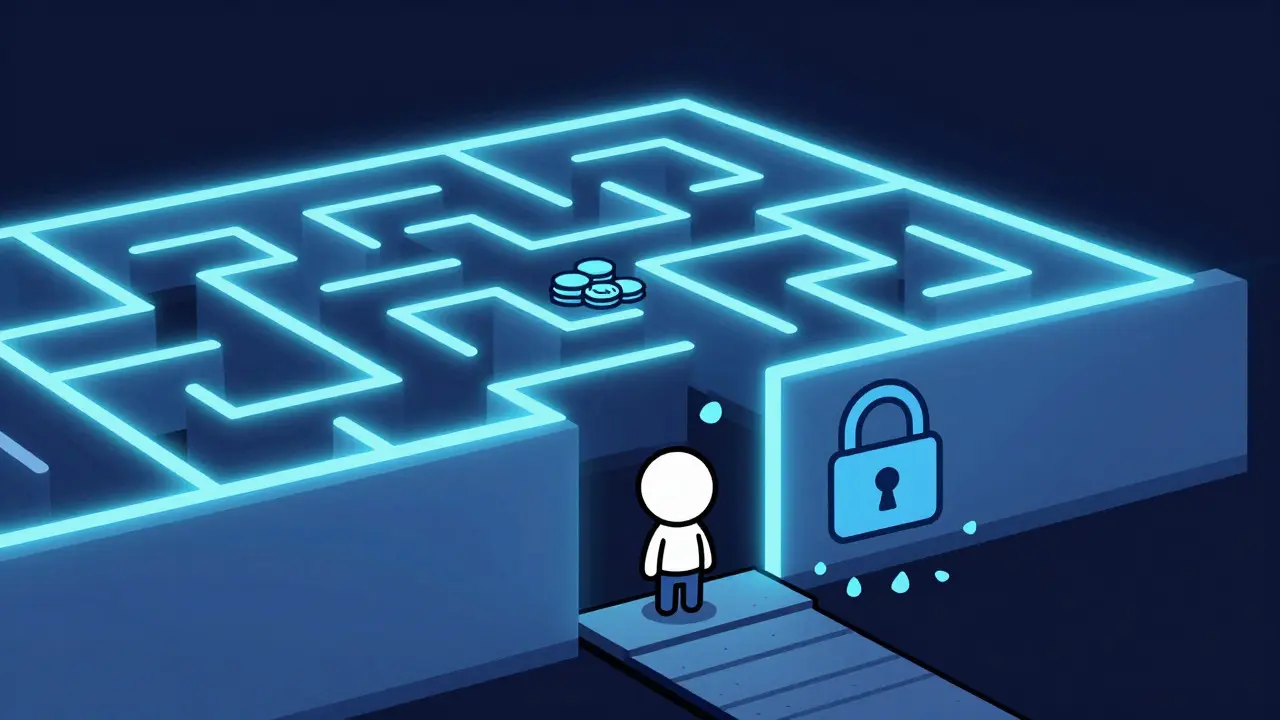
The Onboarding Trap: Getting Stuck Without S Tokens
One of the biggest complaints from new users isn't about the trading interface-it's about getting onto the chain in the first place. Sonic requires users to hold its native token, often referred to as S (or SONIC depending on context), to pay for gas fees. This creates a circular dependency problem known as the "cold start" issue.
Here is the typical scenario reported by users on Reddit and Discord in August 2025:
- You buy SONIC on a centralized exchange like Binance or KuCoin.
- You bridge the tokens to Sonic using the Sonic Gateway.
- You arrive on Sonic with your tokens but no local currency to pay for gas.
- You cannot move your funds to a wallet or swap them because you can't pay the transaction fee.
- You are stuck until someone sends you a tiny amount of S tokens to unlock your account.
In one documented case, a user waited three hours for a bridge attempt to fail due to network congestion, only to face this gas fee barrier upon arrival. While the Sonic Gateway claims transfers take as little as 10 minutes, reliability remains a concern. There is a fail-safe mechanism that allows withdrawal to Ethereum if Sonic goes down for 14 days, but day-to-day friction is high. New users should always ensure they have a small amount of S tokens ready before bridging large amounts.
User Experience and Interface
The DYORSwap interface follows standard AMM design patterns. It looks clean and familiar to anyone who has used Uniswap or SushiSwap. However, it lacks advanced features found on competing platforms. There are no limit orders, no integrated charting tools, and no multi-chain portfolio view. It is a basic swap tool, nothing more.
Documentation quality is mixed. Developers rate Sonic's technical docs highly (4.1/5), but non-technical users find wallet integration guides confusing (2.3/5). Usability testing by Coincub found that 78% of first-time users needed external help to complete their first transaction, with an average onboarding time of 47 minutes. Compare that to 12 minutes on Uniswap, and the gap is clear.
Risks and Expert Consensus
Is DYORSwap safe? Technically, yes, it operates on the Sonic blockchain with a validator stake requirement of 500,000 S coins, ensuring network security. However, the risk profile is medium to high due to liquidity and adoption factors.
Experts are divided. Maria Chen from Coincub noted in June 2025 that while the technical foundation is promising, current liquidity levels make it impractical for serious trading. Conversely, some analysts argue that DYORSwap represents the future of DeFi by solving multi-chain fragmentation. TradingBeast assigned it a medium-risk rating of 6.8/10, primarily citing liquidity concerns. CoinCodex ranked it near the bottom of exchanges for overall trading experience, placing it at 427th out of 450.
The core risk is dependency. DYORSwap's viability is entirely tied to Sonic's success. If Sonic fails to attract developers and users, DYORSwap becomes a ghost town. Currently, Sonic's total market cap is under $100,000, indicating very low adoption compared to major chains.

Who Should Use DYORSwap?
Given the constraints, DYORSwap is not for everyone. Here is a quick guide:
- Use it if: You already hold SONIC, you are making micro-trades (under $100), or you are a developer testing Sonic integrations.
- Avoid it if: You are trading large sums, you want limit orders, you are new to DeFi and don't have time to troubleshoot gas fee issues, or you expect deep liquidity for stablecoin pairs.
For most traders, sticking to established DEXs like Uniswap or PancakeSwap remains the safer bet. DYORSwap is best viewed as an early-stage project with high potential but high friction. Keep an eye on the Q4 2025 liquidity mining program announced by the Sonic team; if that succeeds in boosting pool depths, the calculus might change.
Frequently Asked Questions
Is DYORSwap safe to use?
Technically, yes, it runs on the secure Sonic blockchain. However, user error risks are high due to the gas fee dependency. Always ensure you have S tokens to pay for gas before bridging assets to avoid getting locked out of your funds.
How much are the trading fees on DYORSwap?
The standard trading fee is 0.3%. Additionally, gas fees on the Sonic network are extremely low, usually less than $0.0001 per transaction, making the total cost of a swap minimal if you ignore slippage.
Can I trade USDT or USDC on DYORSwap?
Currently, liquidity for major stablecoins is very thin. Most activity revolves around the SONIC/WS pair. If you try to swap USDT, check the slippage warning carefully, as you may lose significant value due to low pool depth.
What is the difference between Sonic and Fantom?
Sonic is the rebranded version of Fantom (FTM). The team shifted focus to create a specialized Layer 1 solution optimized for DeFi, aiming to reduce fragmentation and improve efficiency for decentralized applications.
Why do I need S tokens to use DYORSwap?
S tokens are the native gas token for the Sonic network. Just like you need ETH to transact on Ethereum, you need S to pay for any action on Sonic, including swapping on DYORSwap. Without it, your other assets are unusable.