Faster Block Times: Benefits and Trade-offs Explained
 Mar, 10 2026
When you send a crypto transaction, how long do you wait to see it confirmed? If it’s been more than a minute, you’re probably on a network with a slow block time. Many people think faster block times are just better - and in some ways, they are. But there’s a catch. Cutting block time from 10 minutes to 1 second doesn’t just make things quicker. It changes everything: security, decentralization, and even who gets to run a node. Let’s break down what faster block times actually do - and what they break.
What Is Block Time, Really?
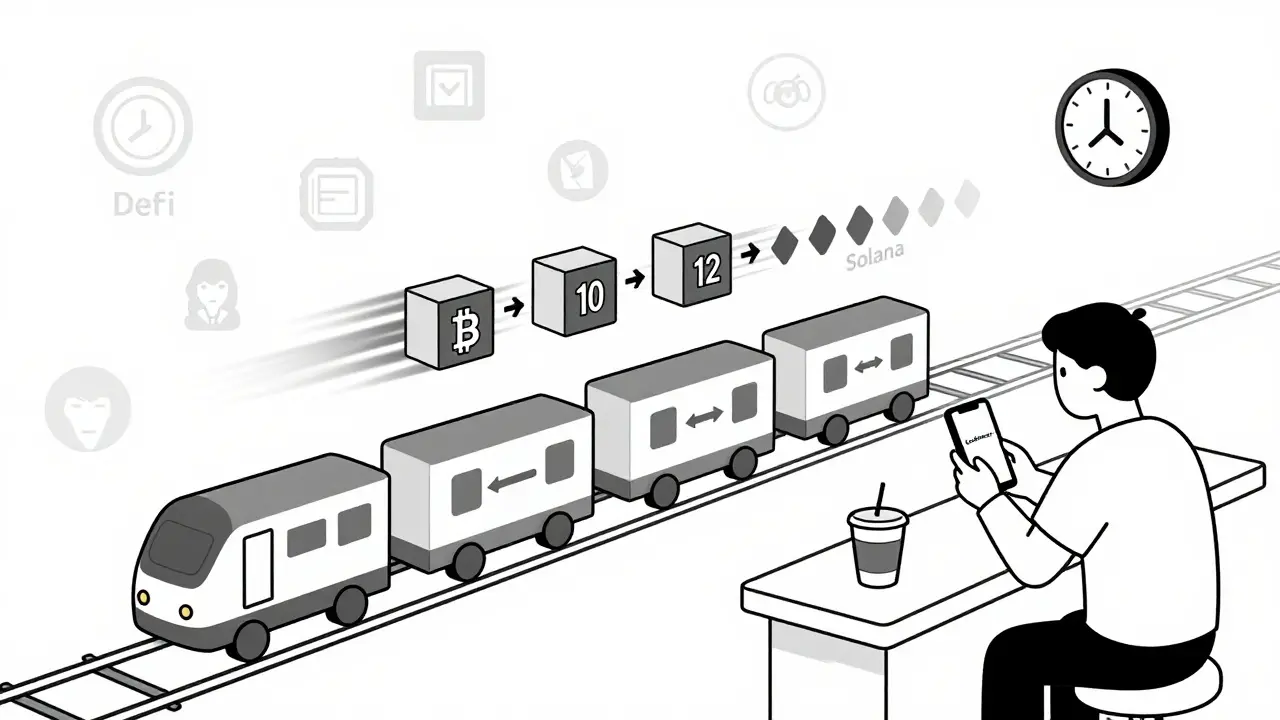
Block time is the average time between one block being added to the blockchain and the next. Bitcoin’s block time is about 10 minutes. That means if you send Bitcoin, you wait around 10 minutes for your first confirmation. Ethereum, after its upgrade, runs at roughly 12 seconds. Solana? Around 400 milliseconds. That’s less than half a second.
Shorter block times mean faster confirmations. That’s the whole point. If you’re buying coffee with crypto, you don’t want to wait 10 minutes. You want it to show up like a Venmo payment. For DeFi trading, NFT minting, or gaming, speed matters. A delay of even a few seconds can mean losing out on a deal or getting front-run by bots.
But here’s the thing: block time isn’t just a dial you turn up. It’s tied to how the whole network stays in sync. When blocks come too fast, the network can get confused.
The Big Win: Speed and Throughput
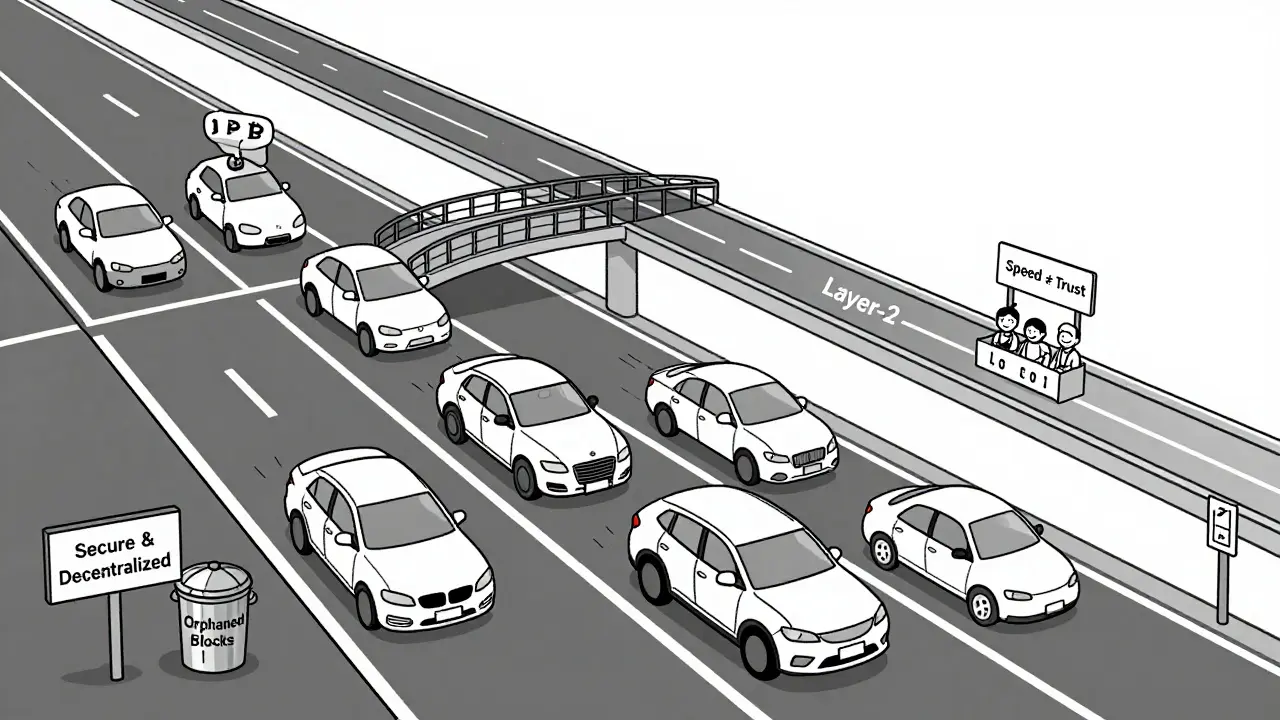
Faster block times directly boost transaction throughput. Think of it like a highway. If cars (transactions) can enter the road every 10 minutes, you’ll get maybe 6 cars an hour. If they can enter every 1 second, you’re handling 3,600 cars an hour. That’s the difference between a clogged street and a smooth-flowing freeway.
Networks like Solana and Polygon use sub-second block times to handle thousands of transactions per second (TPS). Compare that to Bitcoin’s 7 TPS. That’s why DeFi apps, NFT marketplaces, and Web3 games now mostly run on chains with fast blocks. They need to process trades, mint NFTs, and update game states in real time.
Lower fees come with it, too. When blocks fill up, users bid up fees to get in first. Faster blocks mean more space per minute, so congestion drops. That’s why users on networks like Avalanche or Near pay pennies instead of dollars during peak times.
The Hidden Cost: Orphaned Blocks and Forks
Here’s where things get messy. When blocks are produced too quickly, two miners or validators might solve a block at almost the same time. The network can’t instantly tell which one came first. So one gets accepted. The other becomes an orphaned block - a valid block that gets thrown away.
Orphaned blocks are normal. Bitcoin sees them every now and then. But when block time drops below 15 seconds, they become common. Solana, with its 400ms blocks, sees orphaned blocks more often than most people realize. That’s not a bug - it’s a trade-off.
Worse, when orphaned blocks pile up, they can cause chain forks. A fork happens when the network splits into two versions of truth. That’s dangerous. If one version has your transaction and the other doesn’t, you might lose funds. Networks try to fix this with better gossip protocols and faster block propagation, but it’s still a vulnerability.
Decentralization Takes a Hit
One of blockchain’s core promises is decentralization - no single entity controls the network. But faster block times make it harder for ordinary people to participate.
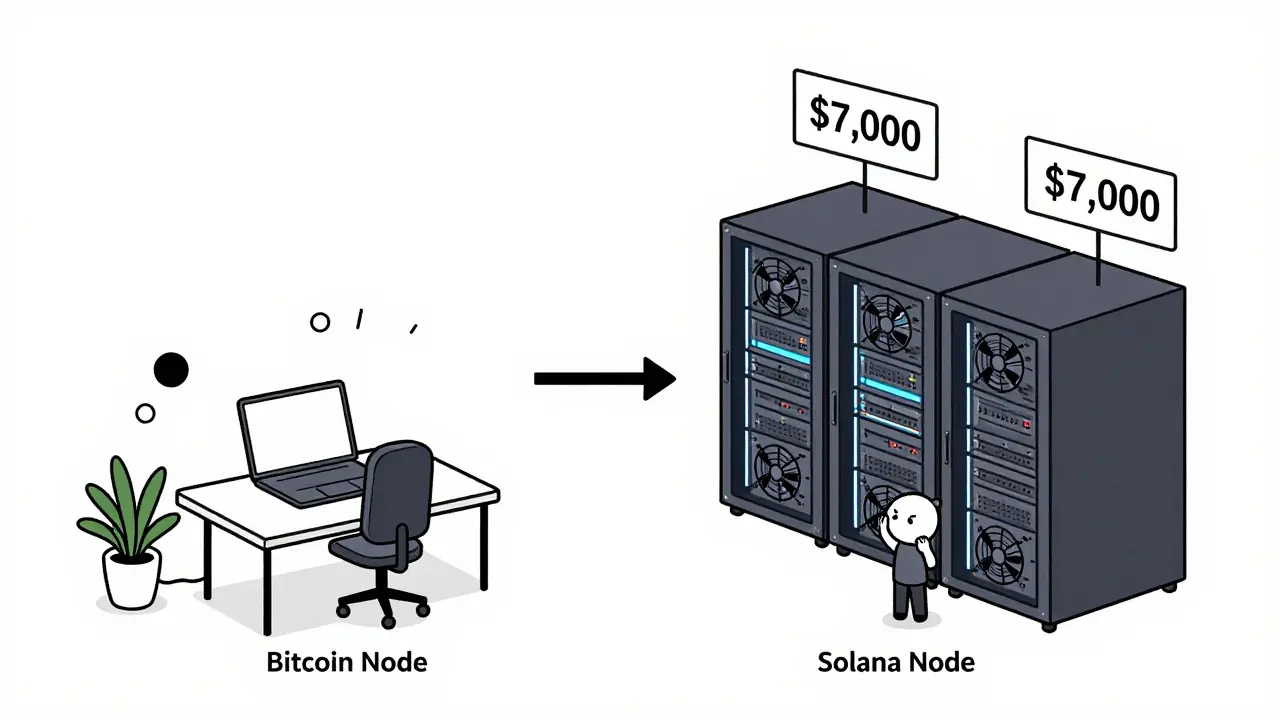
Running a full node on Bitcoin is doable on a $500 laptop. You need modest storage, decent internet, and a little patience. Now try running a node on Solana. You need:
- 12+ CPU cores
- 256 GB of RAM
- 1 TB+ NVMe SSD
- 1 Gbps internet connection
That’s not a home setup. That’s a small server. And the cost? Easily $5,000-$8,000 just to start. That means only big players - exchanges, hedge funds, data centers - can run nodes. That’s not decentralization. That’s centralization in fancy clothing.
When fewer people can validate the chain, the network becomes more vulnerable. If just 10 entities control 80% of the nodes, they could collude, censor transactions, or even shut down the network. Fast block times don’t cause this - but they accelerate it.
Security Gets Weaker
Proof of Work (PoW) blockchains like Bitcoin rely on mining difficulty to secure the network. Slower block times mean more time for miners to spread their work. That gives the network time to detect and reject bad blocks.
With faster block times, that safety buffer disappears. In PoW systems, reducing block time makes it easier for well-funded miners to dominate. Why? Because they have the fastest hardware and the best network connections. Smaller miners get left behind. That’s why Bitcoin’s 10-minute block time has held up - it’s designed to be slow enough for fairness.
Proof of Stake (PoS) chains avoid this by not relying on raw computing power. But they have their own risks. Validators who go offline for even a few seconds can miss their turn. With 400ms blocks, a 1-second outage means you miss two blocks. That’s a penalty. And if you’re a small validator with unstable internet? You get slashed. The system punishes the little guys.
State Bloat and Node Overload
Every transaction gets stored forever. More blocks = more data. Faster block times mean the blockchain grows faster. Ethereum’s state - the current balance of every account, contract code, and storage slot - is already over 1.5 terabytes. At faster block times, it grows even quicker.
Full nodes must download and verify every single block. If each block adds 1 MB of data and you get 10 blocks per second, you’re adding 360 GB per day. That’s not sustainable. Nodes can’t keep up. New nodes joining the network might take weeks to sync. That’s a disaster for adoption.
Some chains try to fix this with pruning or state expiry, but those are workarounds. They don’t solve the core problem: faster blocks = more data = harder to run a node.
Consensus Matters More Than You Think
Not all blockchains are built the same. The consensus mechanism shapes how block time affects everything else.
- Proof of Work (PoW): Slower block times (like Bitcoin’s 10 minutes) are safer. More time = better propagation = fewer forks. But energy use is high.
- Proof of Stake (PoS): Allows faster blocks (Ethereum: 12s, Solana: 0.4s). Less energy. But validators must be online constantly. Miss one slot? Penalty.
- Delegated PoS (DPoS): Used by EOS and Tron. Only 21-100 validators. Very fast, but centralized by design.
- Practical Byzantine Fault Tolerance (PBFT): Used in private chains. Extremely fast. But only works if you trust the validators. Not for public blockchains.
The best systems don’t just cut block time. They combine it with other tools - like layer-2 rollups, sharding, or sidechains - to get speed without sacrificing decentralization or security.
What’s the Right Balance?
There’s no universal sweet spot. But history gives us clues.
Bitcoin’s 10 minutes? Designed for a world with slow internet and no smartphones. It’s secure, but unusable for daily payments.
Ethereum’s 12 seconds? A good middle ground. Fast enough for most apps. Slow enough that nodes can still run on consumer hardware. That’s why Ethereum remains the most decentralized major chain.
Solana’s 400 milliseconds? Blazing fast. But you need a data center to run a node. That’s not for everyone.
The real winners aren’t the ones with the fastest blocks. They’re the ones that combine fast blocks with layer-2 scaling. Think of it like this: the base chain handles security and settlement. Layer-2s handle speed. That’s how Arbitrum, Optimism, and zkSync do it. They use Ethereum’s security but process transactions off-chain at 10,000+ TPS.
That’s the future. Not just faster blocks. Smarter architecture.
What Should You Care About?
If you’re a user: You want speed and low fees. Go for chains with sub-5-second block times and active layer-2 support. Avoid chains where node requirements cost more than a car.
If you’re a developer: Don’t assume faster = better. Test how your app behaves under network stress. Will it still work if 10% of validators go offline? Will users get confused if transactions revert?
If you’re a node operator: Ask yourself - can I afford to run this? If the answer is no, then the chain isn’t as decentralized as it claims.
Speed is sexy. But blockchain isn’t just about speed. It’s about trust. And trust needs time - even if it’s just a few extra seconds.
Can block time be changed after a blockchain launches?
Yes, but it’s risky. Changing block time requires a hard fork - a major network upgrade that all participants must agree to. Bitcoin has never changed its 10-minute block time. Ethereum adjusted its target from 15 seconds to 12 seconds after the Merge, but that was part of a broader upgrade. Most chains avoid changing block time unless absolutely necessary, because it can destabilize the network.
Why don’t all blockchains use the fastest possible block time?
Because speed comes at the cost of security and decentralization. A blockchain with 100ms blocks might process 100,000 transactions per second, but if only 50 companies can run nodes, it’s not a blockchain - it’s a private database with a crypto label. The whole point of blockchain is to remove trust in central authorities. Fast block times can accidentally rebuild those authorities.
Do faster block times make blockchains more energy-efficient?
Not necessarily. In Proof of Work, faster blocks mean more mining attempts per second, which increases energy use. But in Proof of Stake, block time doesn’t affect energy use much - because there’s no mining. That’s why PoS chains like Ethereum can have fast blocks and still use 99% less energy than Bitcoin.
What’s the minimum block time a blockchain can have?
Technically, there’s no hard limit. But practical limits exist. At around 100-200ms, network latency starts to dominate. If a block takes longer to travel across the globe than it takes to produce, you’ll get constant orphaned blocks and forks. Most successful chains stay above 200ms. Solana’s 400ms is near the edge - and it still has sync issues.
Is a 1-second block time enough for everyday use?
Yes, for almost all real-world use cases. A 1-second confirmation is faster than most bank transfers. Most DeFi trades, NFT mints, and gaming actions don’t need sub-500ms. What users really care about is consistency - not raw speed. A 1-second block time with 99.9% uptime is better than a 200ms block time that crashes every few hours.