How Blockchains Communicate with Each Other: A Guide to Interoperability
 Sep, 22 2026
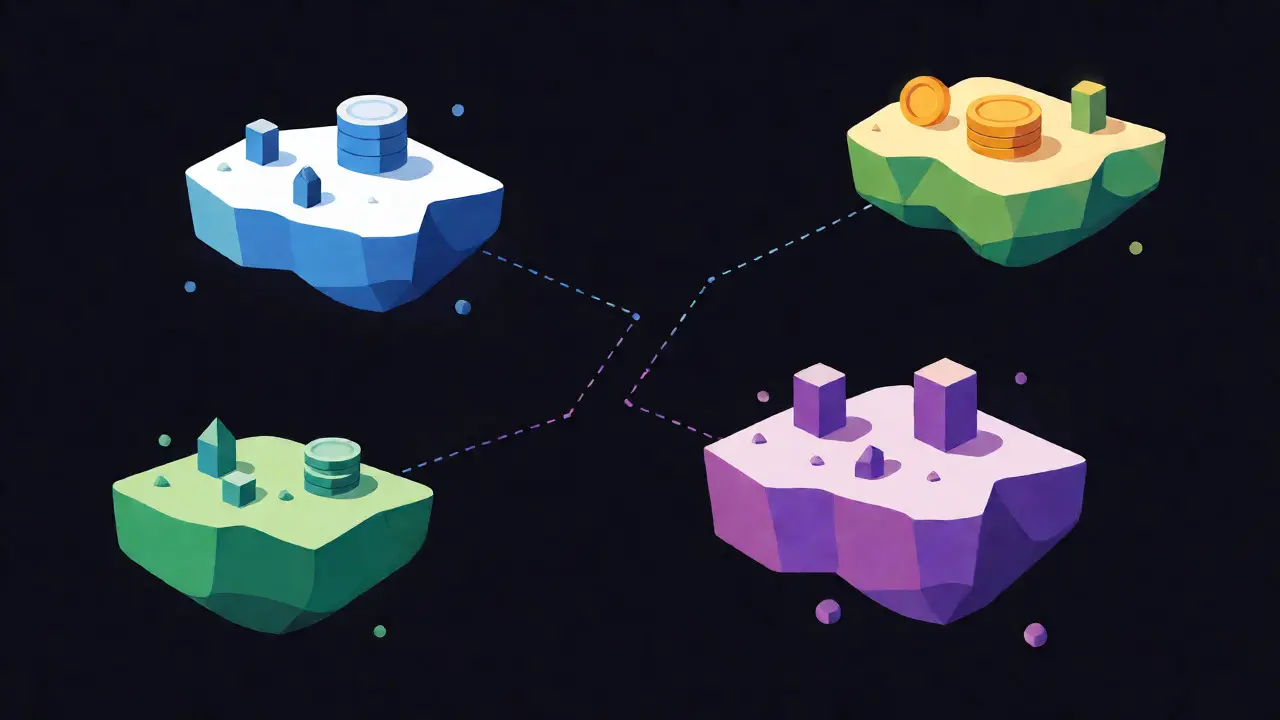
You have Bitcoin on one chain and want to use it in a DeFi app on another. Without a way for these networks to talk, you are stuck. You might send your assets to a centralized exchange, wait for confirmation, trade them for a wrapped version, and then withdraw them back to the new chain. This process is slow, expensive, and relies on trusting a third party. It is like sending a letter by carrier pigeon when you have email available. The solution lies in blockchain interoperability, which allows distinct blockchain networks to communicate and exchange data directly without centralized intermediaries. This technology transforms isolated digital islands into a connected web, enabling seamless value transfer across different ledgers.
The Core Problem of Isolated Ledgers
Blockchains were designed as secure, self-contained systems. This isolation is a feature for security but a bug for usability. If Bitcoin cannot natively interact with Ethereum or Solana, users face friction every time they want to move assets between ecosystems. Early attempts to solve this involved simple bridges that locked assets on one chain and minted equivalent tokens on another. While functional, these early bridges often lacked robust security models, leading to significant financial losses. In fact, cross-chain exploits have cost the industry over $1.2 billion USD in recent years. This history highlights why understanding how blockchains communicate is not just academic-it is critical for protecting capital.
Interoperability does more than move money. It allows smart contracts on different chains to call each other. Imagine using collateral from a Bitcoin loan to participate in an Ethereum-based governance vote. This requires passing complex data structures, not just simple token balances. The goal is to create a unified digital economy where information and value flow freely, regardless of the underlying ledger technology.
Understanding the Inter-Blockchain Communication (IBC) Protocol
One of the most mature solutions for blockchain communication is the Inter-Blockchain Communication (IBC) protocol, which operates through a two-layer architecture comprising transport/authentication and application layers. Originally developed for the Cosmos ecosystem, IBC provides a standardized way for sovereign chains to connect. Think of it as the TCP/IP of blockchains. It ensures that data packets sent from Chain A arrive at Chain B exactly as intended, with proof of their origin.
The architecture splits responsibilities clearly. The TAO layer handles the heavy lifting of transport, authentication, and ordering. It establishes secure connections and verifies data integrity. The APP layer sits on top, defining how specific applications package and interpret the data. This separation means developers do not need to reinvent the wheel for every new application; they can rely on the TAO layer’s security guarantees while focusing on business logic in the APP layer.
| Feature | IBC Protocol | CCIP (Chainlink) | Traditional Bridges |
|---|---|---|---|
| Security Model | Light Client Verification | Decentralized Oracles & Risk Network | Trusted Validators or Multi-sig |
| Data Type | Arbitrary Messages & Tokens | Arbitrary Messaging & Token Transfers | Mostly Token Lock/Mint |
| Trust Assumption | Permissionless / Trust-minimized | Oracle Consensus | High Trust in Bridge Operators |
| Primary Use Case | Cosmos Ecosystem & Sovereign Chains | Ethereum & Major L1/L2s | Simple Asset Swaps |
How IBC Connections Are Established
Establishing a connection between two blockchains using IBC is not instantaneous. It involves a rigorous four-message handshake process that ensures both parties recognize each other’s state. This happens entirely on-chain, removing the need for off-chain trusted parties during setup.
- OpenInit: The initiating chain sends its information and expresses intent to connect.
- OpenTry: The destination chain receives this request. It uses its Light Client to verify the source chain’s data. If valid, it responds confirming the source chain’s identity.
- OpenACK: The source chain receives the response and uses its own Light Client to verify the destination chain’s data.
- OpenConfirm: The final message confirms the connection is open and ready for data transfer.
Once the connection is established, channels are created on top of it. These channels act like dedicated lanes for specific applications. Each channel has a unique ID and port number, ensuring that data meant for a lending protocol doesn’t accidentally get routed to a gaming application. This structure prevents congestion and maintains clarity in data routing.

Chainlink’s Cross-Chain Interoperability Protocol (CCIP)
While IBC dominates the Cosmos world, Chainlink’s Cross-Chain Interoperability Protocol (CCIP) provides a global standard for cross-chain communication encompassing arbitrary messaging and token transfers for major networks like Ethereum, Avalanche, and Polygon. CCIP addresses the fragmentation problem by offering a single interface for developers to build cross-chain applications.
CCIP relies heavily on decentralized oracle networks to relay messages. Instead of relying solely on light clients, which can be complex to implement on every chain, CCIP uses a network of independent node operators to monitor source chains and deliver updates to destination chains. This approach leverages Chainlink’s existing infrastructure, which has already secured hundreds of billions of dollars in transactions.
A key component of CCIP’s security is the Risk Management Network. This separate group of nodes monitors transaction patterns for anomalies. If a sudden spike in volume or unusual behavior occurs, the system can pause transfers automatically. This adds a layer of defense against sophisticated attacks that might bypass initial validation checks. For developers, interacting with CCIP is straightforward. They can use the `ccipSend` function for direct user-initiated transfers or integrate sender contracts for automated dApp workflows.
The Role of Light Clients and Relayers
At the heart of trustless interoperability lie two critical components: light clients and relayers. A light client is a simplified version of a blockchain node that stores only block headers, allowing it to verify proofs efficiently. It does not download the entire blockchain history, saving space and resources. Instead, it keeps track of the latest state roots and consensus mechanisms.
Relayers are off-chain agents that watch the source chain for events. When a packet is sent, the relayer picks it up and submits it to the destination chain along with a cryptographic proof generated by the light client. Crucially, relayers do not need to be trusted. Even if a malicious relayer tries to submit fake data, the light client on the destination chain will reject it because the proof won’t match the known state of the source chain. This design ensures that security remains anchored in the consensus of the originating blockchains.

Benefits Beyond Simple Transfers
Why should you care about these technical details? Because interoperability unlocks real utility. Consider these practical scenarios:
- Unified Liquidity: Users can access liquidity pools across multiple chains without holding native tokens on each one. This reduces the need for constant swapping and lowers gas fees.
- Enhanced Security: Assets can be stored on a highly secure chain like Bitcoin while being used for yield generation on faster, cheaper chains. This separates custody from usage.
- Innovation Acceleration: Developers can combine features from different ecosystems. For example, combining Ethereum’s smart contract capabilities with Solana’s high throughput for a specific application.
- Simplified User Experience: Wallets can show a single portfolio view across all supported chains, hiding the complexity of bridging from the end-user.
These benefits drive adoption. As networks become more interconnected, the barrier to entry for new users drops. They no longer need to understand the nuances of consensus algorithms or bridge security models to participate in the broader crypto economy.
Challenges and Future Outlook
Despite the progress, challenges remain. Security is the biggest concern. Every new bridge or protocol introduces potential attack vectors. The $1.2 billion lost to exploits serves as a stark reminder that code is law, but bugs are fatal. Ensuring that light clients correctly parse consensus changes is difficult, especially as blockchains upgrade their protocols.
Scalability is another hurdle. Verifying proofs on the destination chain costs gas. If too many messages are sent simultaneously, verification costs can skyrocket, negating the efficiency gains of moving to a cheaper chain. Solutions like optimistic rollups and zero-knowledge proofs are being integrated into newer interoperability standards to mitigate this.
Looking ahead, we expect a shift toward universal standards. Rather than having dozens of incompatible bridges, the industry is moving toward a few dominant protocols like IBC and CCIP. These standards aim to accommodate diverse consensus mechanisms, from Proof-of-Work to Proof-of-Stake, creating a truly modular blockchain stack. The future isn’t about one chain winning; it’s about all chains talking to each other seamlessly.
What is the difference between a bridge and an interoperability protocol?
A bridge typically focuses on locking assets on one chain and minting them on another, often relying on trusted validators. An interoperability protocol like IBC or CCIP enables arbitrary message passing and data exchange, not just asset transfers. They also tend to use more robust, trust-minimized security models like light clients or decentralized oracle networks.
Is cross-chain communication safe?
It carries inherent risks, primarily due to smart contract vulnerabilities and validator collusion. However, modern protocols like IBC and CCIP significantly reduce these risks by using on-chain verification and decentralized monitoring networks. Always check if a bridge has undergone audits and has a track record of handling large volumes without incidents.
Do I need to pay extra fees for cross-chain transactions?
Yes, cross-chain transactions usually incur higher fees than standard on-chain transfers. This includes gas fees on the source chain, fees for the relayer or oracle service, and gas fees on the destination chain. Some protocols offer fee subsidies or aggregators to help minimize these costs.
Can any two blockchains communicate?
Not immediately. Both chains must support a common interoperability standard or have a compatible bridge deployed. Additionally, they need light clients or oracle networks configured to verify each other's states. As standards like IBC gain wider adoption, compatibility between disparate chains will increase.
What happens if a relayer goes offline?
In permissionless systems like IBC, anyone can run a relayer. If one goes offline, others can pick up the pending packets. The system is designed to be redundant. However, delays may occur until another active relayer processes the backlog, potentially increasing latency for users.