How Liquidation Works in Leveraged Crypto Trading
 Sep, 28 2026
You think you’re safe because your stop-loss is set. Then a whale dumps $50 million of Bitcoin at 3 AM, the order book thins out, and your position vanishes before your brain even registers the red candle. This isn’t bad luck; it’s liquidation, the automatic closure of a leveraged position when collateral falls below the required threshold. In the high-stakes world of crypto derivatives, understanding this mechanism is the difference between managing risk and blowing up your account.
Liquidation sounds scary, but it’s actually a safety feature. Without it, if the market moved against you faster than you could react, you might owe more money than you deposited. The exchange steps in to close your trade, ensuring they don’t lose their own capital. But for you, it means losing your initial investment-plus fees. Let’s break down exactly how this works, why it happens, and how to keep your account alive.
The Core Mechanics: Margin and Leverage
To understand liquidation, you first need to grasp leverage. When you use leverage to amplify your trading position size relative to your actual capital, you’re borrowing money from the exchange. If you have $1,000 and use 10x leverage, you control a $10,000 position. Your $1,000 is your initial margin the upfront collateral required to open a leveraged position.
Here’s the catch: markets move. If you go long on Bitcoin and the price drops, your profit shrinks. Once your remaining equity (your initial margin plus any unrealized P&L) hits a specific floor called the maintenance margin the minimum amount of equity required to keep a position open without being liquidated, the exchange pulls the plug. For most major exchanges like Binance or Bybit, this maintenance margin is typically between 0.5% and 1% of the total position value. It sounds small, but with high leverage, that tiny percentage represents a very narrow window for price movement.
Calculating Your Liquidation Price
Your liquidation price isn’t random. It’s calculated based on your entry price, leverage, and the maintenance margin rate. While every exchange has slight variations, the general logic holds true across centralized platforms.
For a Long Position, the formula looks something like this:
- Liquidation Price = Entry Price × (1 - Initial Margin Rate + Maintenance Margin Rate)
For a Short Position, it flips:
- Liquidation Price = Entry Price × (1 + Initial Margin Rate - Maintenance Margin Rate)
Let’s make this concrete. Imagine you buy Bitcoin at $60,000 with 10x leverage. Your initial margin rate is 10%. If the maintenance margin is 0.5%, your liquidation price would be roughly $54,300. That’s about a 9.5% drop. Now, bump that leverage to 50x. Your initial margin drops to 2%. Suddenly, your liquidation price moves much closer to your entry point-around $58,800. A mere 2% dip wipes you out. See why high leverage is dangerous?
| Leverage | Initial Margin | Approx. Liquidation Price | Price Drop to Liquidate |
|---|---|---|---|
| 2x | 50% | $30,300 | ~49.5% |
| 10x | 10% | $54,300 | ~9.5% |
| 20x | 5% | $57,300 | ~4.5% |
| 50x | 2% | $58,800 | ~2.0% |
Mark Price vs. Last Traded Price
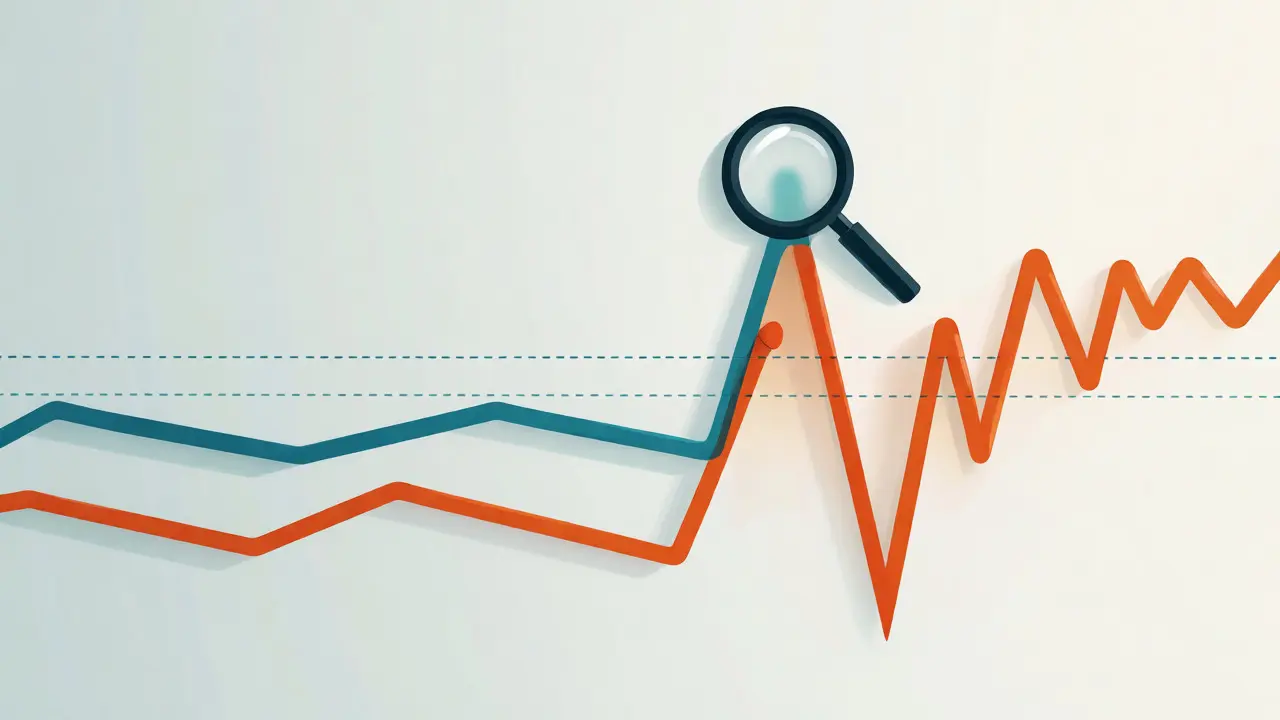
This is where many traders get burned. You might see the last traded price on the chart hit your liquidation level, but your position stays open. Or worse, the chart shows a safe price, but you get liquidated anyway. Why? Because exchanges use mark price a calculated index price used to determine unrealized P&L and liquidation triggers, distinct from the last traded price for these calculations.
The mark price is an average derived from multiple external spot exchanges. It’s designed to prevent manipulation. If one trader dumps a huge order on a single exchange, causing the last traded price to spike momentarily, the mark price remains stable. This protects you from "wick" manipulations. However, during extreme volatility, the mark price can still diverge significantly from the spot price. Always check which price your exchange uses for liquidation-it’s almost always the mark price, not the one you see ticking on the main chart.
Partial vs. Full Liquidation
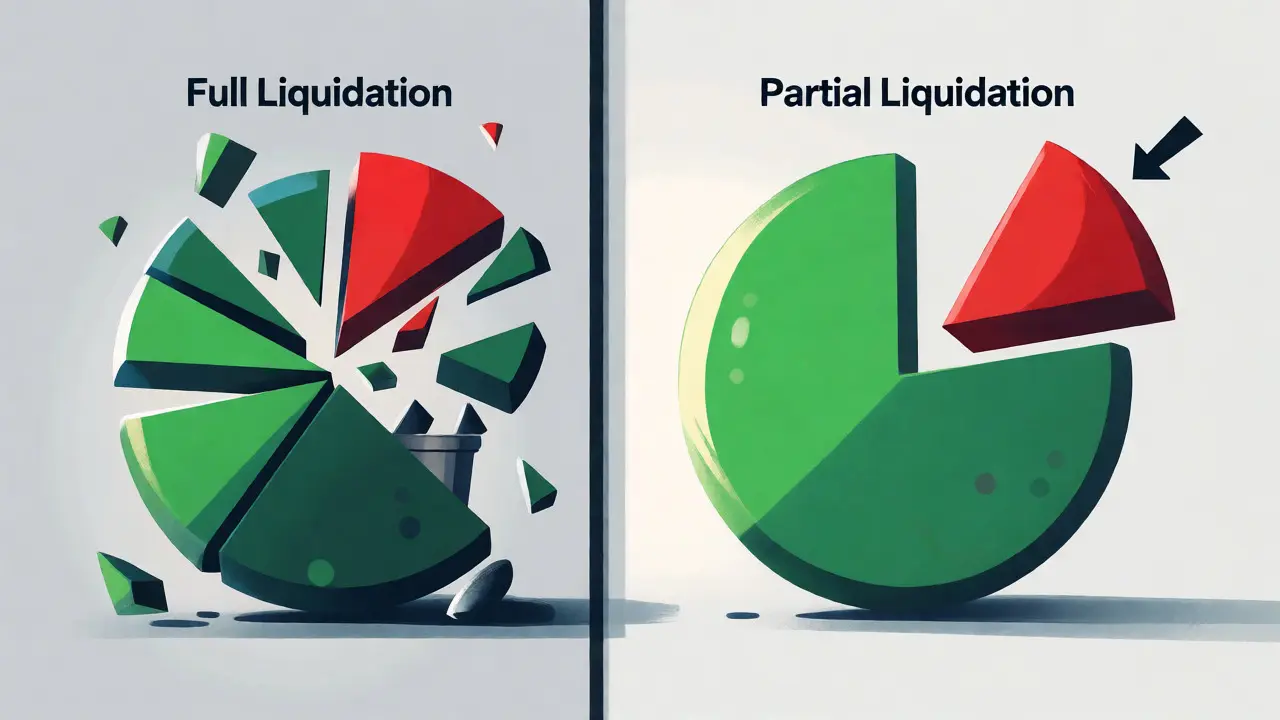
Not all liquidations are created equal. Older systems would close your entire position once you hit the maintenance margin. Modern engines, like those updated by Deribit and Bybit in recent years, often use partial liquidation a process where only enough of the position is closed to bring the margin ratio back above the maintenance requirement.
In a partial liquidation scenario, if you’re slightly over the limit, the system might sell only 25% of your position. This reduces your exposure, lowers the required maintenance margin, and potentially saves the rest of your trade. It’s a smarter way to handle minor dips. However, if the market crashes hard and fast, you’ll likely face full liquidation. The key takeaway? Don’t assume you’ll get a partial save. Assume full wipeout unless your exchange explicitly guarantees tiered handling.
The Liquidation Penalty and Fees
Getting liquidated costs more than just losing your margin. Most exchanges charge a liquidation fee a penalty charged when a position is forcibly closed due to insufficient margin. This fee compensates the exchange for the risk and operational cost of closing your position at potentially unfavorable prices.
Fees vary wildly. BitMEX historically charged around 0.5%, while others like Binance have integrated this cost into the liquidation price itself, making the effective exit price worse than the market rate. DeFi platforms operate differently. On protocols like Aave, liquidators (bots or users who repay your debt) get to buy your collateral at a discount, usually 5-15%. This incentive ensures someone is always willing to step in and clean up the mess, keeping the protocol solvent.
Common Pitfalls and How to Avoid Them
Why do so many traders get liquidated? It’s rarely just bad market timing. It’s usually poor risk management.
- Ignoring Funding Rates: In perpetual futures, funding rates shift every 8 hours. Positive funding means longs pay shorts. Over time, this drains your margin balance, effectively moving your liquidation price closer to your entry. Check your predicted liquidation price regularly, not just when you open the trade.
- Using Cross-Margin Blindly: Cross-margin pools all your available balance to support positions. It prevents premature liquidation of one asset if another is profitable. But it also puts your entire account at risk. If one trade goes catastrophically wrong, it can drain your whole wallet. Isolated margin keeps risks contained per position.
- Setting Stop-Losses Too Close: Many traders set stop-losses right next to their liquidation price. During high volatility, slippage can cause the stop-loss to miss, triggering liquidation instead. Keep your stop-loss well above your liquidation price-aim for at least 70-80% of the distance to liquidation.
Advanced Strategies for Survival
Professional traders don’t just hope for the best. They engineer survival. Here’s what works:
Maintain Excess Collateral: Never run at 100% capacity. Keep 20-30% more margin than the minimum requires. This buffer absorbs normal market noise without triggering alerts.
Use Tiered Margin Systems: Understand your exchange’s tiered leverage structure. As your position size grows, the maximum allowable leverage often decreases, and maintenance margins increase. Scaling in slowly rather than going all-in at max leverage gives you room to breathe.
Monitor Order Book Depth: Thin order books are liquidation magnets. If there aren’t enough buyers/sellers at certain price levels, a large market order can jump several ticks instantly, skipping your stop-loss and hitting your liquidation trigger. Tools that visualize liquidity heatmaps can help you avoid trading in "ghost zones" where orders are sparse.
What happens to my money after liquidation?
Your initial margin is used to cover the loss and pay the liquidation fee. If the market gap was massive, you might end up with zero balance. In rare cases with extreme gaps, some exchanges may allow negative balances, but most modern platforms auto-close before this happens to protect both parties.
Can I add more margin to save a position before liquidation?
Yes, in cross-margin mode, adding funds increases your equity, pushing the liquidation price further away. In isolated margin, you can manually top up the specific position’s margin. However, during flash crashes, you might not have enough time to react, so pre-funding is safer.
Is liquidation different in DeFi compared to CEXs?
Significantly. Centralized exchanges (CEXs) use internal engines and proprietary mark prices. DeFi protocols like Compound or Aave rely on decentralized oracles (like Chainlink) for price feeds. DeFi liquidations involve third-party liquidators who repay your debt to claim your collateral at a discount, whereas CEXs simply close the contract internally.
Why did I get liquidated when the price didn't hit my target?
This is usually due to the difference between Last Traded Price and Mark Price. Your liquidation is triggered by the Mark Price, which is an index average. If the spot price spiked briefly due to low liquidity, but the Mark Price stayed lower, you wouldn't be liquidated. Conversely, if the Mark Price dropped sharply due to broader market trends, you could be liquidated even if the spot chart looked okay.
Do stop-loss orders prevent liquidation?
They should, but not always. Stop-losses become market orders when triggered. In fast-moving markets, slippage can occur, meaning the execution price is worse than expected. If the gap is too large, the stop-loss might execute at a price that still leaves insufficient margin, leading to immediate liquidation of the remainder. Placing stops far from liquidation levels mitigates this.