Karatbit Crypto Exchange Review: Red Flags and Risks
 Sep, 13 2026
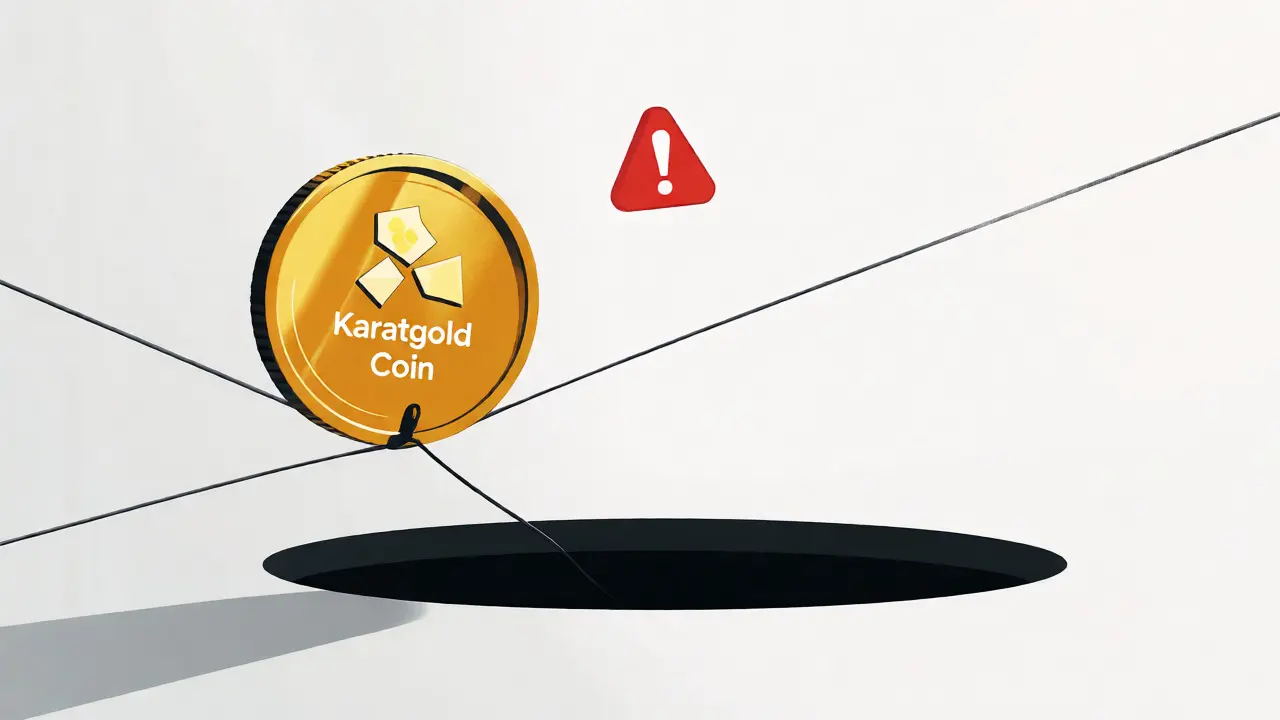
You’re looking at Karatbit and wondering if it’s the next big thing in gold-backed crypto. Maybe you saw a referral link promising high returns or heard about Karatgold Coin (KBC) from a friend. It sounds shiny, literally. But before you deposit your hard-earned cash, there is a massive warning sign flashing red on this platform.
As of late 2025, Karatbit isn’t just "new" or "niche." It is flagged as an Untracked Listing by major data aggregators like CoinMarketCap. That means they don’t even bother reporting volume because the numbers are too low to matter. Worse, regulatory bodies in Canada and Singapore have issued formal alerts against it. This isn’t a case of being overly cautious; it’s a case of seeing a pattern that usually ends with users losing money.
| Feature | Karatbit | Regulated Exchange (e.g., Coinbase) |
|---|---|---|
| Regulatory Status | Unregulated / Alert Listed | Licensed (FCA, MAS, etc.) |
| Data Transparency | Untracked (No Volume Data) | Verified via Blockchain Analytics |
| KYC Requirements | Minimal (Email only) | Strict (ID, Address, Facial) |
| User Support Response | Poor (Weeks delay) | Rapid (Hours/Days) |
What Is Karatbit?
Karatbit launched in February 2019 under Karat Gold Cooperation PTE. LTD., registered in Singapore. On paper, it looks like a standard crypto exchange. In practice, it functions primarily as a trading venue for its own token, Karatgold Coin (KBC). The pitch is simple: each KBC token represents a fractional amount of physical gold. Sounds solid, right? Gold is stable. Crypto is volatile. Combine them, and you get stability, supposedly.
But here’s the catch. Unlike legitimate gold-backed tokens like PAXG or PMGT, which are audited and traded on major exchanges, Karatbit operates in a silo. You can’t easily move your KBC tokens elsewhere because liquidity is virtually non-existent. CoinGecko data from October 2025 shows KBC has only three active trading pairs across all platforms, with a daily volume hovering around $12,450. Compare that to USDT’s $52 billion daily volume, and you realize you’re not trading in a market; you’re trading in a vacuum.
The Regulatory Void
If you live in New Zealand, Australia, or Europe, you know regulators take crypto seriously now. They want licenses. They want audits. They want proof that your money is safe. Karatbit offers none of this. TradersUnion’s October 2025 analysis confirmed that Karatbit is not regulated by any recognized financial authority. No license. No oversight. No protection.
This isn’t just a technicality. The Canadian Securities Administrators (CSA) listed Karatbit in their official investor alert database. Why? Because they identified "characteristics commonly associated with high-risk investment schemes." The UK’s Financial Conduct Authority and Singapore’s Monetary Authority have also flagged it. When multiple government agencies from different countries independently point at the same company and say "be careful," you should listen.
Think about what happens if Karatbit disappears tomorrow. If Binance goes down temporarily, you still own your Bitcoin on the blockchain. If Karatbit vanishes, where do you go? There is no insurance fund. There is no legal recourse in most jurisdictions. Your funds exist only on their private server, and without regulation, there’s no one forcing them to keep those servers running or honest.

User Experience and Technical Issues
Let’s talk about the actual user experience, because reviews tell a grim story. Users on Revain.org report significant interface problems. One user noted, "The exchange has a lot of blank spaces," while another complained about slow load times. These aren’t minor annoyances; they suggest poor infrastructure investment. Legitimate exchanges spend millions on uptime and security. Karatbit seems to be cutting corners everywhere else.
Security protocols are another black box. Established exchanges publish Proof-of-Reserves reports regularly. They use cold storage for the majority of assets. They undergo third-party audits. Karatbit? Nothing. No public audit reports. No clear breakdown of how much gold actually backs the coins. Dr. Elena Rodriguez’s 2025 academic paper on gold-backed crypto fraud patterns identifies "unverifiable gold reserves" as a key red flag. Karatbit fits this description perfectly.
Withdrawal issues are the most common complaint. A user named 'CryptoSafetyFirst' reported attempting to withdraw 0.5 ETH and getting blocked due to fabricated "KYC issues." Another user, 'GoldSaver2025,' deposited SGD 2,500 and found their tokens suddenly marked "unavailable" after an overnight interface change. Customer support ignored 17 emails over 32 days. Imagine waiting a month for a reply while your money sits in limbo.
The Referral Trap
One specific mechanic raises eyebrows: withdrawal conditions tied to referrals. Some users reported needing to refer five new users within 72 hours just to process a withdrawal. This structure screams pyramid scheme. In a healthy exchange, you trade because you want to buy or sell. Here, the system seems designed to incentivize recruitment over actual trading utility. The Canadian CSA specifically cited these "pyramid scheme characteristics" in their investigation.
Furthermore, referral commissions are reportedly excessive, sometimes exceeding 30%. Where does that money come from? Usually, it comes from new deposits. This creates a cycle where early investors get paid from later entrants’ pockets. Once new inflows dry up, the model collapses. And given KBC’s price drop from $0.082 in January 2025 to $0.014 by October 2025, the inflows are definitely drying up.

Why Liquidity Matters
You might think, "I’ll just hold the gold backing." But holding a token that nobody wants to buy is risky. If you need to exit your position quickly-say, you have an emergency-you can’t just click "sell" and get out at market price. With such low volume, a single large sell order could crash the price further. You become a prisoner of the platform’s internal pricing mechanisms.
Compare this to Perth Mint’s PMGT token, which accounts for nearly 90% of the legitimate gold-backed crypto volume. PMGT trades on regulated exchanges with transparent order books. Karatbit trades in the shadows. The global gold-backed crypto market was valued at $2.3 billion in Q3 2025, but Karatbit captures a negligible slice of that pie. Most of that value flows to compliant, audited projects.
Final Verdict: Should You Invest?
Is Karatbit a scam? Technically, we can’t prove intent until a court says so. But is it safe? Absolutely not. The combination of zero regulation, unverifiable reserves, poor user support, and declining token value makes it a highly speculative gamble rather than an investment.
J.P. Morgan’s Digital Asset Report predicts a 90% failure rate for unlicensed gold-backed exchanges within 18 months. Karatbit fits the profile of a platform likely to fail. If you are already in, try to withdraw small amounts first to test the waters. Do not assume you can pull out large sums instantly. If you are considering entering, ask yourself: why choose a platform with no oversight when regulated alternatives exist?
For most people, the risk-reward ratio here is terrible. You’re taking on maximum risk for minimal upside potential. Stick to exchanges with track records, audits, and licenses. Your peace of mind is worth more than a potentially inflated referral bonus.
Is Karatbit regulated?
No, Karatbit is not regulated by any major financial authority. It has been flagged by regulators in Canada, the UK, and Singapore for lacking proper licensing and oversight.
Can I trust the gold backing of Karatgold Coin?
There is little evidence to support the claim. Unlike audited tokens like PAXG, Karatbit does not publish regular third-party audits proving physical gold reserves match the circulating supply.
Why is Karatbit listed as 'Untracked' on CoinMarketCap?
CoinMarketCap marks exchanges as 'Untracked' when they fail to provide verifiable trading volume data or meet transparency standards. This indicates extremely low activity and potential manipulation.
What are common complaints from Karatbit users?
Users frequently report delayed withdrawals, unresponsive customer support, sudden changes to token availability, and requirements to refer new users to process withdrawals.
Is Karatbit suitable for beginners?
Generally, no. Beginners benefit from regulated environments with consumer protections. Karatbit’s lack of oversight and complex referral-based withdrawal mechanics make it risky for those unfamiliar with crypto pitfalls.