KyberSwap Classic (Optimism) Review: Is It Still Worth Using in 2026?
 May, 30 2026
Remember when swapping tokens on Ethereum mainnet felt like paying a luxury tax? If you’ve been in the game since 2021, you know the pain of $50 gas fees for a simple swap. That’s why Layer-2 solutions like Optimism became the lifeline for retail traders. But not all exchanges on Optimism are created equal. You might be looking at KyberSwap Classic, wondering if it’s still a viable option in 2026 or if it’s just legacy tech holding onto relevance.
The short answer? KyberSwap Classic is a reliable workhorse for small-to-medium swaps, but it’s showing its age. While it offers rock-bottom fees and decent routing, it lacks the liquidity depth and modern features of newer competitors. Let’s break down exactly what you’re getting into, whether it’s worth your time, and how it stacks up against the current landscape of Optimism-based trading.
What Exactly Is KyberSwap Classic?
To understand KyberSwap Classic, you first need to separate it from the broader Kyber Network brand. Kyber Network, founded back in 2017 by Loi Luu, Victor Tran, and Yaron Velner, was one of the pioneers of decentralized finance. They built an infrastructure that allows different blockchains to talk to each other. KyberSwap Classic is the specific implementation of their original concentrated liquidity model on various chains, including Optimism.
Unlike centralized exchanges like Coinbase or Binance, where you send your money to them and they hold it, KyberSwap is non-custodial. Your assets never leave your wallet until the moment of the swap. This means no KYC (Know Your Customer) hurdles, no frozen accounts, and total privacy. However, it also means there’s no customer support hotline if things go wrong. You are responsible for your keys, your gains, and your losses.
The "Classic" label is important here. Kyber has since launched "KyberSwap Elastic," which uses dynamic fee tiers. Classic sticks to a fixed 0.3% fee structure for standard pairs. Think of Classic as the stable, predictable older sibling, while Elastic is the flashy new kid with more complex mechanics. For most users, Classic is simpler to understand, even if it’s less capital-efficient for liquidity providers.
The Core Value: Aggregation and Low Fees
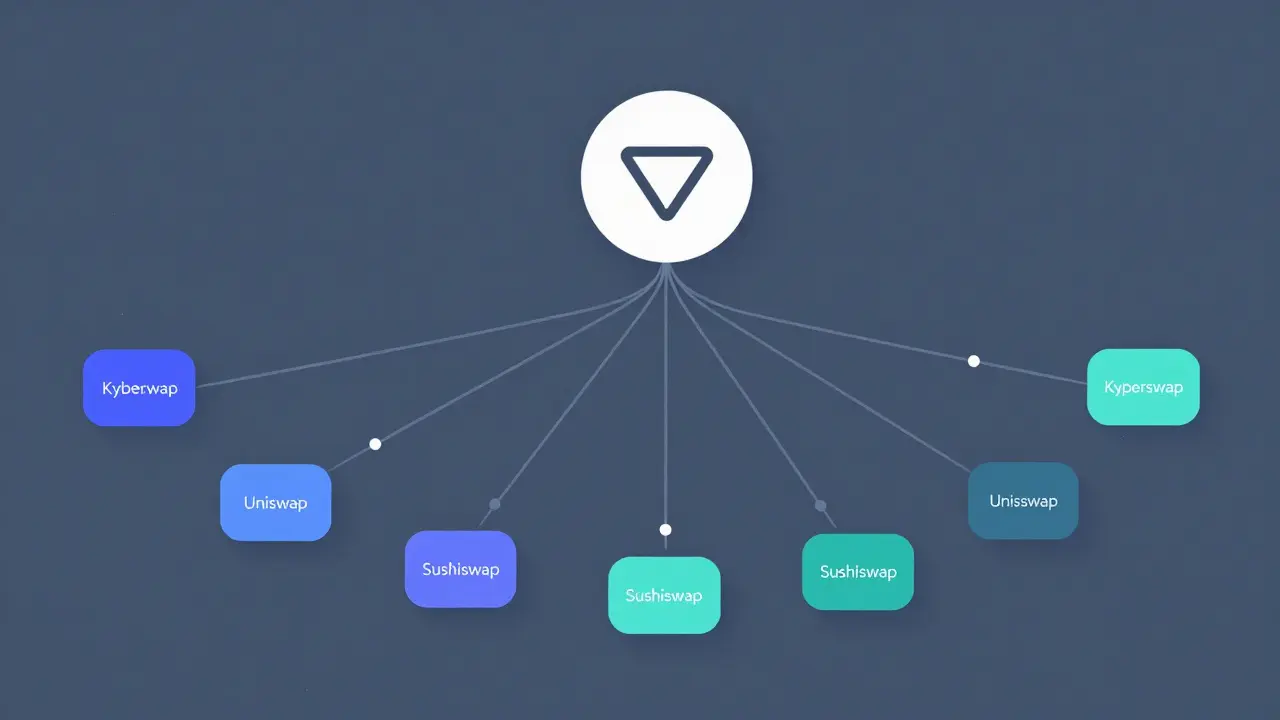
So, why use KyberSwap Classic instead of just going directly to Uniswap or Velodrome? The secret sauce is aggregation. When you initiate a swap on KyberSwap, it doesn’t just look at its own liquidity pools. It scans over 15 different liquidity sources-including Uniswap, Sushiswap, and 1inch-to find the best possible price for you.
This matters because liquidity is fragmented. A token might have better pricing on one pool than another. By splitting your trade across multiple sources, KyberSwap minimizes slippage (the difference between the expected price and the executed price). In benchmarking studies from 2023, this aggregation saved users an average of 0.5% to 2.3% per trade compared to using a single DEX. On a $1,000 trade, that’s $5 to $23 saved instantly.
Then there’s the cost factor. Because KyberSwap Classic operates on Optimism, you benefit from the Layer-2 scaling solution. Transaction finality takes about 12 minutes (matching Ethereum’s block time), but the gas fees are negligible. We’re talking about $0.01 to $0.05 per swap. Compare that to Ethereum mainnet fees, which can spike to $10 or more during busy periods, and the savings are obvious. This makes KyberSwap Classic ideal for frequent, smaller trades where high fees would eat into your profits.
| Feature | KyberSwap Classic | Velodrome Finance | Synapse Protocol |
|---|---|---|---|
| Primary Model | Aggregator + AMM | Ve(3,3) Voting Escrow AMM | Cross-chain Bridge & Swap |
| Average Gas Fee | $0.01 - $0.05 | $0.01 - $0.05 | $0.01 - $0.05 |
| Fee Structure | Fixed 0.3% | Variable (Governance) | Dynamic |
| Liquidity Depth | Moderate ($18k avg) | High ($127k avg) | High (Cross-chain) |
| Best For | Small/Medium Swaps | Large Trades & Yield Farming | Cross-chain Transfers |
Where KyberSwap Classic Falls Short
No platform is perfect, and KyberSwap Classic has some glaring weaknesses that you need to be aware of before committing funds. The biggest issue is liquidity depth. While the aggregation helps, the native liquidity within KyberSwap’s own pools is relatively shallow. Data from late 2023 showed an average order book depth of around $18,500 for top pairs, compared to over $127,000 on Velodrome.
Why does this matter? If you’re trying to swap $100 or $500, you’ll likely get a great rate. But if you’re moving $50,000, you’ll experience significant slippage. The platform simply isn’t designed for whale-sized transactions. For large orders, you’d be better off using a specialized limit-order protocol or breaking the trade into smaller chunks across different platforms.
Another downside is the user interface. While functional, many users describe it as "dated" compared to sleeker competitors like Matcha or CowSwap. Beginners often struggle with the liquidity provision interface, particularly when trying to set up concentrated liquidity positions. Only about 32% of new liquidity providers configure their price ranges correctly on the first try, according to internal data. This steep learning curve can lead to failed transactions or suboptimal yields.
Additionally, KyberSwap Classic lacks advanced trading features. There are no native limit orders, stop-losses, or take-profit functions built directly into the Classic interface. If you want these tools, you’ll need to integrate with third-party services or move to a more sophisticated platform. For active day traders who rely on precise entry and exit points, this limitation is a dealbreaker.
Security and Trust: What You Need to Know
In the world of DeFi, security isn’t just a feature; it’s the foundation. KyberSwap Classic relies on the security of the underlying blockchain-Optimism-and its smart contracts written in Solidity. As of mid-2026, there have been no major reported exploits specific to KyberSwap Classic on Optimism, which is a strong track record.
However, "non-custodial" doesn’t mean "risk-free." The risks shift from the exchange being hacked to user error. Common pitfalls include:
- Phishing Attacks: Always double-check the URL. Scammers create fake sites that look identical to KyberSwap to steal your private keys.
- Smart Contract Risk: While audited, smart contracts can still have bugs. Interacting with unverified tokens can expose you to malicious code.
- Wallet Vulnerabilities: Your security is only as strong as your weakest link. If your MetaMask or Trust Wallet is compromised, your assets are gone.
It’s also worth noting that KyberSwap operates without traditional regulatory oversight. FXVerify reported zero high-trust regulators overseeing the platform. This aligns with the ethos of decentralization but means you have no recourse if something goes wrong. Unlike a regulated bank or exchange, there’s no insurance fund to reimburse you for losses due to hacks or errors.
Who Should Use KyberSwap Classic?
Not every trader needs the same tool. Here’s a quick guide to help you decide if KyberSwap Classic fits your strategy:
Use KyberSwap Classic if:
- You’re making frequent, small-to-medium swaps (under $10,000).
- You prioritize low fees and speed over advanced features.
- You want simplicity and don’t want to navigate complex yield farming interfaces.
- You’re already in the Optimism ecosystem and want to minimize bridging costs.
Avoid KyberSwap Classic if:
- You’re executing large trades (over $50,000) where liquidity depth matters.
- You require advanced order types like limit or stop-loss orders.
- You’re a beginner who finds DeFi interfaces confusing and wants hand-holding.
- You’re looking for high-yield farming opportunities with governance rewards.
Getting Started: A Practical Guide
If you’ve decided to give KyberSwap Classic a try, here’s how to do it safely and efficiently:
- Set Up Your Wallet: Install an EVM-compatible wallet like MetaMask. Ensure you have a backup of your seed phrase stored offline.
- Add Optimism Network: Go to the Optimism Gateway or use a bridge service to add the Optimism network to your wallet. You’ll need ETH on Optimism to pay for gas fees.
- Bridge Assets: Transfer your assets from Ethereum mainnet or another chain to Optimism. This process typically takes 4-12 hours depending on network congestion.
- Connect to KyberSwap: Visit the official KyberSwap website and connect your wallet. Double-check the URL to avoid phishing sites.
- Execute Your Swap: Select the tokens you want to swap, enter the amount, and review the quote. Pay attention to the estimated output and slippage tolerance.
- Confirm the Transaction: Approve the transaction in your wallet. Wait for confirmation on the Optimism network.
Pro Tip: Before making a large trade, test the process with a small amount first. This helps you familiarize yourself with the interface and ensures your wallet settings are correct.
The Future of KyberSwap on Optimism
The DeFi landscape moves fast. KyberSwap Classic is part of a larger ecosystem that is constantly evolving. Kyber Network has announced plans to migrate many of its Classic implementations to KyberSwap Elastic, which offers dynamic fee tiers and improved capital efficiency. This migration aims to address some of the limitations of the Classic model, such as rigid fee structures and lower liquidity provider incentives.
For now, KyberSwap Classic remains a solid option for straightforward swaps on Optimism. Its aggregator technology continues to provide value by finding the best rates across multiple sources. However, as competition intensifies with newer, more specialized DEXs emerging on Layer-2 networks, KyberSwap will need to innovate to maintain its market share.
Keep an eye on updates from Kyber Network regarding the Elastic migration. If you’re heavily invested in the platform, staying informed about these changes will help you adapt your strategy accordingly. The future of DeFi is multi-chain and agile, and platforms that fail to evolve risk becoming obsolete.
Is KyberSwap Classic safe to use?
Yes, KyberSwap Classic is generally safe as it is non-custodial and relies on secure smart contracts. However, users must protect their private keys and beware of phishing sites. There have been no major hacks specific to the platform, but always verify contract addresses and use reputable wallets.
What are the fees for using KyberSwap Classic?
KyberSwap Classic charges a fixed 0.3% fee for standard trading pairs. Additionally, you pay minimal gas fees on the Optimism network, typically ranging from $0.01 to $0.05 per transaction. These fees are significantly lower than those on Ethereum mainnet.
Can I provide liquidity on KyberSwap Classic?
Yes, you can provide liquidity using the concentrated liquidity model. This allows you to allocate capital within specific price ranges for higher efficiency. However, the interface can be complex for beginners, and you should carefully manage your price ranges to avoid impermanent loss.
How does KyberSwap Classic compare to Velodrome?
Velodrome has deeper liquidity and offers yield farming incentives, making it better for large trades and passive income seekers. KyberSwap Classic excels in aggregation, finding the best prices across multiple sources, which is ideal for small-to-medium swaps where saving on slippage is key.
Do I need KYC to use KyberSwap Classic?
No, KyberSwap Classic is a decentralized exchange (DEX) and does not require any Know Your Customer (KYC) verification. You can start trading immediately after connecting your cryptocurrency wallet, maintaining full anonymity and control over your assets.