Protocol Incentives for Liquidity Providers: A 2026 Guide to Sustainable DeFi Yield
 Sep, 5 2026
You put $10,000 into a liquidity pool last year. You earned 15% in token rewards. But when you checked your wallet today, your total value dropped by 4%. What happened? You didn't lose money to fees or hacks. You lost it to impermanent loss, and the reward tokens you were paid had crashed in value. This scenario plays out daily across decentralized finance (DeFi). While liquidity providers (LPs) keep markets running by supplying capital to trading pairs, they face a complex math problem: how do you earn more than you lose?
Protocol incentives are the structured reward mechanisms designed to solve this exact problem. They aren't just "free money." They are sophisticated economic tools that balance risk, reward, and market stability. As of early 2026, the landscape has shifted dramatically from the wild west of high-yield farming to sustainable models like Protocol-Owned Liquidity (POL). If you want to survive as an LP in today's market, you need to understand not just how to farm, but why protocols pay you, and what those payments actually cost you in hidden risks.
The Evolution of Liquidity Rewards
In the early days of DeFi, around 2018-2020, incentives were simple. Protocols like Uniswap and Balancer shared trading fees with anyone who provided liquidity. It was straightforward: if people traded ETH for USDC, you got a slice of the fee. But relying solely on fees wasn't enough to attract massive capital. So, protocols introduced liquidity mining. They printed their own governance tokens-like CRV, UNI, or SUSHI-and handed them out to LPs as extra bonuses.
This worked... until it didn't. By 2023, data showed that slippage costs across DeFi hit $12.7 billion annually. High inflation rates on reward tokens meant their value plummeted faster than LPs could sell them. Today, we are seeing a pivot toward sustainability. The total value locked in incentivized pools is $48.3 billion, but the strategies behind it have matured. We've moved from "renting" liquidity through temporary emissions to "owning" it through bonding curves and treasury management.
Decoding the Reward Layers
Not all incentives are created equal. When you look at a pool's APY, you're usually looking at three distinct layers stacked on top of each other. Understanding these helps you spot which yields are real and which are mirages.
- Trading Fees: This is the baseline. On Uniswap V3, fees range from 0.01% to 1.00% per swap. These are distributed based on your share of the pool within specific price ranges. It's predictable cash flow, often yielding 0.5-1.2% APY on major pairs like ETH/USDC.
- Token Emissions: This is the "liquidity mining" part. Protocols like Curve Finance distribute their native tokens (CRV) based on gauge weights. In 2021, Curve allocated 2.4 million CRV monthly. While this boosts APY to 8-15%, it comes with high churn. Data shows 65-78% of LPs leave once emissions dry up.
- Rebates and Lockups: Some platforms, like PancakeSwap, offer fee rebates (up to 20%) if you lock your LP tokens for 30 days. This reduces immediate liquidity but stabilizes the pool for the protocol.
The catch? Token emissions are inflationary. If a protocol emits 15% of its supply annually to pay LPs, the token's value must grow by more than 15% just to break even. Stanford University research indicates that 83% of protocols with such high emissions create negative net present value for investors within 18 months.
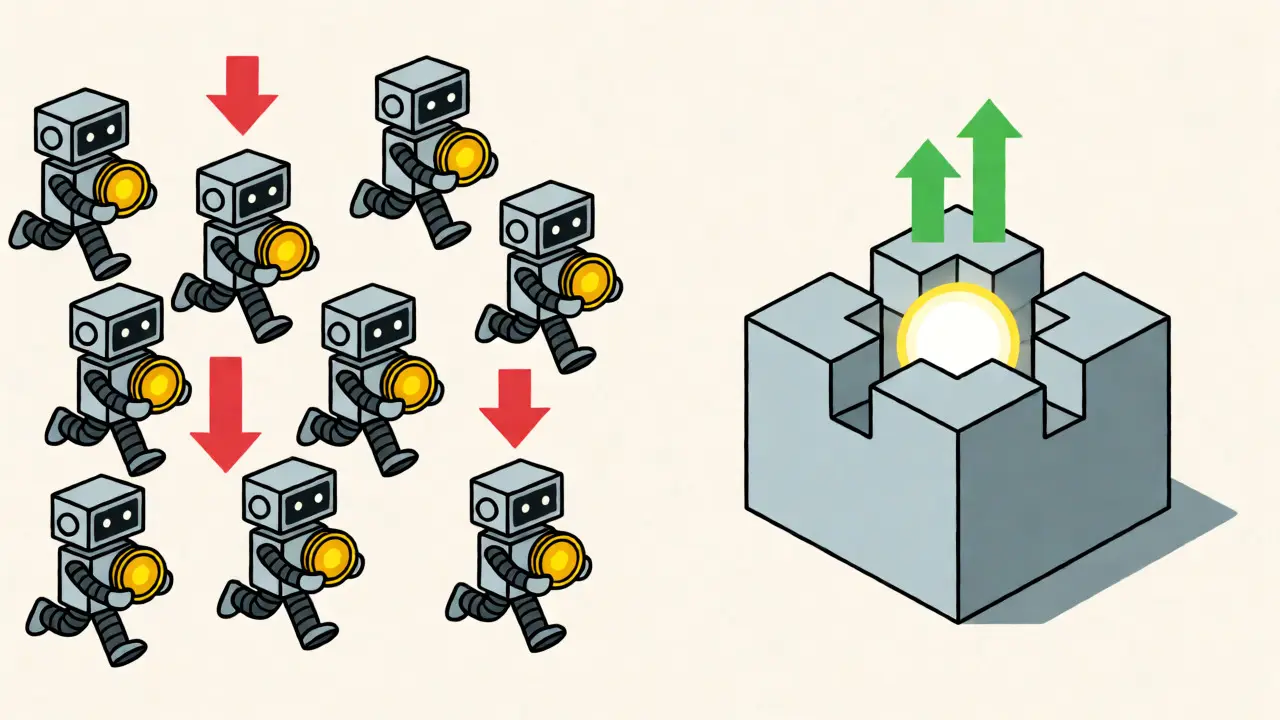
Impermanent Loss vs. Real Yield
Let's address the elephant in the room: impermanent loss (IL). IL occurs when the price ratio of the assets in your pool changes compared to when you deposited them. You end up holding less of the appreciating asset and more of the depreciating one.
A Reddit user recently documented losing 28.7% of their principal on an ETH/USDC pair despite earning 14.2% in rewards. Why? Because ETH rallied hard, and the AMM automatically sold off some ETH to buy USDC, locking in losses relative to simply holding the ETH. For single-asset stakers, IL exceeding reward yields impacts 68% of users during volatile periods.
So, how do you protect against this? Experienced LPs use specialized tools. Gamma Strategies helps manage concentrated liquidity positions on Uniswap V3 to minimize IL. Bancor offers built-in IL protection, though it requires understanding their BNT token mechanics. If you're new, stick to stablecoin pairs like USDC/USDT on Curve. Slippage there is 45-60% lower than non-incentivized pools, and IL is near zero because the peg rarely breaks significantly.
The Rise of Protocol-Owned Liquidity (POL)
If traditional liquidity mining is renting liquidity, Protocol-Owned Liquidity (POL) is buying it. Instead of paying LPs in inflated tokens, the protocol uses its treasury to acquire liquidity positions directly. OlympusDAO pioneered this with its bonding mechanism. Users buy OHM tokens at a discount using DAI, and the protocol adds that DAI/OHM pair to its own liquidity pool.
| Feature | Traditional Liquidity Mining | Protocol-Owned Liquidity (POL) |
|---|---|---|
| Liquidity Ownership | Rented from external LPs | Owned by Protocol Treasury |
| Retention Rate | Low (22-35%) | High (>90%) |
| APY Source | Token Emissions + Fees | Bonding Discounts + Treasury Growth |
| Market Impact | High volatility due to selling pressure | Stable depth, less sell pressure |
| Example Protocol | SushiSwap (early era) | OlympusDAO, Tokemak |
OlympusDAO achieved 99.8% protocol-owned liquidity for its OHM/DAI pair. This means the protocol doesn't rely on fickle retail LPs who dump tokens after a week. However, POL isn't magic. It creates supply-side pressure. OHM's circulating supply jumped from 1.2 million to 14.7 million between 2024 and 2026. If the demand for the token doesn't keep up with this issuance, the price crashes, dragging down the value of everyone's holdings.

Vampire Attacks and Governance Risks
Even with good intentions, incentive design can fail spectacularly. One common failure mode is the vampire attack. This happens when a new protocol launches higher rewards to steal liquidity from an established one. In 2025, vampire attacks accounted for 41% of protocol liquidity losses. SushiSwap famously launched by offering SUSHI tokens to Uniswap LPs, draining billions in TVL overnight.
Governance token devaluation is another silent killer. If you earn rewards in a governance token, your effective APY depends entirely on that token's price. In 2025, 22 out of 30 analyzed protocols saw their effective APY drop by 37-89% because the reward token lost value. This is why "real yield"-fees paid in stablecoins or blue-chip assets-is gaining traction over pure token emissions.
There is also smart contract risk. Even audited protocols face exploits. Immunefi reports a 1.2% annual exploit rate for top-tier protocols. Using insurance services like InsurAce, which covers 85% of top protocols for ~0.85% annually, is a prudent move for larger positions.
Practical Strategy for 2026
So, how should you allocate your capital now? The era of chasing 100%+ APY on obscure tokens is ending. Here is a checklist for modern LPing:
- Check the Fee Tier: Ensure the trading fees alone cover your expected gas costs and a portion of potential IL. On Ethereum L1, gas fees average $1.20-$3.50 per transaction. Small trades eat profits fast.
- Analyze Tokenomics: Look at the emission schedule. Is the reward token inflation capped? If emissions exceed 10% of supply annually, be skeptical.
- Diversify Across Layers: Don't put everything in one pool. Mix stablecoin pools (low risk, low yield) with volatile pairs (higher risk, higher potential) and consider POL-based bonds for exposure without direct LP risk.
- Use Automation: Professional LPs use tools like Gelato Network for automated stop-losses and rebalancing. 37% of pro LPs use these services to manage concentrated liquidity ranges.
Remember, liquidity providing is not passive income; it's active portfolio management. The best returns come from understanding the underlying economics, not just clicking "stake." As we head into Q2 2026 with Ethereum's Pectra upgrade reducing staking costs, the efficiency of these systems will improve, but the fundamental rule remains: if the yield looks too good to be true, someone else is likely paying for it.
What is the difference between liquidity mining and protocol-owned liquidity?
Liquidity mining involves paying external users in native tokens to provide liquidity, leading to high turnover and sell pressure. Protocol-Owned Liquidity (POL) involves the protocol using its own treasury to acquire and hold liquidity positions, resulting in higher retention rates and greater market stability, though it increases the circulating supply of the protocol's token.
How does impermanent loss affect my actual returns?
Impermanent loss reduces your position value compared to simply holding the assets. If the price of one asset in the pair rises significantly, the Automated Market Maker (AMM) sells some of it for the other asset. If the impermanent loss exceeds the trading fees and token rewards earned, you end up with less value than if you had just held the coins in your wallet.
Are liquidity mining rewards taxable?
In many jurisdictions, including the US, liquidity mining rewards are considered ordinary income at the fair market value when received. Selling the LP tokens or swapping them may trigger capital gains tax. Regulations vary, so consult a tax professional, especially given recent SEC guidance classifying some rewards as securities.
Why do APY numbers change so frequently?
APY is dynamic. It depends on trading volume (which fluctuates daily), the number of other liquidity providers competing for the same fees, and the current price of the reward token. A sudden influx of new LPs dilutes your share of fees, lowering your APY instantly.
Is it safe to provide liquidity on newer protocols?
Newer protocols carry higher smart contract risk. While audits help, they don't guarantee safety. New protocols also face "vampire attack" risks where competitors launch better incentives to drain liquidity. Always check audit history, team transparency, and whether the protocol has been battle-tested through multiple market cycles.