Public Key Cryptography in Bitcoin: How It Works and Why It Matters
 Nov, 1 2026
Imagine sending $50,000 to a stranger across the internet. You don't know them, they don't know you, and there's no bank acting as a middleman to verify who owns what. Yet, the money arrives safely. The magic behind this isn't trust; it's math. Specifically, it's public key cryptography, the asymmetric system that secures every single transaction on the Bitcoin network.
If you've ever wondered how your wallet knows which coins are yours, or why anyone can send you Bitcoin but only you can spend it, you're asking about public keys. This isn't just technical jargon-it's the lock and key of the digital age. Let's break down exactly how Bitcoin uses these cryptographic tools to keep billions of dollars safe without a central authority.
The Core Concept: Asymmetric Keys vs. Symmetric Locks
Most people understand passwords. If you have a password, you can open your account. That's symmetric cryptography: one secret is used for both locking and unlocking. But Bitcoin doesn't work like that. It uses asymmetric cryptography, also known as public-key cryptography.
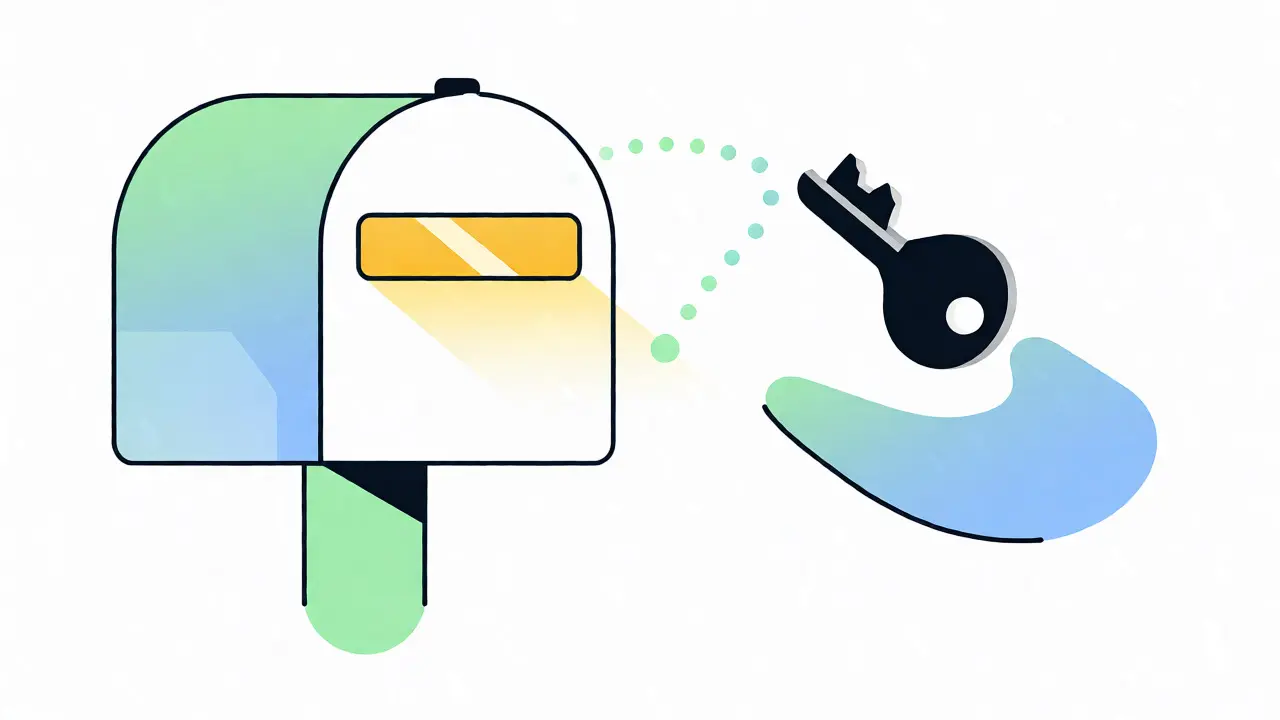
Think of it like a mailbox. Anyone can drop a letter into your mailbox (send Bitcoin to your address). Only you have the physical key to open the mailbox and retrieve the letters (spend Bitcoin). In this analogy:
- The Mailbox Slot: Your Public Key (or derived Address). This is shared with the world.
- The Physical Key: Your Private Key. This stays secret, always.
The critical innovation here is mathematical linkage. The public key is derived from the private key using complex math. However, the reverse is impossible. You cannot calculate the private key if you only have the public key. This one-way street is what makes Bitcoin secure. If someone steals your public key, they can see your balance but can't move your funds. If they steal your private key, they own everything.
Under the Hood: Elliptic Curve Cryptography (ECC)
Bitcoin doesn't use random number generation alone. It relies on a specific type of public key cryptography called Elliptic Curve Cryptography (ECC). More specifically, it uses a curve named secp256k1.
Why an elliptic curve? Because it offers massive efficiency. Older systems like RSA require huge numbers (3072 bits) to achieve strong security. ECC achieves the same level of security with just 256-bit keys. This means smaller transaction sizes, faster verification, and less data clogging the network. Given that Bitcoin processes hundreds of thousands of transactions daily, this efficiency is non-negotiable.
The secp256k1 curve is defined by the equation y² = x³ + 7 over a finite field. While the math looks intimidating, the practical application is straightforward. Your private key is essentially a random number between 1 and n-1. Your public key is the result of multiplying that private key by a fixed point on the curve, known as the generator point G.
| Feature | Bitcoin (ECC secp256k1) | Traditional RSA |
|---|---|---|
| Key Size for ~128-bit Security | 256 bits | 3072 bits |
| Signature Size | ~71-73 bytes | ~384 bytes |
| Verification Speed | Fast (optimized hardware support) | Slower (heavy computation) |
| Primary Use Case | Digital Signatures | Encryption & Signatures |
From Keys to Addresses: The Hashing Process
Here is where many beginners get confused: your public key is not your Bitcoin address. They are related, but distinct.
When you generate a new receiving address in your wallet, the software performs a series of steps:
- Generate Private Key: A random 256-bit integer.
- Derive Public Key: Multiply the private key by the curve's base point. This results in a coordinate pair (x, y).
- Hash the Public Key: The public key is passed through two hashing algorithms: SHA-256 and then RIPEMD-160. This produces a 160-bit hash.
- Add Network Prefix: A version byte is added to identify the network (mainnet vs. testnet).
- Encode: The final step uses Base58Check encoding to create the familiar alphanumeric string starting with '1' (legacy), '3' (script), or 'bc1' (bech32).
Why hash the public key? Two reasons. First, it shortens the address, making it easier to read and share. Second, it adds a layer of security against potential future weaknesses in the elliptic curve mathematics. Even if someone cracks the curve math, they still need to invert the hash function to find your public key, which is computationally difficult.

Signing Transactions: Proving Ownership
Sending Bitcoin isn't about moving digital tokens from one place to another. It's about proving you have the right to spend previous outputs. This is done via a digital signature.
Bitcoin uses the Elliptic Curve Digital Signature Algorithm (ECDSA). When you send BTC, your wallet takes the details of the transaction (who sent it, who receives it, how much) and creates a unique message digest using SHA-256. Then, it uses your private key to sign this digest.
The resulting signature has three properties:
- Authenticity: It proves the signer holds the private key corresponding to the public key in the output script.
- Integrity: Any change to the transaction data invalidates the signature.
- Non-repudiation: You can't deny having signed it later.
Miners and full nodes verify this signature using your public key. If the signature matches, the transaction is valid. If not, it’s rejected. This process happens millions of times a day, securing the ledger without any human intervention.
Recent Upgrades: Schnorr Signatures and Taproot
For over a decade, Bitcoin relied solely on ECDSA. While secure, ECDSA had limitations. It wasn't perfectly linear, meaning combining multiple signatures was inefficient. This changed in November 2021 with the Taproot upgrade.
Taproot introduced Schnorr signatures, a more advanced form of public key cryptography. Unlike ECDSA, Schnorr signatures allow for aggregation. If five people need to sign a transaction (a multisig setup), ECDSA requires five separate signatures on the blockchain. Schnorr allows them to combine those five signatures into one single signature that looks identical to a standard single-signature transaction.
This brings two major benefits:
- Privacy: Complex smart contracts look simple on-chain. Outsiders can't tell if a transaction involved a simple payment or a complex multi-party agreement.
- Efficiency: Smaller transaction sizes mean lower fees for everyone.
This shift demonstrates Bitcoin's ability to evolve its cryptographic foundation while maintaining backward compatibility.

Common Pitfalls and Best Practices
Understanding the theory is one thing; managing the reality is another. Most losses in Bitcoin aren't due to hackers cracking the encryption-they’re due to user error regarding key management.
Confusing Formats: Private keys can appear as raw hex strings or Wallet Import Format (WIF). Compressed and uncompressed public keys look different and derive different addresses. Mixing these up can make funds seem "lost" when they are actually just at a different address.
Reusing Keys: While technically possible, reusing the same public key for multiple transactions reduces privacy. Advanced analysis can cluster your spending habits. Modern wallets automatically generate new addresses for each transaction to prevent this.
Quantum Computing Threats: Some fear quantum computers will break Bitcoin's encryption. Current estimates suggest we need powerful, error-corrected quantum computers to break ECDSA. Most experts believe Bitcoin has time to migrate to post-quantum algorithms before this becomes a critical risk. The network's soft-fork mechanism allows for such upgrades without splitting the chain.
Why This Matters for Developers and Users
For developers, understanding public key cryptography is essential for building wallets, exchanges, and payment processors. You need to handle key derivation paths (BIP32/BIP44) correctly to ensure users can recover their funds. Incorrect sighash flags or malformed DER encodings can cause transaction failures.
For users, the takeaway is simple: protect your private key. It is the only proof of ownership. No customer support agent can reset it. No government can seize it if it's stored offline. Conversely, never expose your private key unnecessarily. Your public key/address is safe to share publicly; your private key is not.
Can someone hack my Bitcoin if they know my public key?
No. Knowing your public key allows anyone to see your transaction history and current balance, but it does not allow them to spend your Bitcoin. Spending requires a digital signature created with your private key, which cannot be derived from the public key due to the discrete logarithm problem in elliptic curve cryptography.
What is the difference between a public key and a Bitcoin address?
A public key is a direct mathematical result of your private key (an elliptic curve point). A Bitcoin address is a hashed version of your public key (specifically, the RIPEMD-160 hash of the SHA-256 hash of the public key). Addresses are shorter, easier to read, and provide an extra layer of security against potential cryptographic weaknesses.
Is Bitcoin's cryptography vulnerable to quantum computers?
Potentially, yes. Shor's algorithm on a sufficiently powerful quantum computer could derive private keys from public keys, breaking ECDSA. However, such computers do not yet exist. Bitcoin developers are actively researching post-quantum cryptography alternatives, and the network can upgrade its signature schemes via soft forks before quantum threats become imminent.
Why did Bitcoin switch to Schnorr signatures?
The Taproot upgrade enabled Schnorr signatures to improve privacy and scalability. Schnorr signatures allow for signature aggregation, meaning multiple signatures can be combined into one. This makes multisignature transactions look like single-signature transactions on the blockchain, enhancing privacy and reducing transaction size and fees.
What happens if I lose my private key?
If you lose your private key and have no backup (like a seed phrase), your Bitcoin is effectively lost forever. There is no central authority to reset your password or recover the key. The funds remain on the blockchain, but they are unspendable because no one can produce the required digital signature.