Singapore Crypto Regulations and Licensing Framework: The 2026 Guide
 Sep, 7 2026
You might think that running a crypto business in Singapore is as easy as setting up a website and accepting Bitcoin. But if you tried to launch an exchange here today without the right paperwork, the Monetary Authority of Singapore (MAS) would shut you down faster than you can say "blockchain." As of September 2026, the landscape has shifted dramatically from the early days of loose oversight. The Monetary Authority of Singapore is Singapore's central bank and integrated financial regulator, responsible for regulating all financial services including digital tokens. Their approach is strict, clear, and surprisingly comprehensive. If you are planning to operate here, or just want to understand why so many global firms chose this tiny island nation, you need to grasp the current rules.
The Shift From PSA to FSMA: What Changed?
For years, the Payment Services Act (PSA) was the primary law governing payment services and digital token exchanges in Singapore served as the backbone of crypto regulation. Introduced in January 2020, it brought digital payment tokens (DPTs) under a unified framework. But the game changed on June 30, 2025. That was the day the new regime under the Financial Services and Markets Act 2022 (FSMA) is legislation that expanded MAS powers to regulate digital token service providers with extraterritorial reach came into full force. This wasn't just a tweak; it was a complete overhaul. Now, any entity providing digital token services from Singapore must be licensed, even if they only serve overseas clients. There is no transitional period left. If you aren't licensed, you can't operate. Period.
This shift signals MAS's intent to close loopholes that previously allowed some offshore-focused entities to operate with minimal local oversight. It creates a level playing field but raises the barrier to entry significantly. You can't just fly under the radar anymore. The extraterritorial reach means that if your team sits in Singapore, you fall under their jurisdiction, regardless of where your customers are located.
Licensing Tiers: Which One Fits Your Business?
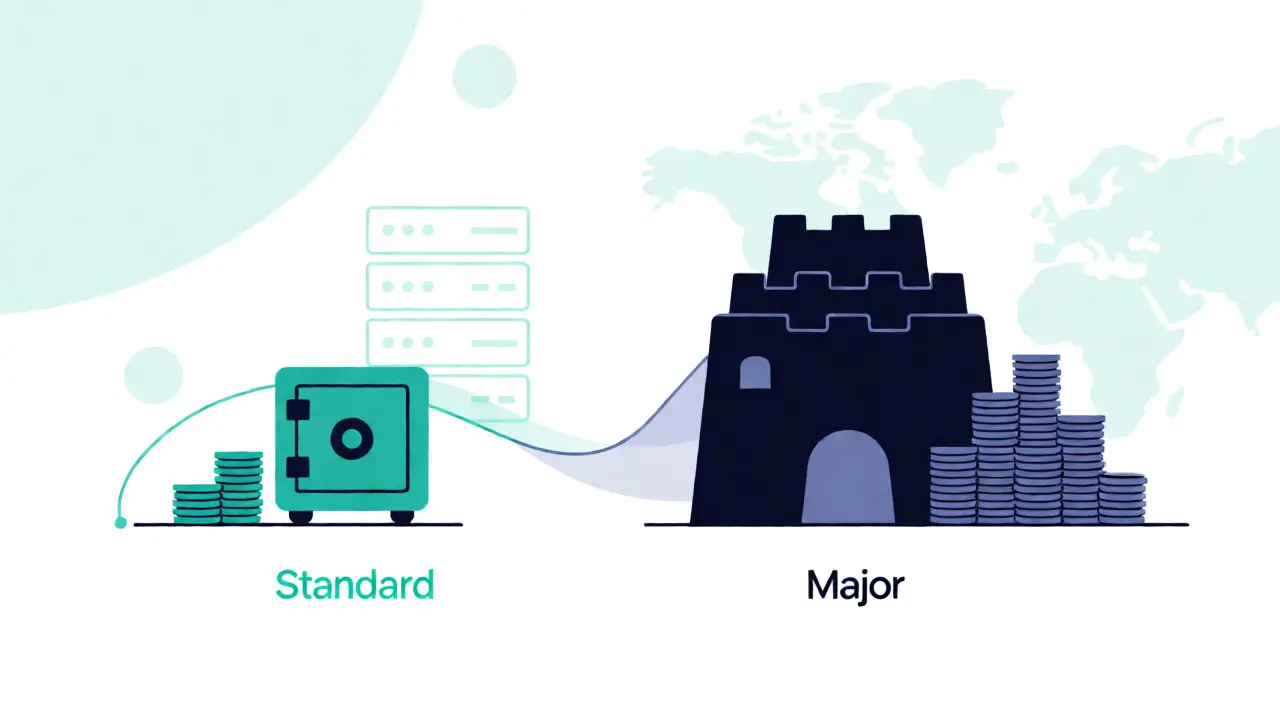
Singapore doesn't believe in a one-size-fits-all approach. The licensing structure is tiered based on transaction volume and risk. Understanding which tier applies to you is the first step to compliance.
| License Type | Monthly Transaction Volume | Minimum Capital Requirement | Target Operator |
|---|---|---|---|
| Standard Payment Institution | Up to SGD 3 million | SGD 100,000 | Small exchanges, wallet providers, payment processors |
| Major Payment Institution | Above SGD 3 million | SGD 250,000 | Large exchanges, institutional platforms, high-volume traders |
| Exempt PSP | Low-risk specific activities | Varies by activity | Niche services with limited scope |
If you are a startup processing less than SGD 3 million monthly, the Standard Payment Institution license is your likely path. It requires SGD 100,000 in paid-up capital. For the big players handling millions daily, the Major Payment Institution license is mandatory, requiring SGD 250,000 and much stricter compliance protocols. The key difference isn't just money; it's the operational burden. Major licensees face enhanced audits, advanced risk management systems, and more frequent reporting to MAS.
Anti-Money Laundering: The Travel Rule in Action
Compliance isn't just about filling out forms. It's about knowing who you are dealing with. The core of Singapore's AML strategy is MAS Notice PSN02 is a regulatory notice detailing anti-money laundering and combating the financing of terrorism guidelines for digital token service providers, often referred to as the Crypto Travel Rule. This rule mandates that every crypto platform must maintain detailed knowledge of its customers' identities and financial activities.
Think of it like traditional banking KYC (Know Your Customer), but applied rigorously to blockchain transactions. You must verify customer identity, monitor transactions for suspicious patterns, and report anomalies to authorities. If you fail to do this, you aren't just risking fines; you risk losing your license. The standard is high because Singapore wants its crypto ecosystem to match the integrity of its traditional banking sector. There is no room for anonymous wallets slipping through the cracks.
Capital Markets and Retail Protections
Not all crypto activities are treated equally. If your platform acts as a market maker or offers securities-like tokens, you might need a Capital Market Services (CMS) license is a license required for entities involved in dealing in securities or fund management involving digital tokens under the Securities and Futures Act. This adds another layer of complexity, ensuring that firms facilitating trading or investment products meet rigorous financial health standards.
Moreover, MAS has introduced specific restrictions to protect retail investors. In 2025, amendments banned the use of credit cards for purchasing cryptocurrencies. Why? To prevent excessive leverage. Buying crypto on margin with borrowed money amplifies losses, and regulators saw too many retail investors getting burned. By blocking credit card purchases, they encourage using cash or debit, promoting more responsible investing habits.

Stablecoins and Innovation Balance
While the rules are strict, Singapore isn't anti-innovation. They have finalized a comprehensive framework for stablecoins, recognizing their role in the broader financial system. Issuers must ensure adequate backing and redemption mechanisms. This clarity attracts fintech companies looking for a predictable environment. Unlike jurisdictions that wait for crises to react, Singapore sets rules proactively. This balance makes it a hub for serious projects, not just speculative ventures.
Global Context: Why Choose Singapore?
How does Singapore stack up against other hubs? Hong Kong has introduced its own licensing regimes, but they are still evolving. The US is moving toward clearer rules, but enforcement actions remain unpredictable. The EU's MiCAR creates transitional uncertainty. Singapore, however, offers immediate operational certainty. Its framework is mature, well-defined, and consistently enforced. For businesses seeking stability, this predictability is worth more than lower taxes or laxer rules elsewhere.
Is Bitcoin legal tender in Singapore?
No, Bitcoin is not legal tender in Singapore. However, it is recognized as a digital payment token (DPT) and is a legal asset. You can buy, sell, and hold it legally, but merchants are not obligated to accept it as payment for goods and services.
Do I need a license if my crypto company serves only overseas clients?
Yes. Under the Financial Services and Markets Act 2022, which came into force in June 2025, any digital token service provider operating from Singapore must be licensed, even if they exclusively serve overseas clients. The location of the operator determines the regulatory requirement.
What is the minimum capital for a Standard Payment Institution license?
The minimum paid-up capital requirement for a Standard Payment Institution license is SGD 100,000. This applies to operators handling monthly transaction volumes up to SGD 3 million.
Can I buy cryptocurrency with a credit card in Singapore?
No. As part of the 2025 regulatory amendments aimed at protecting retail investors from excessive leverage, the use of credit cards for purchasing cryptocurrencies was banned. Debit cards and direct bank transfers remain common methods.
Who regulates cryptocurrency in Singapore?
The Monetary Authority of Singapore (MAS) is the primary regulator. They oversee licensing, anti-money laundering compliance, and consumer protection for digital token service providers under both the Payment Services Act and the Financial Services and Markets Act.