Underground Crypto Premiums in Banned Jurisdictions: China, Afghanistan & Egypt
 Jun, 18 2026
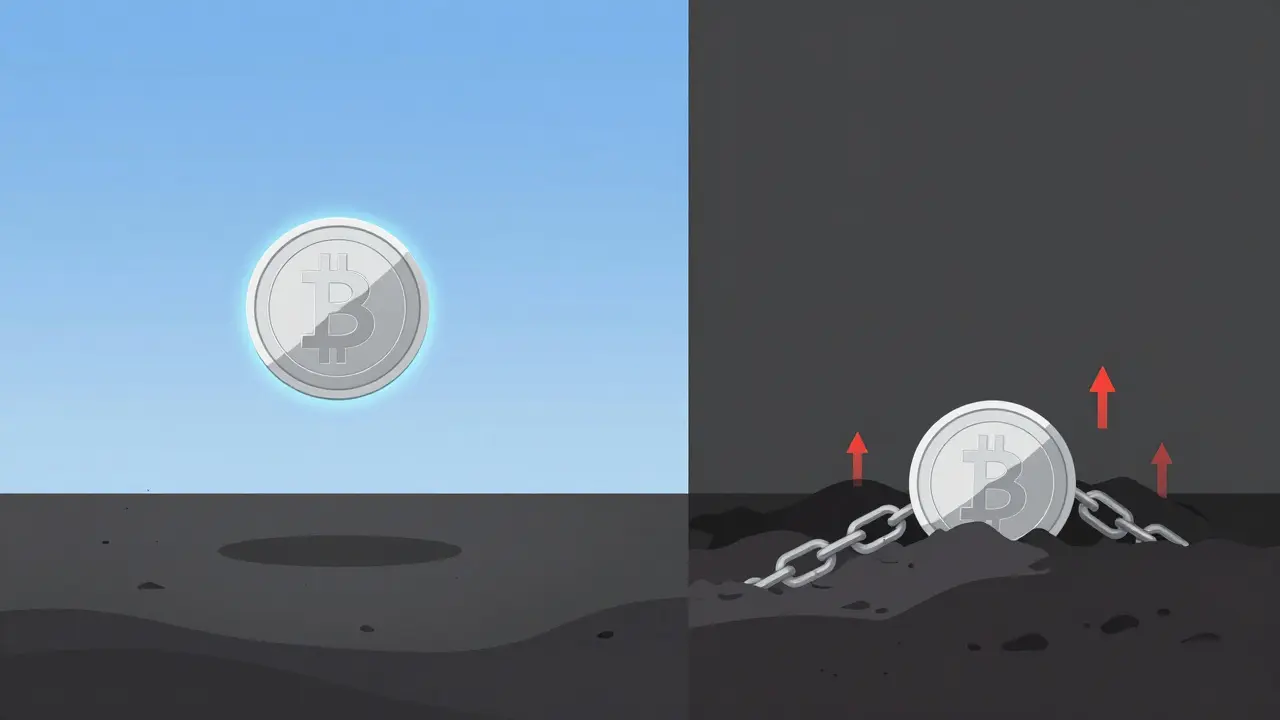
Imagine trying to buy a simple commodity like coffee or gasoline. In most places, the price is set by supply and demand on open exchanges. But what happens when the government declares that owning that commodity is a crime? The price doesn't disappear. It goes underground, and it skyrockets. This is the reality of underground crypto market premiums in jurisdictions where digital assets are prohibited.
As of mid-2026, the global landscape for cryptocurrency has fractured. While many nations have embraced regulation, others have drawn hard lines. These prohibitions create a shadow economy where risk dictates value. When you can’t trade Bitcoin on Coinbase or Binance because it’s illegal, you turn to peer-to-peer (P2P) networks, decentralized exchanges (DEXs), or local cash-for-crypto deals. Each step away from regulated infrastructure adds a layer of cost-a premium-for the buyer and seller.
The Economics of Prohibition: Why Premiums Exist
To understand these premiums, we need to look at basic economic principles applied to a black market. In a free market, prices converge. If Bitcoin trades at $100,000 in New York, it should trade close to that figure in London after accounting for fees. But in a banned jurisdiction, the "free market" is inaccessible.
Three main factors drive the price up in these underground markets:
- Risk Compensation: Sellers face jail time, asset seizure, or social ostracization. They charge extra to cover this danger.
- Liquidity Constraints: Underground markets are small and fragmented. Finding a buyer or seller takes longer, creating wider bid-ask spreads.
- Supply Shortages: With official channels closed, the available supply of crypto is limited to those willing to break the law, driving up demand relative to supply.
This isn't just theory. We see similar dynamics in foreign exchange markets in countries with strict capital controls. When people cannot legally convert their local currency into dollars, they do it on the street at a significant markup. Crypto works the same way, but with higher stakes due to the anonymity and borderless nature of the technology.
China: The Total Ban and the Digital Yuan Shift
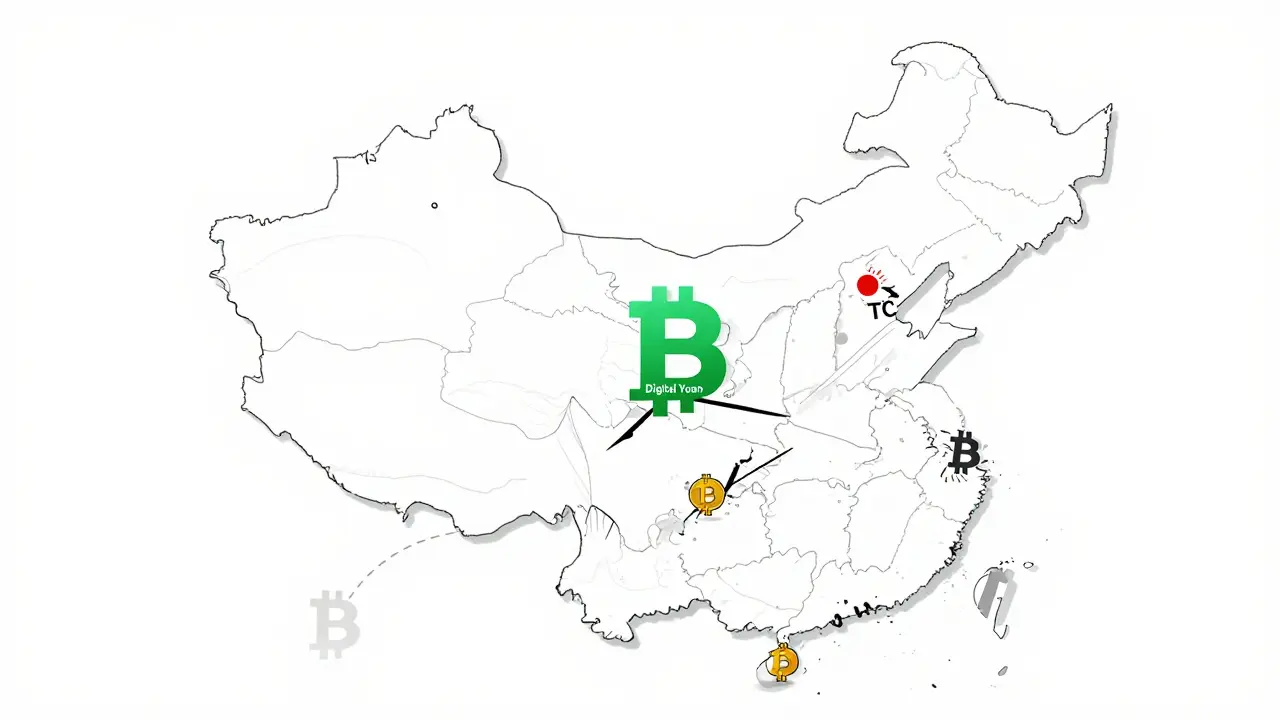
No discussion of banned jurisdictions is complete without looking at China. On May 30, 2025, Beijing took its restrictions to an unprecedented level. The new legislation didn't just ban mining or trading; it criminalized personal ownership of cryptocurrencies like Bitcoin and Ethereum. This was a strategic move to clear the path for the state-backed Central Bank Digital Currency (CBDC), known as the digital yuan.
China's crypto ban represents the most restrictive policy globally. By making private holdings illegal, the government aimed to eliminate any competition to its sovereign digital currency. However, human desire for financial sovereignty doesn't vanish with a law. Instead, it moves deeper underground.
In practice, this means Chinese users seeking Bitcoin must rely on OTC (over-the-counter) dealers or cross-border P2P platforms. These transactions often involve complex escrow arrangements and trusted intermediaries. The premium here isn't just about money; it's about trust. In a vacuum of legal recourse, reputation becomes the only currency. Sellers who can prove their reliability command higher prices, while buyers pay a risk premium to ensure they aren't scammed or caught by authorities monitoring blockchain transactions.
Afghanistan: Religious Edicts and Financial Control
While China’s ban is driven by monetary policy, Afghanistan’s prohibition stems from religious interpretation and regime stability. Since taking power in 2022, the Taliban regime has declared all cryptocurrency activities "haram" (forbidden) under Sharia law. The justification is twofold: religious purity and maintaining control over a fragile financial system.
Enforcement is handled by Da Afghanistan Bank (DAB) and the Financial Transactions and Reports Analysis Center of Afghanistan (FinTRACA). They have shut down exchanges, arrested traders, and confiscated funds. Yet, despite these efforts, crypto usage persists. For Afghans facing international sanctions and banking isolation, crypto offers a lifeline to send remittances abroad or preserve wealth against inflation.
The underground premium in Afghanistan is likely among the highest in the world. The risks are existential-arrest can mean severe punishment. Consequently, only deeply embedded networks facilitate these trades. The lack of transparency makes exact pricing data unavailable, but the operational costs for sellers are immense. They must use privacy-focused tools and avoid digital footprints entirely, which limits the volume of trade and drives up the per-unit cost.
Egypt and Nigeria: Enforcement vs. Reality
Not all bans are absolute, but some are aggressive enough to function as de facto prohibitions. Egypt imposed a blanket ban on crypto trading, yet in 2025 alone, authorities arrested 112 individuals for violations. This high arrest rate signals active underground activity. When the police are actively hunting traders, the premium reflects the intensity of that hunt.
Nigeria presents a different case. While not fully banned, the Economic and Financial Crimes Commission (EFCC) seized $38 million in crypto assets linked to cybercrime in 2024, a 27% increase from the previous year. This aggressive enforcement creates a chilling effect. Legitimate businesses may hesitate to operate openly, pushing more activity into gray areas where premiums emerge due to uncertainty and fear of seizure.
The Role of Technology in Shadow Markets
Technology plays a dual role in these underground economies. On one hand, blockchain analytics firms help governments track illicit flows. On the other, new technologies enable users to evade detection.
Decentralized Exchanges (DEXs) allow users to swap tokens without a central intermediary holding their keys. Platforms like Uniswap or SushiSwap don't require KYC (Know Your Customer) checks, making them attractive in banned regions. However, using DEXs requires technical knowledge and exposure of wallet addresses, which can still be traced if linked to real-world identity.
This is where privacy coins come in. Cryptocurrencies like Monero (XMR) and Zcash (ZEC) offer enhanced anonymity features. In banned jurisdictions, these assets often command higher premiums than transparent coins like Bitcoin. Why? Because they reduce the risk of detection. A seller in Cairo or Kabul is more willing to accept Monero than Bitcoin because it leaves fewer forensic trails. This demand for privacy directly inflates the price of these specific assets in restricted markets.
| Jurisdiction | Ban Type | Primary Driver | Enforcement Intensity | Theoretical Premium Level |
|---|---|---|---|---|
| China | Total Ownership Ban | CBD Promotion | High (Surveillance) | Very High |
| Afghanistan | Religious/Legal Ban | Sharia Law/Stability | Moderate (Arrests) | Extremely High |
| Egypt | Trading Ban | Capital Control | High (Arrests) | High |
| Nigeria | Strict Regulation | Crime Prevention | Moderate (Seizures) | Moderate |
Global Regulatory Pressure and Emerging Markets
The trend isn't limited to outright bans. Across emerging markets, regulatory pressure is intensifying. As of 2025, 83% of emerging market countries implemented mandatory registration for Virtual Asset Service Providers (VASPs). This is up from 66% in 2023. Compliance is expensive. It requires robust Anti-Money Laundering (AML) systems, customer due diligence, and reporting mechanisms.
When compliance costs rise, some operators choose to go underground rather than pay. India’s Financial Intelligence Unit (FIU) fined non-compliant platforms $9.5 million in 2024. South Africa suspended licenses for 12 firms failing AML requirements. The Philippines blacklisted 20 unlicensed exchanges, freezing $150 million in funds. These actions push users toward less regulated, riskier channels where premiums exist simply because the service provider is operating outside the law.
Measuring the Unmeasurable: Data Challenges
One of the biggest hurdles in studying underground crypto premiums is data availability. By definition, these markets are hidden. Participants do not publish transaction records. Blockchain explorers can show transfers, but they cannot easily link them to fiat prices paid in cash or through informal barter systems.
Researchers rely on proxies. They might analyze P2P platform order books, though these are often manipulated or fake. They might look at arbitrage opportunities between compliant and non-compliant exchanges. Or they might use anecdotal evidence from journalists and whistleblowers. All of these methods have limitations. The true premium is a moving target, fluctuating daily based on news cycles, enforcement raids, and geopolitical events.
Despite the lack of precise numbers, the direction is clear. Wherever there is a ban, there is a premium. And wherever there is a premium, there is an incentive for innovation-both in evasion techniques by users and detection methods by regulators.
Future Outlook: Will Bans Hold?
History suggests that total bans on financial instruments rarely succeed in the long term. Prohibition tends to drive activity underground, making it harder to tax, regulate, or monitor. For governments, this is a paradox. They ban crypto to protect their monetary sovereignty, but in doing so, they lose visibility into capital flows.
By June 2026, the Financial Action Task Force (FATF) noted that 99 jurisdictions had passed or were passing crypto-related legislation. The global consensus is shifting from "ban everything" to "regulate everything." Countries that maintain hard bans risk becoming isolated financially. Their citizens will continue to use crypto, but they will do so in shadows, paying heavy premiums and exposing themselves to greater risks.
For investors and observers, understanding these premiums provides insight into the true cost of freedom in the digital age. It shows how resilient the demand for decentralized finance is, even in the face of state coercion. The underground market is not just a glitch; it is a feature of a world where technology outpaces regulation.
What causes crypto premiums in banned countries?
Premiums are caused by the combination of high risk for sellers (potential arrest or fines), low liquidity (fewer buyers and sellers), and restricted supply. Sellers charge extra to compensate for the danger of operating illegally.
Is it legal to use crypto in China?
No. As of May 2025, China has banned all personal ownership, trading, and mining of cryptocurrencies. Possession is criminalized to promote the adoption of the digital yuan.
Why is Monero more valuable in banned jurisdictions?
Monero offers enhanced privacy features that make transactions harder to trace. In countries with strict surveillance, users prefer privacy coins to avoid detection, driving up demand and price premiums compared to transparent blockchains like Bitcoin.
How do people trade crypto in Afghanistan?
Traders in Afghanistan rely on informal peer-to-peer networks and trusted intermediaries. Due to the Taliban's ban citing Sharia law, transactions are often conducted in cash or through encrypted messaging apps to avoid detection by authorities like FinTRACA.
Do underground crypto markets affect global prices?
Generally, no. Underground markets are too small and fragmented to impact global spot prices significantly. However, they can create localized arbitrage opportunities and indicate stress in specific regional economies.