Understanding Circulating Supply in Market Cap
 Mar, 14 2026
When you see a cryptocurrency priced at $0.01, it’s easy to think it’s a bargain. But what if that coin has 100 billion tokens in circulation? Meanwhile, another coin costs $50,000 - but only 1 million are out there. Which one is actually more valuable? The answer isn’t in the price per coin. It’s in circulating supply.
Circulating supply is the number of coins or tokens that are actively trading in the market. It’s not the total number ever created. It’s not the maximum limit either. It’s just what’s out there, in people’s wallets, on exchanges, and being bought and sold right now. This number is the heartbeat of market cap - the single most important metric for comparing cryptocurrencies.
What Is Circulating Supply?
Circulating supply is the best estimate of how many coins are actually available for trading. It excludes tokens that are locked up, reserved for team members, held in treasury wallets, or not yet mined. For example, Bitcoin’s circulating supply is around 19.5 million as of 2026. That’s not because only 19.5 million were created - it’s because 19.5 million have been mined and released into the public market. The rest, the final 1.5 million out of the 21 million cap, are still waiting to be mined over the next few decades.
Some coins have tokens locked in smart contracts. Maybe the team can’t touch their 30% allocation for another year. Or maybe a large portion of tokens are locked in staking pools. None of those count toward circulating supply. Only the coins that can be freely bought, sold, or transferred today matter.
Platforms like CoinMarketCap and CoinGecko track this data by analyzing blockchain activity, exchange listings, and project disclosures. They don’t have perfect visibility - no one does - but they use the best available data to give you the closest real-time picture possible.
How Market Cap Works
Market capitalization - or market cap - is calculated with one simple formula:
Market Cap = Current Price × Circulating Supply
That’s it. No fancy math. No hidden variables. Just multiply the price of one coin by how many are out there trading.
Let’s look at two real examples:
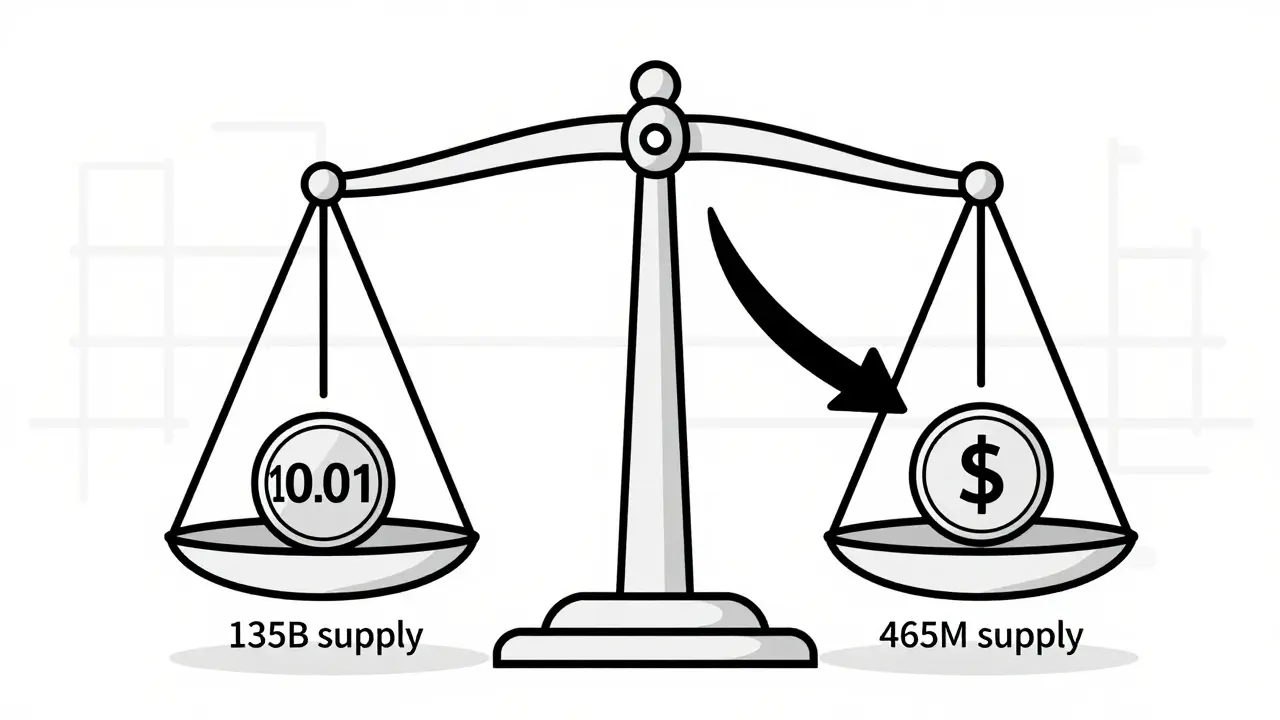
- Dogecoin (DOGE): Price ≈ $0.07, Circulating Supply ≈ 135 billion → Market Cap ≈ $9.45 billion
- Solana (SOL): Price ≈ $145, Circulating Supply ≈ 465 million → Market Cap ≈ $67.4 billion
Even though Dogecoin costs less than a penny, Solana is worth over seven times more. Why? Because Solana has fewer coins in circulation - and more demand. That’s the power of circulating supply. It flips the script on price perception. A $10,000 Bitcoin isn’t ‘expensive’ - it’s just rare. A $0.01 token isn’t ‘cheap’ - it might be everywhere.
Circulating Supply vs. Total Supply vs. Maximum Supply
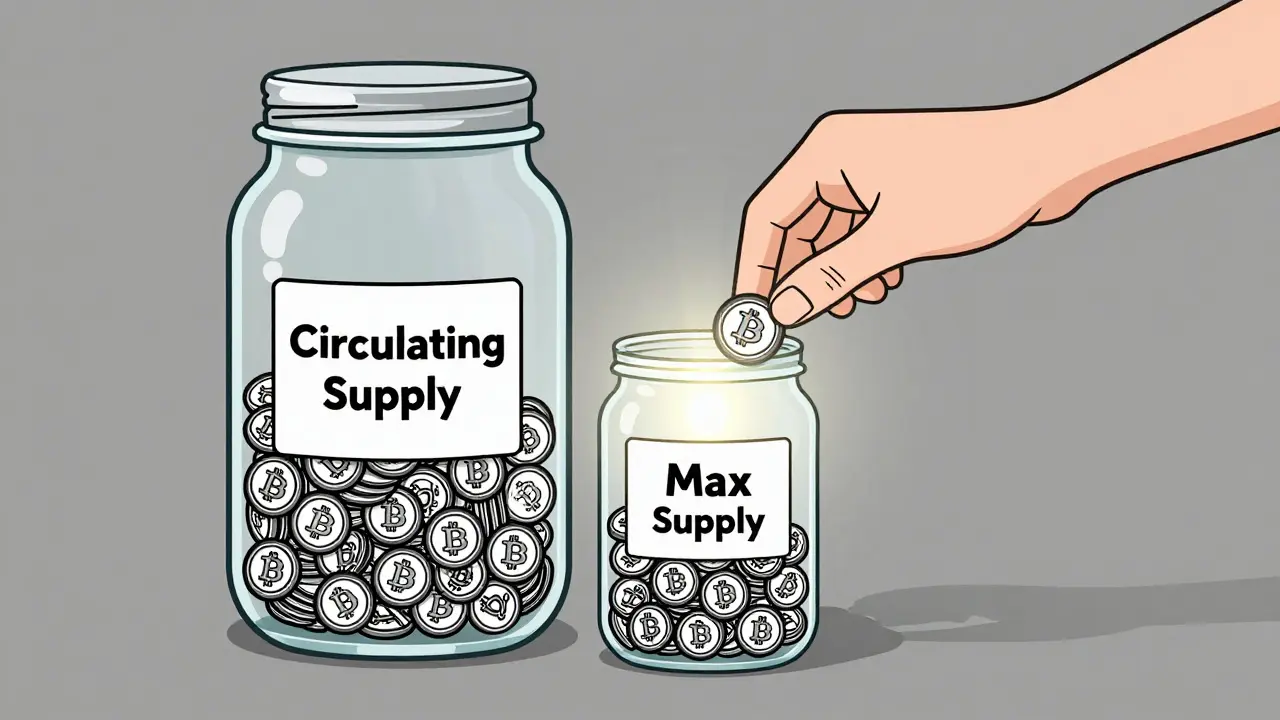
People mix up these three terms all the time. Here’s how they differ:
| Supply Type | Definition | Example: Bitcoin | Example: Ethereum |
|---|---|---|---|
| Circulating Supply | Coins actively trading in the market | 19.5 million | 120 million |
| Total Supply | All coins created so far, including locked or reserved | 19.5 million | 120 million |
| Maximum Supply | Hard limit on total coins that will ever exist | 21 million | No limit |
Bitcoin’s total and circulating supply are nearly identical because nearly all mined coins are in circulation. Ethereum has no maximum supply, so its total and circulating supply are the same too - but that could change if future upgrades lock up more ETH.
Projects with high total supply but low circulating supply? That’s a red flag. If 80% of tokens are still locked in team wallets, you’re not investing in the market - you’re betting on a future dump. That’s why smart investors always check: How much is actually out there?
Why Circulating Supply Matters More Than Price
Beginners often fall into the trap of thinking a $0.10 coin is a better buy than a $100 coin. That’s like thinking a $5 T-shirt is a better investment than a $500 designer jacket. It’s not about the sticker price - it’s about scarcity and demand.
Imagine a supermarket. Circulating supply is the apples on the shelf. Total supply is the apples in the warehouse. Maximum supply is how many apples the orchard can grow in a year. If there are only 10 apples on the shelf but 1,000 in the warehouse, the price stays low. But if only 10 apples exist in total - and everyone wants one - the price skyrockets.
That’s why Bitcoin’s price keeps rising even as it gets harder to mine. Fewer new coins enter circulation. Demand stays strong. Scarcity drives value.
On the flip side, coins with massive circulating supply - like Shiba Inu or Dogecoin - can’t surge unless demand explodes. Even if the price doubles, the total market cap might barely move because there are so many coins to buy. It’s like trying to lift a 10-ton truck with your hands.

What You Should Do as an Investor
Here’s how to use circulating supply in real time:
- Check market cap first. A coin with a $100 million market cap is a different beast than one with $10 billion. Stability usually comes with size.
- Then check circulating supply. If 90% of the total supply is still in the team’s hands? Run. That’s a recipe for a rug pull.
- Compare similar coins. If two projects both claim to be ‘Ethereum killers,’ look at their circulating supply. The one with fewer coins and higher market cap might be more trusted.
- Watch for upcoming unlocks. Use sites like TokenUnlocks.info to see when large chunks of tokens will hit the market. A sudden flood of supply can crash prices.
- Ignore price alone. A $0.001 coin isn’t ‘affordable.’ A $20,000 coin isn’t ‘out of reach.’ Market cap tells the real story.
Top investors don’t chase low prices. They chase scarcity, adoption, and locked-in value. Circulating supply is the key to seeing all three.
What’s Next for Supply Metrics?
The crypto market is getting smarter. Beyond circulating supply, tools like Realized Cap and MVRV Ratio are now used to measure not just how many coins are out there - but when they were last moved. If a coin hasn’t moved in five years, it’s likely held by a long-term investor. If it’s moving every day, it’s speculative.
But none of that matters if you don’t start with circulating supply. It’s the foundation. Every valuation model, every trading strategy, every risk assessment begins here.
As crypto matures, regulators and exchanges are pushing for clearer supply disclosures. Projects that hide their token unlock schedules or misrepresent circulating supply are getting flagged. Transparency is becoming non-negotiable.
So next time you’re eyeing a new coin, skip the hype. Open CoinMarketCap. Look at the market cap. Look at the circulating supply. Ask yourself: Is this scarcity or just noise?
What’s the difference between circulating supply and total supply?
Circulating supply is the number of coins currently available for trading. Total supply includes all coins ever created, even those locked, reserved, or not yet released. For example, Bitcoin’s circulating supply is 19.5 million, and its total supply is also 19.5 million because almost all mined coins are in circulation. But a new DeFi token might have a total supply of 1 billion, with only 300 million circulating because the rest is locked for staking or team vesting.
Why is circulating supply used instead of total supply for market cap?
Because market cap measures current value, not potential future value. If 80% of a coin’s supply is locked up and can’t be traded, it doesn’t affect the price today. Only the coins people can actually buy and sell matter for real-time valuation. Using total supply would overstate the market’s true size and mislead investors.
Can circulating supply change over time?
Yes, constantly. Circulating supply increases when new coins are mined or unlocked from vesting schedules. It decreases if coins are burned (permanently removed from circulation). For example, Ethereum burns a portion of transaction fees, which reduces circulating supply over time. Meanwhile, projects like Solana unlock team tokens every quarter, which increases it. That’s why you need to check this number regularly.
Is a high circulating supply good or bad?
It depends. A high circulating supply with strong demand (like Bitcoin or Ethereum) means widespread adoption and stability. But a high circulating supply with weak demand (like meme coins with hundreds of billions of tokens) means low price per coin and little upside. The key is the ratio between supply and demand. High supply + low demand = low price. High supply + high demand = strong market cap.
How do I find accurate circulating supply data?
Use trusted platforms like CoinMarketCap or CoinGecko. They pull data from hundreds of exchanges and update it in real time. Avoid relying on project websites alone - they might overstate circulating supply to look more valuable. Look for third-party verification and check if the data includes locked or unclaimed tokens.