What is Mode (MODE) Crypto? A Guide to the AI-Powered DeFi Layer 2
 Aug, 12 2026
Have you ever wondered why some blockchain projects promise to change everything while others quietly build in the background? Mode (MODE) is one of those quiet builders. It is an Ethereum Layer 2 network built on the Optimism stack that focuses specifically on decentralized finance and artificial intelligence. Unlike general-purpose chains that try to do everything from gaming to social media, Mode has a narrow mission: scale DeFi for billions of users using on-chain agents and AI-powered financial apps.
If you are looking at your portfolio and see MODE tokens, or if you just heard the name in a Discord chat, you probably have questions. Is it safe? How does it make money? And what exactly is this "Superchain" everyone talks about? Let’s break down what Mode actually is, how it works, and whether it deserves a spot in your crypto knowledge base.
The Core Concept: What Exactly is Mode?
At its heart, Mode is a scaling solution for Ethereum. If you know how Ethereum works, you know it can be slow and expensive during busy times. Layer 2 networks like Mode solve this by processing transactions off the main Ethereum chain and then posting the results back to it. This makes transactions faster and cheaper-often 95-98% cheaper than on Ethereum mainnet.
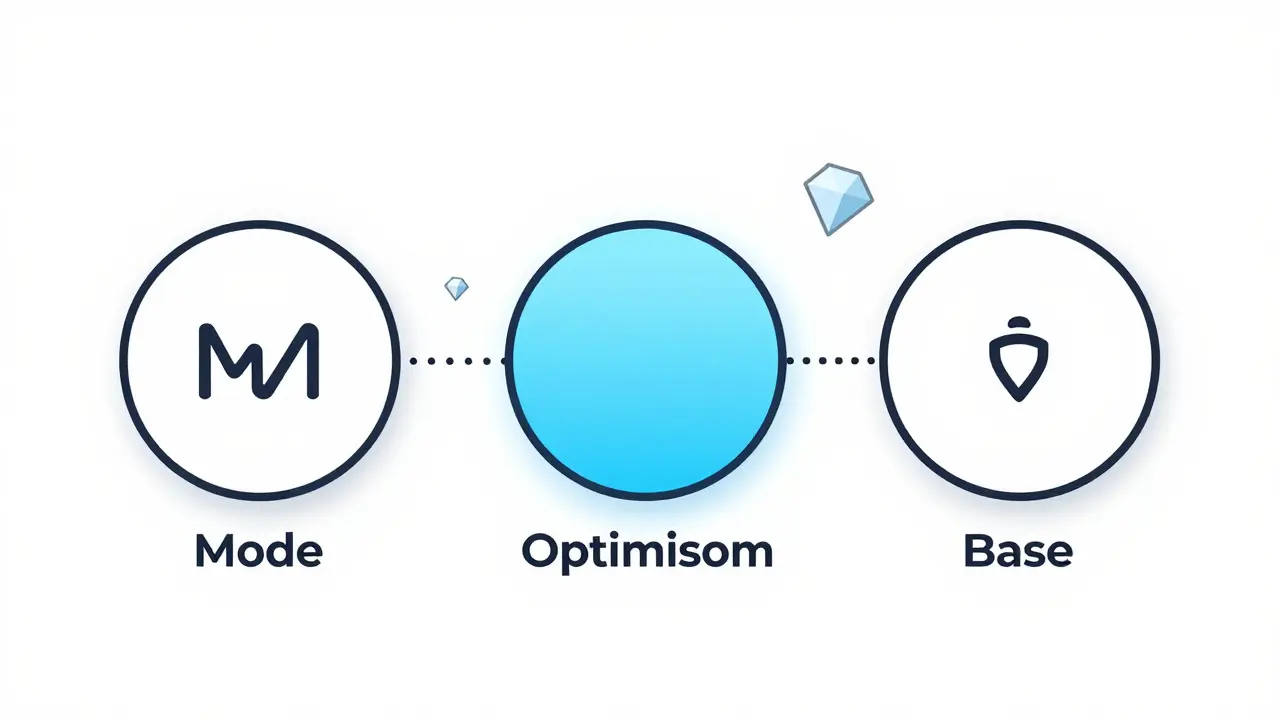
But Mode isn’t just another copy-paste Layer 2. It runs on the OP Stack, which is the same technology used by Optimism. This connection is crucial because it allows Mode to be part of the "Superchain." Think of the Superchain as a group of independent countries that share a common currency and open borders. In crypto terms, this means assets and data can move smoothly between Mode, Optimism, Base, and other OP Stack chains without needing complex bridges.
The unique twist here is the focus. While Arbitrum might host games and Polygon might host NFTs, Mode is optimized for Decentralized Finance (DeFi) applications that use AI. Imagine a trading bot that doesn’t just guess market moves but uses verifiable, on-chain data to execute strategies transparently. That is the kind of app Mode is built to support.
How the MODE Token Works
Every blockchain needs a native token to function, and for Mode, that is the MODE token. But unlike Bitcoin, which is mined, or Ethereum, which started with a massive pre-mine, MODE has a structured distribution designed to keep the ecosystem growing.
The total supply is capped at 10 billion MODE tokens. Here is how they are split:
- 35% for Ecosystem Development: Money to build new apps and attract developers.
- 25% for Community Incentives: Rewards for users who stake, vote, or use the platform.
- 20% for Team and Advisors: Locked up with a 12-month cliff and then released slowly over three years to ensure long-term commitment.
- 15% for Initial Investors: Also locked, with a 6-month cliff and two-year vesting.
- 5% for the Foundation: To run the organization and handle grants.
This structure matters because it prevents early insiders from dumping all their tokens on day one. However, you should always check the current circulating supply. As of late 2024 and into 2025, reports vary between 2.7 billion and 4.7 billion tokens in circulation depending on the exchange reporting lag. This discrepancy can cause confusion when calculating market cap, so always look at multiple sources like CoinGecko or CoinMarketCap.
The AI Angle: Why It Matters
You will hear a lot about "AI" in crypto right now, but most of it is hype. Mode tries to be different by implementing specific technical standards. They introduced the ERC-8004 standard, which is designed for verifiable AI tooling.
What does that mean for you? It means that if an AI agent trades on Mode, the logic behind its decisions can be audited on-chain. You aren’t just trusting a black box; you can verify the strategy. This is huge for institutional players and serious retail traders who want transparency. The network supports specialized frameworks that allow these agents to interact with liquidity pools and yield optimizers automatically.
Currently, there are over 50 DeFi applications hosted on Mode. These aren’t just simple swap interfaces. Many of them involve automated yield farming, cross-chain liquidity aggregation, and AI-driven risk management tools. If you are a developer, this means less time building basic infrastructure and more time focusing on the actual financial product.
User Experience: Getting Started
Using Mode is surprisingly straightforward if you have used any Ethereum-based wallet before. Here is the typical workflow:
- Connect Your Wallet: Add Mode to MetaMask or Rabby. The Chain ID is 34443. You can find the RPC details on the official Mode website.
- Bridge Assets: Move ETH or USDC from Ethereum mainnet or another L2 to Mode. Because it is part of the Superchain, this process is becoming smoother, though bridge times can still take 4-6 hours depending on congestion.
- Interact with Protocols: Use DEXs like Kim DEX to swap tokens or provide liquidity.
- Earn Rewards: Participate in governance or staking programs to earn additional OP tokens or MODE rewards.
One thing to watch out for is liquidity. While Mode is growing, it is not yet as deep as Uniswap on Ethereum. If you try to swap large amounts (say, $500+), you might experience higher slippage. Users recommend starting with smaller amounts to test the waters. The average user rating sits around 3.5/5, with praise for low fees but complaints about limited trading pairs compared to giants like Arbitrum.
Mode vs. Other Layer 2s
To understand where Mode fits, we need to compare it to the heavy hitters. It is not trying to replace Ethereum; it is trying to carve out a niche within the Layer 2 landscape.
| Feature | Mode (MODE) | Arbitrum One | Optimism (OP) |
|---|---|---|---|
| Primary Focus | AI-Powered DeFi | General Purpose / Gaming | Public Goods / Governance |
| Technology Stack | OP Stack | Arbitrum Nitro | OP Stack |
| Market Cap (Approx.) | $6M - $11M | $2.1B+ | $5B+ |
| Key Advantage | Direct User Rewards & AI Integration | Largest Ecosystem & Liquidity | Strong Governance Model |
| Number of Apps | 50+ | 200+ | 100+ |
As you can see, Mode is smaller. Its market cap is a fraction of Arbitrum’s or Optimism’s. This makes it a higher-risk, higher-reward play. If Mode succeeds in capturing even 1-2% of the AI-DeFi market, the growth potential is significant. But if the broader market ignores AI agents, Mode could struggle to gain traction against established competitors.
Risks and Challenges
No investment is without risk. When looking at Mode, consider these factors:
- Price Volatility: The MODE token hit an all-time high of $0.15 in May 2024 and has since declined significantly. Crypto markets are emotional and speculative.
- Liquidity Depth: As mentioned, large trades can suffer from slippage. This limits its usefulness for whale-sized transactions currently.
- Competition: Other chains are also adding AI features. Pendle and Morpho are strong competitors in the DeFi space. Mode needs to prove its AI integration is superior, not just a marketing buzzword.
- Regulatory Uncertainty: Like all utility tokens, MODE faces potential regulatory scrutiny. The SEC’s stance on crypto continues to evolve, which can impact investor confidence.
Future Outlook: What’s Next?
Mode is actively working on its roadmap. Season 6 of their incentive program is pushing hard into AI Trading Agents. They plan to integrate with more restaking protocols like Renzo and ether.fi in mid-2025. There are also plans to implement the Cannon fault proof system later in 2025, which would enhance security and reduce bridge times further.
Analysts suggest that if Mode can maintain its position as a leader in verifiable AI finance, it could see substantial growth. The key metric to watch is not just price, but active wallets and total value locked (TVL). As of late 2024, daily transactions averaged around 18,500, showing steady usage. If this number climbs alongside the adoption of AI agents in traditional finance, Mode is well-positioned to benefit.
Is Mode (MODE) a good investment?
Whether MODE is a good investment depends on your risk tolerance. It is a high-risk, high-reward asset due to its small market cap and niche focus on AI DeFi. If you believe AI agents will transform decentralized finance, Mode offers early exposure. However, be aware of the volatility and lower liquidity compared to larger Layer 2s like Arbitrum or Optimism. Always do your own research and never invest more than you can afford to lose.
How do I buy MODE tokens?
You can buy MODE tokens on various cryptocurrency exchanges such as MEXC, KuCoin, or Gate.io. First, create an account and complete KYC verification if required. Then, deposit fiat currency or another crypto like USDT or ETH. Search for the MODE trading pair and place a buy order. Alternatively, if you already hold assets on the Optimism Superchain, you can sometimes swap directly via decentralized exchanges on the Mode network after bridging your funds.
What is the difference between Mode and Optimism?
Optimism is the parent protocol and one of the largest Layer 2 networks, focusing on public goods and broad application support. Mode is a specific chain built using Optimism's technology (the OP Stack). Think of Optimism as the operating system and Mode as a specialized app store focused solely on AI and DeFi. They are connected through the Superchain, allowing seamless interaction, but they have different governance structures and economic models.
Is Mode secure?
Mode inherits security from the Ethereum mainnet through its Layer 2 architecture. Transactions on Mode are eventually settled on Ethereum, providing a high level of security. Additionally, Mode is moving towards implementing fault proofs (Cannon system) to further enhance trustlessness. However, users should always use reputable wallets and beware of phishing sites, as smart contract risks exist on any blockchain.
What is the maximum supply of MODE?
The maximum supply of MODE tokens is fixed at 10 billion. This supply is distributed among ecosystem development, community incentives, team, investors, and the foundation. The vesting schedules for team and investors help prevent sudden dumps, ensuring a gradual release of tokens into the market over several years.