What is OpenZK Network (OZK)? A Deep Dive into the L2 Staking Ecosystem
 Apr, 4 2026
The Tech Behind the Curtain
To understand how OpenZK works, you have to understand zk-SNARKs. These are complex cryptographic proofs that allow the network to verify a transaction is valid without needing to see all the data behind it. Think of it like showing a bouncer your ID to prove you are over 21 without them needing to know your exact birth date, home address, or social security number. By bundling hundreds of transactions into a single proof and sending that proof to Ethereum, OpenZK drastically reduces the amount of data the main chain has to process. This is the core of the ZK Rollup mechanism. While other Layer 2s might rely on optimistic assumptions (meaning they assume transactions are honest unless proven otherwise), ZK Rollups provide mathematical certainty that the state is correct from the moment the transaction is processed.The Magic of Liquid Restaking
Most people know that staking ETH earns rewards, but your money is usually locked up. OpenZK introduces a more fluid approach. When you bridge your ETH to the network, it doesn't just sit there. The protocol automatically handles the staking and restaking process for you. In exchange for your deposit, you receive ozETH, a liquid restaking token. This token represents your staked ETH plus the rewards you're earning. Because ozETH is liquid, you can use it in other DeFi protocols, trade it, or move it around while your original ETH continues to earn yield in the background. It removes the "opportunity cost" of staking.
Beyond Ethereum: Stablecoin Yields
Not everyone wants to deal with the volatility of ETH. OpenZK targets this crowd with its stablecoin reward system. Users can bridge supported stablecoins into the network to generate ozUSD. This works similarly to the ETH side: your stablecoins are put to work to generate a return, and ozUSD serves as the reference token for your position and the accumulated rewards. For someone who prefers a low-risk strategy, this turns a static wallet of stablecoins into a productive asset without leaving the efficiency of a Layer 2 environment.| Feature | Traditional L2 (e.g., Optimism) | OpenZK Network |
|---|---|---|
| Primary Goal | Transaction Throughput | Throughput + Native Yield |
| Staking Logic | External/Third-party | Integrated Protocol Layer |
| Liquidity | Standard Asset Transfer | Liquid Derivatives (ozETH/ozUSD) |
| Verification | Fraud Proofs (usually) | Validity Proofs (zk-SNARKs) |
Understanding the OZK Token
At the heart of this ecosystem is the OZK token. It isn't just a coin to trade; it's the fuel and the steering wheel for the network. The token is designed with a non-inflationary economic model, which means it avoids the common pitfall where a coin's value drops because too many new tokens are printed every month. OZK serves three main purposes:- Governance: Token holders can vote on protocol upgrades, fee structures, and which new stablecoins to support.
- Staking Rewards: Holding and staking OZK helps secure the network and earns the holder rewards derived from network activity.
- Network Fees: As the ecosystem grows, OZK is positioned to handle the operational costs of the network.
What Can You Actually Do on OpenZK?
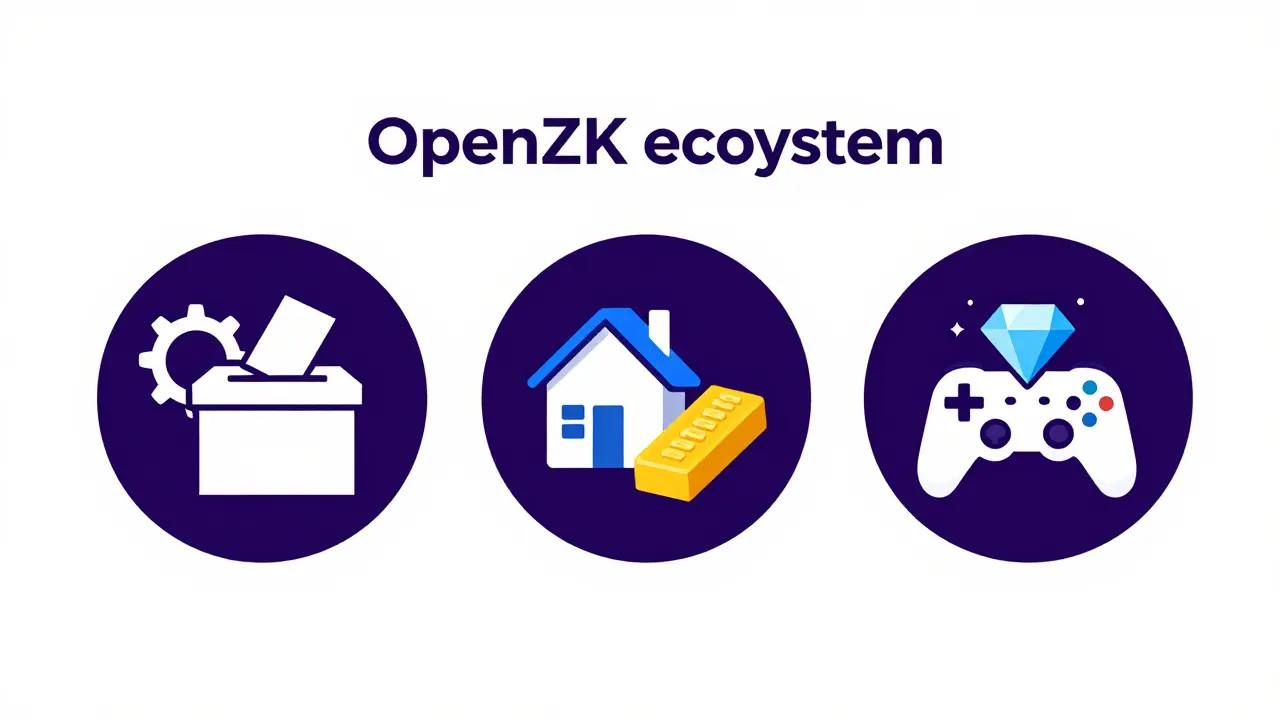
OpenZK isn't just for staking; it's a playground for developers. Because it's a high-performance environment with low fees, it's ideal for:- DeFi: Building decentralized exchanges that don't cost $50 in gas to swap a token.
- Real World Assets (RWA): Bringing property or commodity deeds on-chain with fast verification.
- Gaming & NFTs: Minting items or recording in-game achievements instantly without lagging the network.
Risks You Should Know About
No crypto project is without danger. With OpenZK, the biggest risk is execution. The roadmap is ambitious, and the team needs to deliver on its promises to attract developers. Then there's the tech risk. Zero-knowledge proofs are mathematically sound, but the implementation of that code can have bugs. Finally, there is regulatory risk. Because ozETH and ozUSD behave like derivatives, some governments might view them differently than standard cryptocurrencies, which could impact how they are traded in certain regions.What is the difference between OZK and ozETH?
OZK is the native governance and utility token of the network. You use it for voting and earning staking rewards. ozETH, on the other hand, is a liquid representation of your staked Ethereum. One is a token for the network's growth (OZK), and the other is a receipt for your deposited assets (ozETH).
Is OpenZK Network safe to use?
It uses zk-SNARKs, which are some of the most secure cryptographic tools available. However, like all Layer 2 solutions, it carries smart contract risk. Because it is an emerging project with a smaller market cap, it is generally considered a higher-risk investment than established chains.
How do I earn rewards on OpenZK?
You can earn rewards by bridging ETH into the network to receive ozETH, which automatically earns staking and restaking rewards. Alternatively, you can bridge supported stablecoins to generate ozUSD or stake the native OZK tokens for governance rewards.
Who are the main competitors of OpenZK?
Its main competitors include other ZK-rollup projects like zkSync and Starknet, as well as Optimistic rollups like Arbitrum and Optimism. OpenZK tries to stand out by integrating liquid staking directly into the protocol instead of relying on outside apps.
What happens if I hold OZK and the price drops?
Like any cryptocurrency, if the market price falls, the value of your holdings decreases. Because OZK is a low-cap token, it can experience more extreme price swings than Bitcoin or Ethereum. Diversification and only investing what you can afford to lose is key.