What is Tomb Shares (TSHARE) Crypto? Mechanics, Risks & Status
 Oct, 8 2026
Imagine holding a token that promises governance rights and rewards based on the success of another asset. That was the pitch for Tomb Shares (TSHARE). Launched in mid-2021 on the Fantom Opera network, this coin wasn't just another meme or utility token. It was the engine room of Tomb Finance, a protocol trying to solve one of crypto's hardest problems: creating a stablecoin pegged to FTM without backing it with dollars.
If you are digging into old DeFi projects or wondering why some tokens have massive price swings despite low trading volume, TSHARE is a perfect case study. It shows what happens when complex economic incentives meet market reality. This article breaks down exactly what TSHARE is, how its unique three-token system worked, and where things stand today as of October 2026.
The Core Concept: More Than Just a Governance Token
Tomb Shares (TSHARE) is the capped governance and reward token within the Tomb Finance ecosystem. Unlike typical governance tokens that only let you vote on proposals, TSHARE had a dual role. First, it gave holders voting power over the protocol’s treasury and upgrades. Second, and more importantly for early adopters, it acted as a claim on future profits. When the main token, TOMB, successfully maintained its peg to FTM and expanded its supply, TSHARE stakers received a portion of those newly minted tokens.
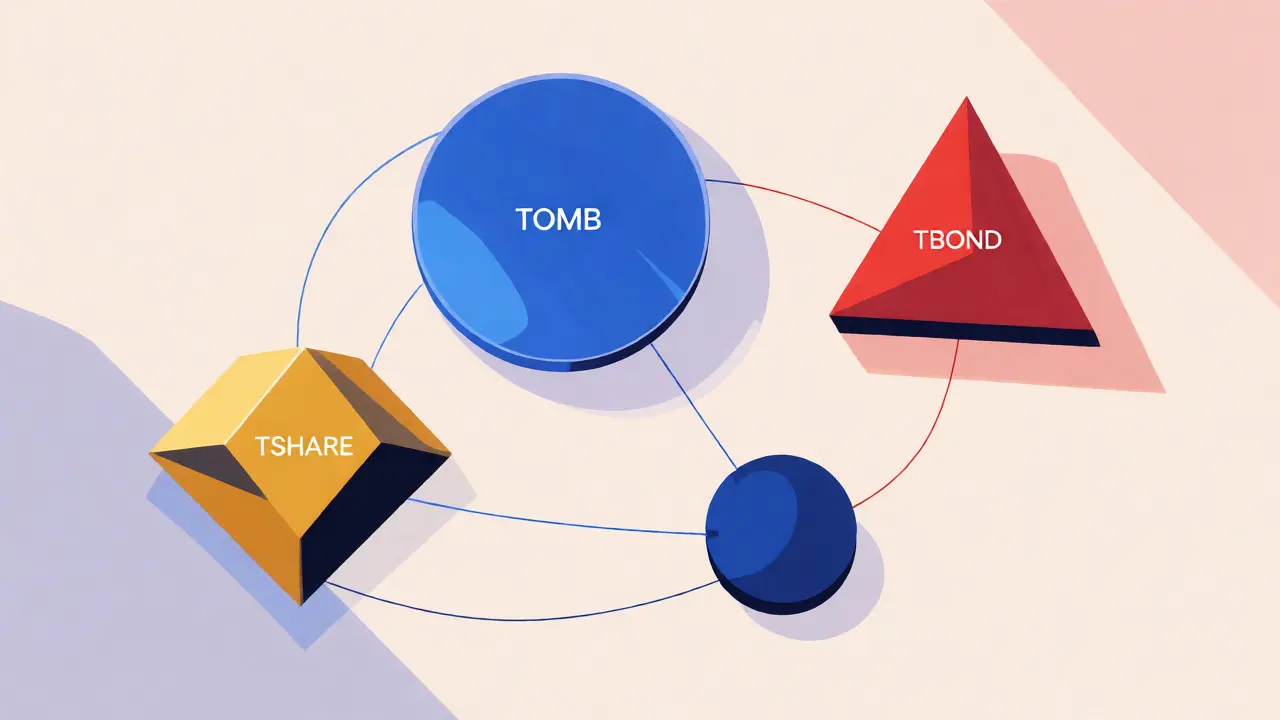
To understand TSHARE, you cannot look at it in isolation. It existed alongside two other critical components:
- TOMB: The primary token intended to track the price of FTM 1:1.
- TBOND: A debt instrument used during periods when TOMB fell below its target price.
- TSHARE: The equity-like component that captured value from successful expansions.
This structure was inspired by earlier experiments like Basis Cash and bDollar. The idea was elegant: if people trusted the system, they would buy TOMB, pushing its price up. To keep the price stable, the protocol would mint more TOMB and give it to TSHARE holders as a yield. If trust broke, the price dropped, and users could buy TBONDS to help stabilize the system later.
How the Seigniorage Mechanism Worked
The heart of Tomb Finance was its seigniorage mechanism. Think of it as an automated central bank that adjusts supply based on demand. The protocol checked the Time-Weighted Average Price (TWAP) of TOMB relative to FTM every six hours, known as an epoch.
Here is the simplified logic flow:
- Expansion Phase: If TOMB traded above 1.01 FTM, the protocol minted new TOMB. 80% of this went to TSHARE stakers, 18% to the DAO treasury, and 2% to developers.
- Neutral Zone: Between 1.00 and 1.01 FTM, no action was taken.
- Contraction Phase: If TOMB dropped below 1.00 FTM, the protocol issued TBONDS. Users bought these bonds with TOMB, effectively removing excess supply from circulation.
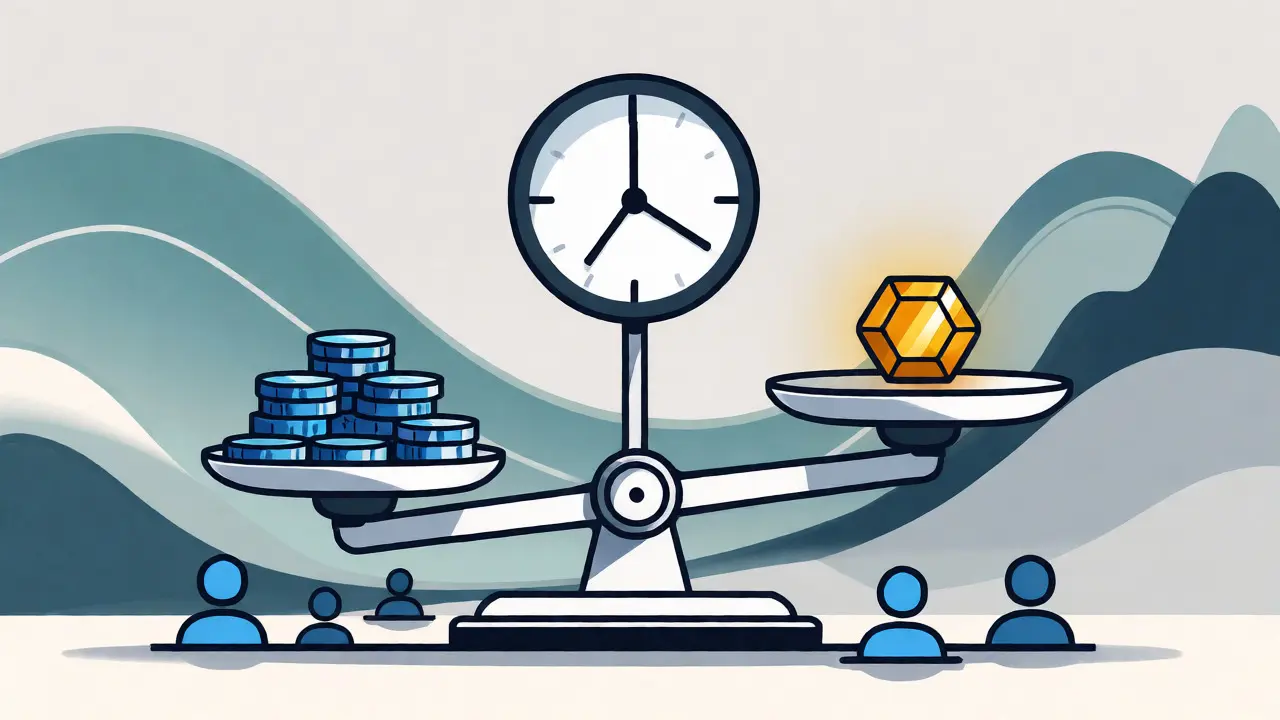
TSHARE holders played a crucial role here. By staking their shares in the "Masonry" (also called the Boardroom), they locked up their tokens for specific periods. In return, they earned TOMB rewards during expansion phases. However, there were strict rules. Claiming rewards locked your TSHARE for another six epochs, meaning you couldn't exit quickly if the market turned sour.
Tokenomics: Supply and Distribution
One of the most attractive features for investors was the hard cap. The maximum supply of TSHARE was set at 70,000. This scarcity was designed to make each share valuable as the protocol grew. Let's look at how those 70,000 tokens were allocated:
| Recipient | Amount (TSHARE) | Vesting Period | Purpose |
|---|---|---|---|
| Liquidity Providers | 59,500 | 12 Months | Incentivizing LPs in TOMB-FTM and TSHARE-FTM pools |
| DAO Treasury | 5,500 | 12 Months Linear | Governance fund and operational reserves |
| Team | 5,000 | 12 Months Linear | Developer compensation |
Emissions concluded around June 2022, meaning all planned TSHARE tokens had been distributed. This fixed supply contrasts sharply with inflationary tokens, but it also means no new incentives can be created through emissions alone. Any future value must come from actual protocol usage or secondary market demand.
Market Reality: Liquidity and Volatility
As of October 2026, TSHARE exists in a state of extreme illiquidity. Market data providers show conflicting prices because there are so few trades happening. For instance, recent snapshots showed prices ranging from $0.82 to $1.26, with daily volumes often under $100. This isn't a typo; we are talking about single-digit dollar transactions moving the entire market capitalization.
Why does this matter? Because high volatility combined with low liquidity creates dangerous trading conditions. You might see a quote for $0.86, but if you try to sell even a small amount, you could crash the price due to lack of buyers. SpookySwap, once a major venue for trading TSHARE, has seen inactive pairs, further fragmenting the market.
Furthermore, circulating supply figures vary across trackers. Some report ~65,000 tokens available, while others calculate market caps based on lower numbers. Always verify data directly on-chain using tools like FTMScan before making decisions.
Risks and Historical Performance
The biggest risk associated with TSHARE was its dependency on TOMB's peg. Algorithmic stablecoins rely entirely on user confidence. When the broader crypto market crashed in May 2022, specifically after the Terra/LUNA collapse, trust in algorithmic models evaporated. TOMB failed to maintain its 1:1 peg with FTM. By September 2022, TOMB was trading at roughly 0.17 FTM.
This failure had cascading effects on TSHARE:
- Loss of Yield: With TOMB depegged, the expansion mechanism stopped working as intended. No expansion meant no TOMB rewards for TSHARE stakers.
- Governance Paralysis: Without a healthy economy, governance votes lost relevance.
- Exit Illiquidity: Holders found it difficult to sell large positions without significant slippage.
Audits provide some reassurance regarding code security. Hacken audited parts of the TOMB Finance contracts in 2022. However, an audit doesn't guarantee economic sustainability. It checks for bugs, not whether the math behind the peg will hold up under panic selling.
Current Status and Future Outlook
Today, Tomb Finance has largely pivoted toward a brand called Lif3. While official documentation remains online, the original vision of a robust FTM-stablecoin ecosystem has faded. TSHARE remains a legacy asset. It still holds technical functionality on the Fantom chain, but active development and community engagement have shifted away from the original three-token model.
For current holders, TSHARE represents a speculative bet on a potential revival or integration into new protocols. For new investors, it serves primarily as a historical artifact of DeFi's experimental phase. Buying TSHARE now requires understanding that you aren't buying into a growing yield farm; you're buying into a thin market with uncertain fundamentals.
Is Tomb Shares (TSHARE) a stablecoin?
No, TSHARE is not a stablecoin. It is a governance and reward token. The stablecoin component of the Tomb Finance ecosystem was TOMB, which aimed to track the price of FTM. TSHARE's value fluctuated based on market sentiment and protocol performance, not a fixed peg.
How do I buy TSHARE today?
You can attempt to buy TSHARE on decentralized exchanges (DEXs) on the Fantom network, such as SpookySwap or Tomb Swap. However, be aware that liquidity is extremely low. Many markets are reported as inactive, and spreads can be wide. Always check the contract address (0x4cdf39285d7ca8eb3f090fda0c069ba5f4145b37) to ensure you are interacting with the correct token.
What happened to the TOMB peg?
The TOMB peg to FTM failed significantly during the May 2022 crypto market downturn. Following the collapse of Terra/LUNA, confidence in algorithmic stablecoins plummeted. TOMB depegged heavily, trading well below 1.00 FTM, which disrupted the expansion mechanisms that rewarded TSHARE holders.
Can I still stake TSHARE for rewards?
Technically, yes, you can interact with the Masonry contract. However, since TOMB is not consistently expanding or maintaining its peg, the rewards generated are minimal or non-existent compared to the project's peak. Staking also involves lock-up periods, which may not be worth the opportunity cost given current yields.
Was Tomb Finance audited?
Yes, portions of the codebase were audited by firms like Hacken. However, audits cover specific versions of smart contracts and do not guarantee the economic model's success. Additionally, not every deployed contract or subsequent update may have undergone a fresh audit, so always verify the scope of any audit claims.